



When you ask ChatGPT regarding the best project management software or the closest vegan food place, it does not come up with just any random response. There are several factors involved that shape its response. This includes training data, live internet search results, and trust signals that help it judge websites. Therefore, there is no single trick that guarantees visibility in ChatGPT. If you want AI tools to show your content in their answers, you need to understand how these factors work together.
This guide covers exactly that — starting with the basics, then moving into the technical factors shaping how AI systems find, understand, and recommend your content in 2026.
What Does It Mean When ChatGPT “Recommends” any Website?
A website can appear in ChatGPT in several ways. However, appearing in ChatGPT is not simply a matter of adding more keywords to a page. When ChatGPT recommends a website, it will either reference the website through the direct link to it or refer to the information provided by the website without any citation at all. The first case matters more to businesses and creators because a visible link can bring actual visitors to their website.
Most importantly, the ChatGPT will not suggest a page just because that page contains a commonly used keyword. The ChatGPT suggests a source when its information gives a clear and reliable answer to the question. Therefore, valuable content on the page matters much more than simply filling the page with keywords.
Does ChatGPT Actually Search the Web?
Yes, at times. Whenever the question you ask on ChatGPT requires up-to-date information like a price, current events, or store operating hours, it can browse the internet and find out. It breaks your question into one or more focused searches, reviews the results, and may search again before giving you an answer. In other words, it works more like someone doing quick research than a book with every answer already written.
But if you ask about something that changes very rarely, like “What is a 301 redirect?”, ChatGPT is likely to know the answer already; hence, there is no need to go online. Freshness matters in some queries more than in others, particularly:
- Product and retail recommendations
- Software and technology comparisons
- Local services and business listings
- News, regulations, and current events
- Medical, legal, or financial guidance
- Pricing, hours, and location details
These subjects can change from time to time; therefore, ChatGPT frequently checks the updated information on the web instead of solely depending on its older training data. This helps it find sources that match the current situation.
What Makes a Website Trustworthy to ChatGPT?
After ChatGPT finds several possible webpages and other material, it compares various signals to decide which are the ones offering more useful information that it can rely upon.
- Strong Google rankings, expert mentions, and genuine reviews can help a website stand out among other sites.
- Fresh content is very important because outdated prices, contacts, or services lessen the usefulness.
- Consistent business details across different websites build stronger trust.
- Lastly, real experiences, case studies, and actual examples hold more importance than content that just copies from other sources.
Which Crawlers Does OpenAI Use?
OpenAI documents different crawlers that serve different purposes. You need to understand carefully the difference because blocking one does not necessarily have the same effect as blocking another.
GPTBot: GPTBot is OpenAI’s web crawler associated with content that may be used to improve its generative AI models.
OAI-SearchBot: OAI-SearchBot supports ChatGPT’s search features.
ChatGPT-User: ChatGPT-User supports certain user-initiated actions and requests.
OAI-AdsBot: It validates the safety and policy compliance of landing pages submitted for ads on ChatGPT.
A Basic robots.txt Setup for ChatGPT Search Visibility
A website that wants to allow OAI-SearchBot while blocking GPTBot can configure robots.txt like this:
User-agent: OAI-SearchBot
Allow: /
User-agent: GPTBot
Disallow: /
This configuration allows OAI-SearchBot to crawl public pages while instructing GPTBot not to crawl them for its separate purpose.
However, robots.txt does not control every layer of website access.
A CDN, firewall, WAF, bot-protection system, login requirement, or server rule can still prevent a crawler from accessing a page.
Therefore, check both robots.txt and your server or security configuration when troubleshooting crawler access.
How Can We Check Whether ChatGPT Can Crawl My Website?
Start by opening:
yourdomain.com/robots.txt
Look for rules that mention:
- OAI-SearchBot
- GPTBot
- ChatGPT-User
If you want your website to remain accessible to ChatGPT Search, make sure your robots.txt rules do not block OAI-SearchBot from the pages you want discovered.
Next, check your CDN, firewall, WAF, and bot-protection settings.
Server logs can provide additional evidence because they can show whether a crawler requested your pages and whether your server allowed or rejected those requests.
This gives you a more reliable picture than checking robots.txt alone.
Can ChatGPT Find a Website That Does Not Rank on Google?
A high Google ranking is not a published requirement for appearing in ChatGPT Search. OpenAI has not stated that a webpage must rank on Google’s first page before ChatGPT can discover or cite it.
Search visibility across the web can still help people and systems discover a brand, but you should not treat Google rankings as a documented ChatGPT ranking factor. Instead, focus on making your content publicly accessible, relevant to the query, accurate, current, and supported by reliable information.
What E-E-A-T Tells AI About Your Website
E-E-A-T is a short form for — Experience, Expertise, Authoritativeness, and Trustworthiness. It is a method that was first developed to rate the content quality. However, E-E-A-T is equally valid in evaluating AI-generated answers because both approaches seek to reward useful content.
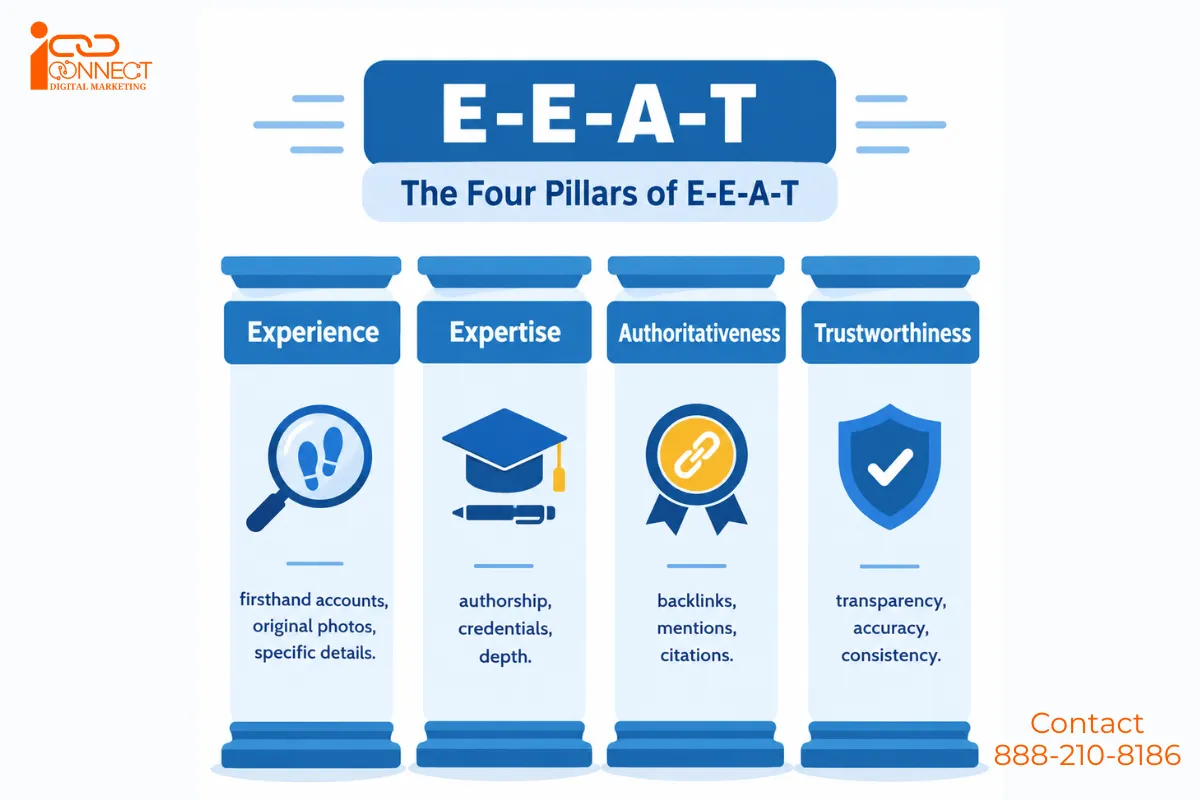
E-E-A-T covers experience, expertise, authoritativeness and trustworthiness—four concepts Google uses when discussing content quality and trust.
Since an AI system has to provide confident answers without human verification, the signals that were used to avoid reproducing uncertain claims play a major role here. This is why increasing E-E-A-T can be considered the best long-term solution to increasing visibility in the field of AI.
You may also be interested in: 👉What Is Google E-E-A-T?
What are the Crawlers used by ChatGPT for Website Discovery?
To find out the crawlers used by ChatGPT to discover websites, you must first understand the different bots of OpenAI, in total three, which work independently of each other. Site owners tend to get confused about these three bots and, therefore, commit errors.
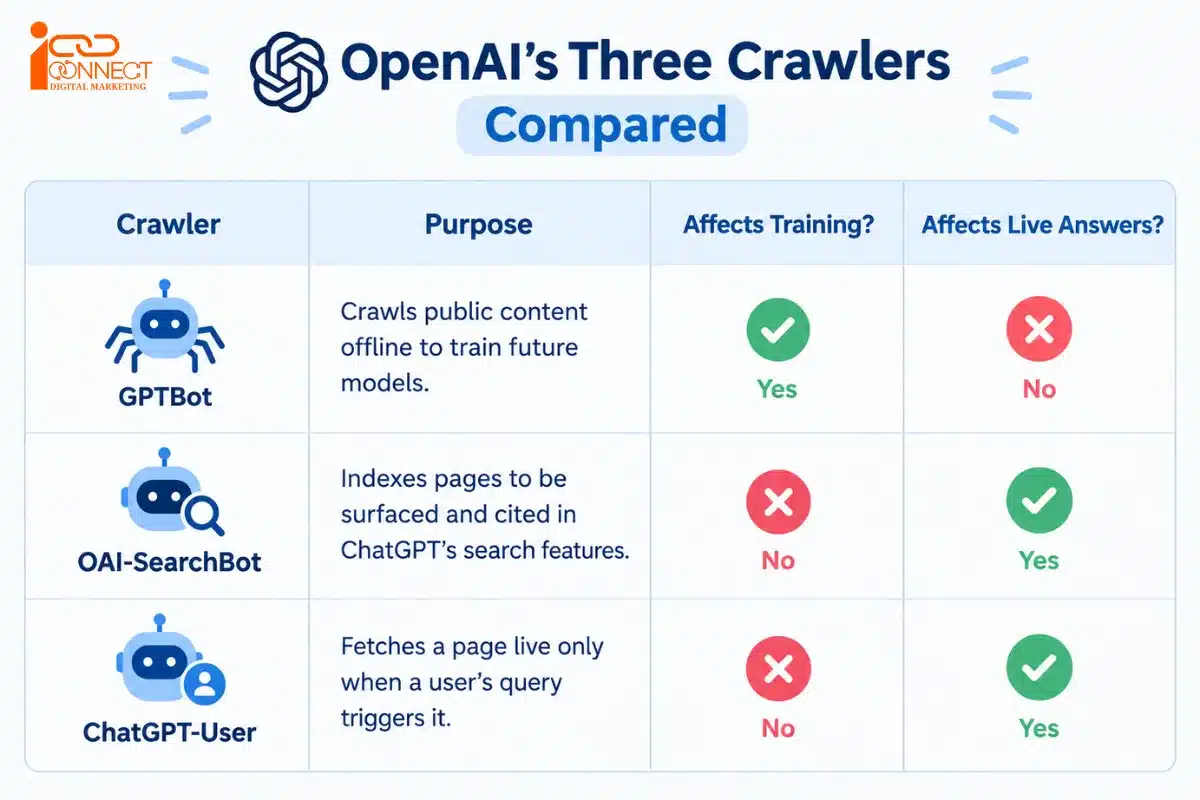
Using robots.txt, the site owners can manage each bot individually. For instance, the site owner can block GPTBot to prevent the training of the model but allow OAI-SearchBot and ChatGPT-User bots to index the website in search-based results. If a site owner blocks OAI-SearchBot, ChatGPT usually fails to show the site in search-based results, although it may still show the site as a normal navigational link in some cases.
A Basic robots.txt Setup for AI Visibility
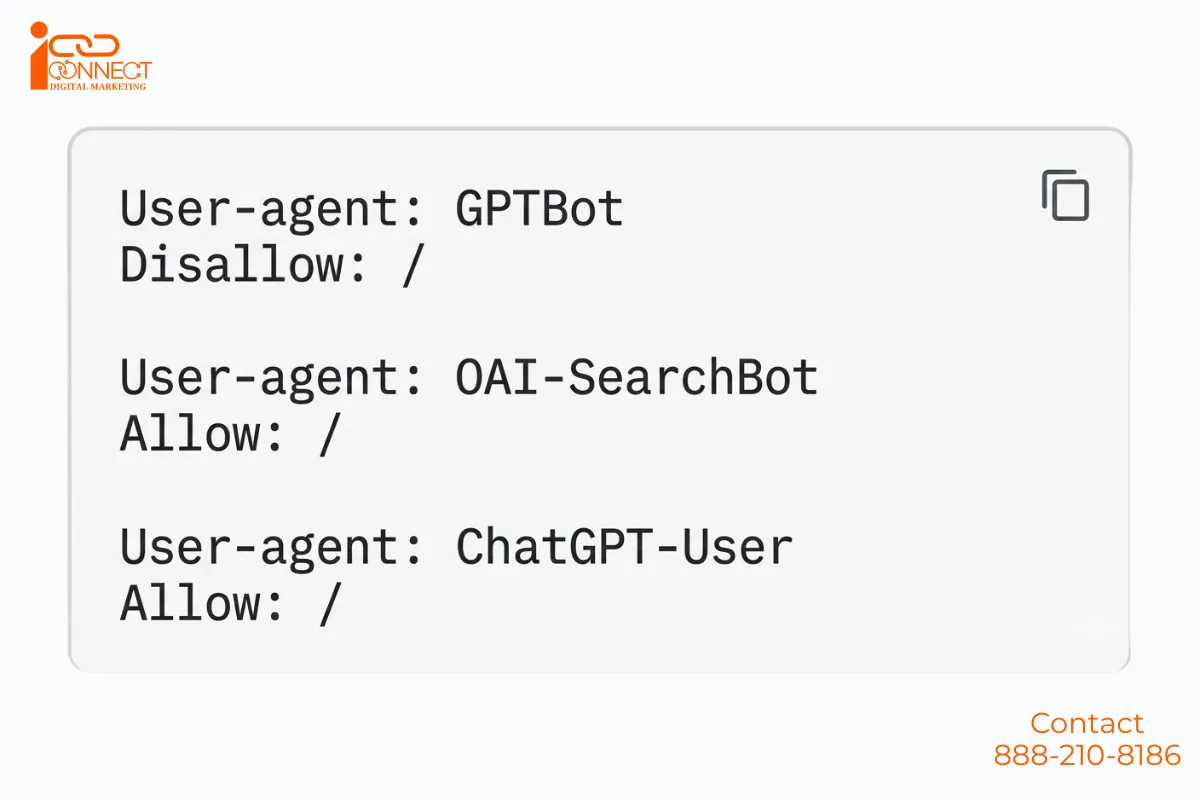
Sites that want citation eligibility without training use often configure things this way:
Although robots.txt is a guideline, it is not mandatory for crawlers to follow it. A good crawler will typically adhere to it. However, it has the option of ignoring the guidelines in case it does not check the file and read them. Furthermore, a CDN firewall that blocks all bots will render any “allow” rule in robots.txt redundant. Thus, always cross-check with your server log files and CDN firewall as well, instead of checking only the robots.txt file.
How Can I Check Whether My Site Allows These Crawlers?
Checking this is straightforward. Open your site’s robots.txt file (usually found at yourdomain.com/robots.txt) and look for entries naming GPTBot, OAI-SearchBot, and ChatGPT-User. If none of these are explicitly disallowed, the crawlers can generally access your content by default. However, if your goal is specifically to appear in AI search answers, it is worth double-checking that OAI-SearchBot is not accidentally blocked, since doing so removes a meaningful opportunity for visibility.
You may also be interested in: 👉How AI Search Is Changing Keyword Research
What Technical Factors Help a Page Get Chosen?
Beyond crawler access, several technical and structural elements influence whether a page becomes a usable source.
Clear, extractable answers. Pages that give the main point directly often work better than pages that hide it under long introductions. AI systems may take useful passages from an article instead of reading the whole page from start to finish. So, each section should make sense on its own.
Structured data and schema markup. Schema does not directly improve rankings, but it helps AI systems understand entities, authors, and content types more clearly. As a result, AI systems can understand the page without guessing its meaning from unstructured text. Article, FAQPage, and HowTo schema types can also help AI systems understand your content better.
Logical site structure. A clean internal linking structure, canonical URLs, and accessible important pages all make it easier for crawlers to find and prioritize the right content.
llms.txt files. Some sites now publish a llms.txt file, essentially a structured summary of their most important pages and categories, specifically to help AI systems locate their best content more efficiently. While not yet universally adopted, this practice is gaining traction as a lightweight way to guide AI discovery.
What’s the Difference Between Ranking on Google and Being Cited by ChatGPT?
Traditional SEO normally emphasizes click-through rate. It tries to convince the user to select one link from the ten links shown in the search results. However, GEO (or Generative Engine Optimization), which has grown with the emergence of ChatGPT, focuses more on citation. It aims to convince the user to use your content as evidence in their answer, even without clicking through to your website.
This shift matters for the following reason:
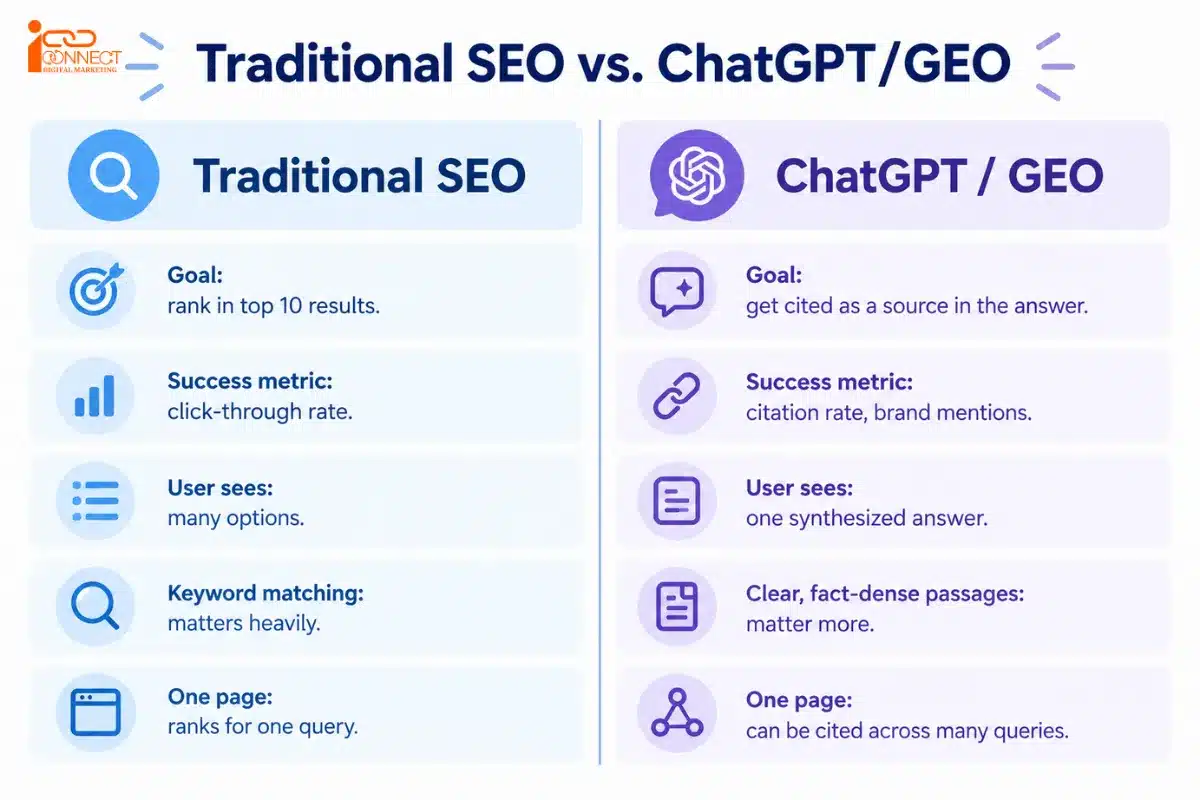
Most of the underlying work — clear writing, real expertise, and credible mentions elsewhere — supports both systems at once. Treating GEO as a completely separate discipline from SEO is usually a mistake that most SEO experts make; these two overlap far more than they diverge.
Can Businesses Guarantee a Recommendation From ChatGPT?
No, and it is worth being direct about that. There is no published formula, and OpenAI does not offer any paid or guaranteed placement within ChatGPT’s organic answers. Rather, visibility is dependent on a combination of accessibility of technology infrastructure, clarity of information, and trustworthy evidence distributed throughout the wider web. In addition, since these characteristics also contribute to regular SEO, most experts suggest that the best approach for AI visibility is to integrate it into the overall search optimization strategy.
What Should You Do First to Improve AI Visibility?
Based on these insights, you can start your strategy with a few simple steps given below:
- Verify that robots.txt allows OAI-SearchBot and ChatGPT-User.
- Keep pricing, service, and location pages fresh and add review dates.
- Feature author details, expert bios, and real customer reviews.
- Deploy useful schema and arrange pages so readers find answers quickly.
- Collect real customer reviews and mentions from sites people already trust, and put them front and center.
- On your important pages, lead with the answer. Save the proof and details for right after.
- Earn true external mentions and citations instead of depending only on what you say about yourself.
Combined together, these steps fix your technical setup while building the deep trust required for ChatGPT to recommend your site.
Frequently Asked Questions
How Does ChatGPT Recommend Businesses?
ChatGPT can make business recommendations based on data from its current knowledge base and, if necessary, up-to-date data from online searches. It might take into account sources that provide a clear explanation of a company’s operations, location, and whether the data answers the user’s query. An exact formula for business recommendations is not published by OpenAI. A company can be made easier to comprehend and assess with accurate business details, helpful website content, independent reviews, credible mentions, and consistent information across trustworthy sources.
Is ChatGPT Always Accurate?
No. ChatGPT does not give correct responses every time. There are possibilities that ChatGPT may give wrong or outdated information or misunderstood information. Even if you go on the web to get updated information, still there are chances that you will get inaccurate responses. If you are a student or a professional, you need to cross-check your important information from the primary sources because of ChatGPT.
How Do I Get ChatGPT to Suggest My Business?
There is no guaranteed method for getting ChatGPT to suggest your business website. The first thing to do is to make sure that all the important information about your business is correct, up-to-date, public and understandable. You need to give clear information on what services you offer, where, when you’re open like business operating hours and all the other necessary information. You should publish helpful content answering customer’s questions. Reviews from customers as well as independent mentions can be helpful. You should also make sure not to accidentally block the OAI-SearchBot.
Can ChatGPT Crawl Websites?
Indeed, OpenAI employs web crawlers that have access to publicly accessible websites for a variety of uses. While GPTBot is linked to content that could be utilized to enhance OpenAI’s generative AI models, OAI-SearchBot supports ChatGPT Search. Through their robots.txt file, website owners can control who has access to these crawlers. But there are other access layers besides robots.txt. The ability of an OpenAI crawler to access a webpage can also be influenced by firewalls, CDNs, Web application firewalls, login limitations, and bot-protection settings.
How Long Does It Take ChatGPT to Discover a Website?
OpenAI has not made publicly available the amount of time needed for ChatGPT to find out about, refresh or reference a webpage. Enabling OAI-SearchBot does not mean that a new page or an updated page will automatically show up in ChatGPTSearch. Discovery may also depend on various factors such as technical accessibility and whether the page is relevant to the search. It would be recommended for website owners to make sure that they keep important pages crawlable, maintain the accuracy, and regularly update the content rather than to rely on the fact of visible presence within a particular period.
Final Thoughts
In the end, ChatGPT does not pick websites using keywords alone. ChatGPT uses its training knowledge, web search, and trust signals to find and recommend websites. OpenAI has not revealed the exact ranking method, but useful and fresh content still stands out. So, create content that shows real knowledge and names the actual author. You need to keep your website clear, useful, and easy for AI systems to access. This approach can help AI systems trust and recommend your site.

Mohit Vij is the Founder & Digital Marketing Trainer at iConnect Digital Marketing Training Hub & Agency (iConnectDM), based in Ghaziabad. With over 9+ years of experience in SEO, Google Ads, Meta Ads, Social Media Marketing, Google Business Profile Management, Search Intent, Content Marketing, and Lead Generation.
Over the past years, He has trained hundreds of Students, Graduates, Job seekers, Working Professionals in building successful careers in digital marketing and also helping businesses improve their search rankings, website traffic, brand visibility, and lead generation through various platforms. His insights are based on hands-on industry experience, continuous learning, and proven digital marketing strategies that deliver measurable results.