

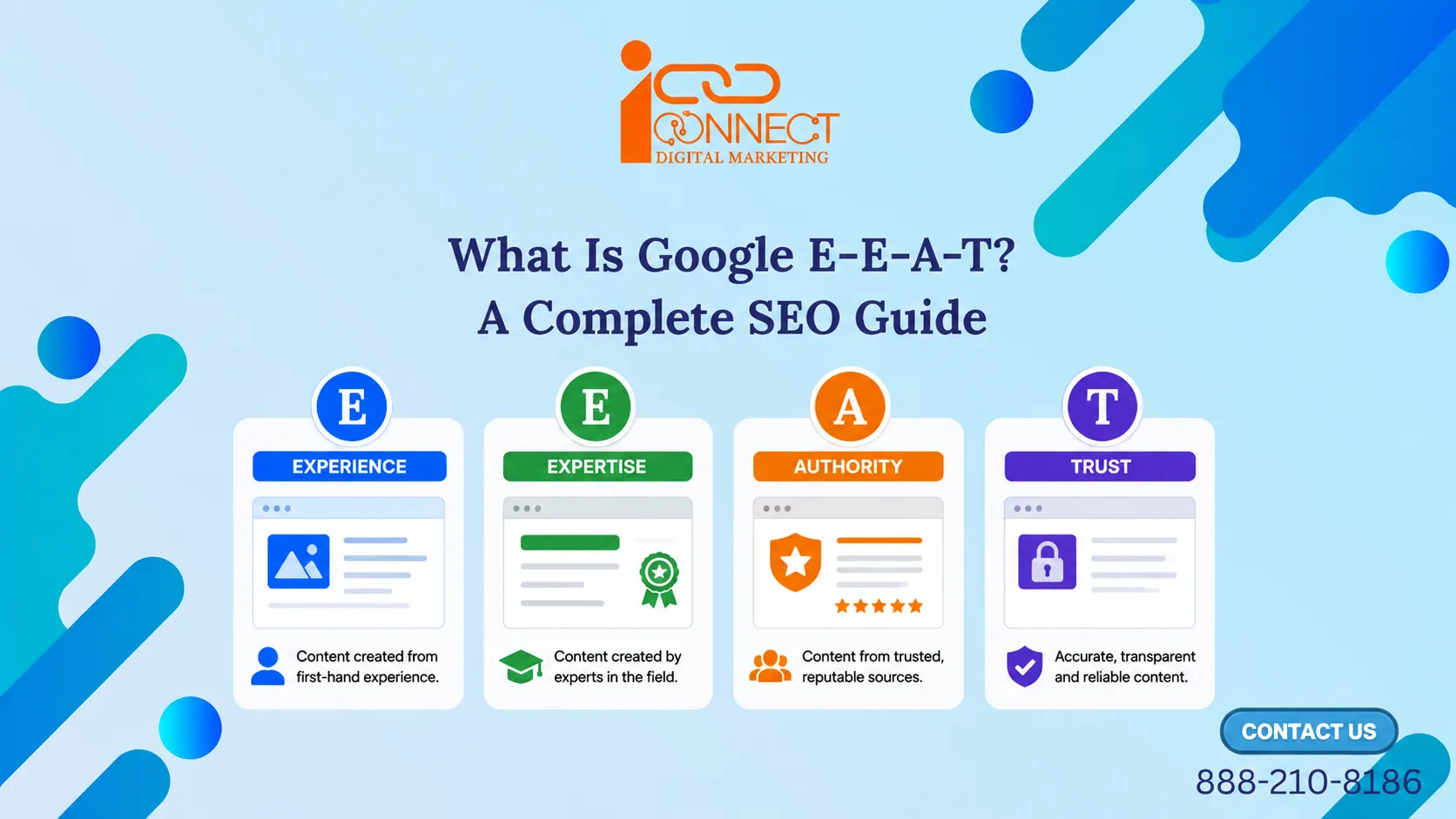
Google E-E-A-T stands for Experience, Expertise, Authoritativeness, and Trustworthiness. These four aspects are used by Google’s automated systems in Google’s Search Quality Rater Guidelines to describe important qualities of helpful, relevant and reliable content.
However, E-E-A-T in itself does not stand for a ranking factor or an E-E-A-T score that is given to any web page or website by Google. In order to maintain a high standard of information on the internet, human evaluators apply the concept of E-E-A-T to verify whether the content is trustworthy or not. Meanwhile, Google’s automated ranking systems use many different signals to identify content that appears helpful and reliable.
Google gives priority to that content that should be created primarily to help people rather than primarily to attract visits from search engines. Out of these four aspects, Google says “Trust” is the most important, while the importance of Experience, Expertise, and Authoritativeness can vary depending on the topic and the user’s needs. Not every page needs to demonstrate all four in the same way.
So, what does E-E-A-T actually mean for website owners, SEO professionals, content creators, and businesses? Let’s understand each part and then look at how you can apply these principles to your own website.
You may also be interested in: 👉 How Does Google Decide Website Rankings?
What Does E-E-A-T Stand For?
You will grasp this concept quite easily once you look at each pillar on its own. In fact, as soon as you understand the individual parts, the whole system clicks.
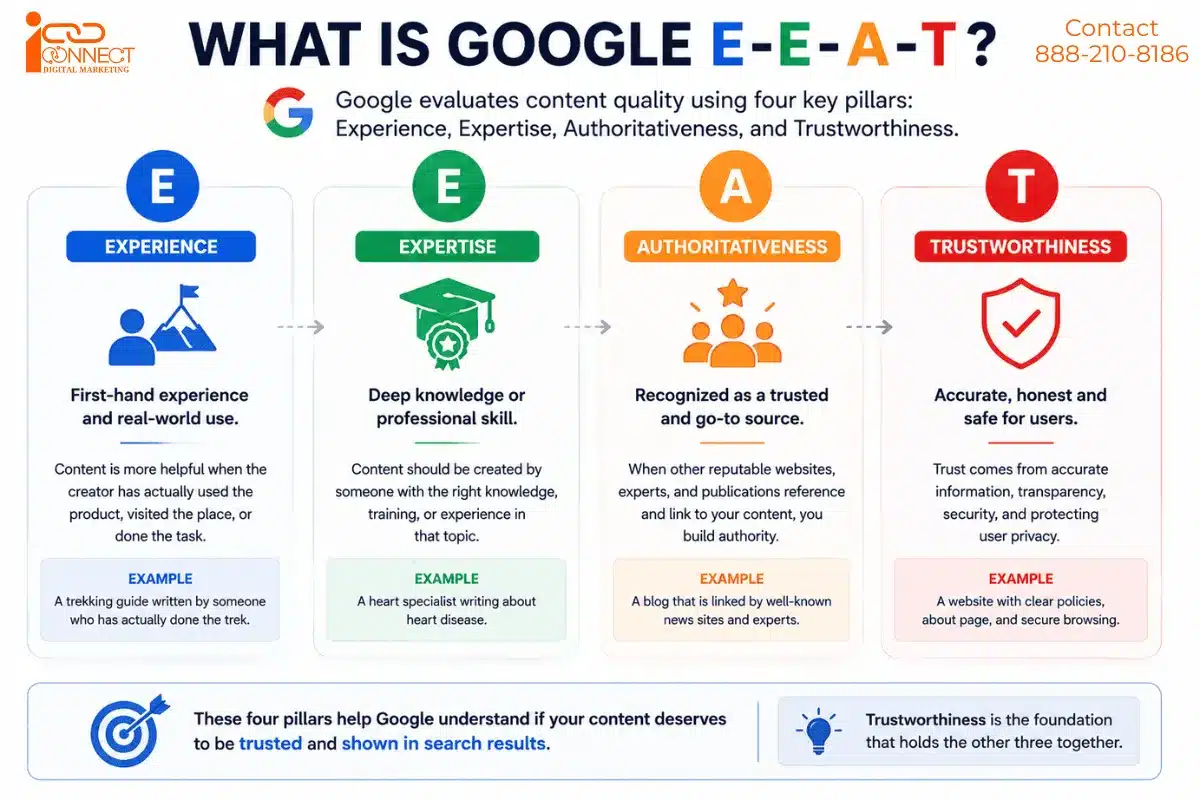
- First, let’s look at Experience. This means you actually try the thing you write about. For example, a hiking backpack review sounds much more real and convincing if you actually carry that pack up a mountain yourself.
For example, an educational article explaining a general SEO concept may not require the author to personally test every aspect of the subject. In such cases, accurate explanations, relevant knowledge, reliable sources, and useful analysis may matter more.
Therefore, ask yourself:
“Does this topic benefit from first-hand experience, and if so, have I actually demonstrated genuine experience?” Most importantly, do not manufacture experience.
If you have not personally tested a product, visited a location, used a tool, or implemented a strategy, you should not imply that you have.
- Next comes Expertise. This pillar requires deep knowledge and professional skill. For example, a heart surgeon shows true expertise when writing about cardiology. Conversely, a casual blogger fails to show expertise when they simply repeat information from a random health site.
For Example, a digital marketing course professional explaining how a Google Ads campaign was structured, tested, measured, and optimized can demonstrate practical expertise more effectively than an article that simply repeats basic definitions from several other websites.
As a result, expertise should be visible through the quality and usefulness of the information, not just through credentials.
- Authoritativeness requires time and effort to build. In this case, other trusted experts, news sites, and blogs establish your authority when they link back to you as a reliable source.
For Example, a website that consistently publishes useful digital marketing resources, practical SEO analysis, campaign tutorials, and original observations may establish stronger topical credibility than a website that occasionally publishes unrelated marketing articles simply to attract search traffic.
However, backlinks should not be treated as the definition of authoritativeness.
Instead, focus on creating something genuinely valuable enough that other people have a reason to reference, recommend, or cite it.
- Finally, trustworthiness ties the whole system together. This trait relies entirely on accurate facts, strong digital safety, and honest information. Because it protects the reader, search evaluators consider trustworthiness the most important pillar of all. After all, even a smart expert can build a website, but they still lose all trust if they hide who they are or steal user information.
Trust is particularly important when inaccurate information could cause significant harm.
For Example, a website publishing medical, financial, legal, or safety-related information needs to take accuracy and reliability especially seriously. At the same time, trust matters for everyday content as well.
A product review that hides important limitations. A tutorial that contains incorrect instructions, or a website that makes exaggerated claims can reduce user confidence even when the subject itself is not considered “YMYL” “Your Money or Your Life” topics.
Therefore, ask:
“Can a reasonable reader understand who created this content, why they should trust it, and what limitations apply?”
Figure below shows how these four components are interrelated and have trustworthiness at their core.
Does Google Give Websites an E-E-A-T Score?
No. Google does not provide website owners with an official E-E-A-T score through Google Search Console. If an SEO tool shows an E-E-A-T score, it is the tool’s own methodology rather than a score directly provided by Google.
Why is E-E-A-T Important for SEO?
E-E-A-T matters because Google aims to show people helpful and reliable information. The goal is not to add an author bio, a few citations, and some keywords simply because you believe Google expects them. Instead, the goal is to create content that genuinely deserves the user’s trust.
It really comes down to three main reasons where this becomes particularly important.
1. YMYL Topics Require Stronger Trust
First, Google sets strict rules for “Your Money or Your Life” (YMYL) content. False information about health, money, and laws may cause severe harm to someone. That is why Google verifies such content twice as carefully. A medical or finance blog must prove its credibility instantly, whereas a site ranking the best pizza toppings can get away with a casual approach.
For Example:
- Health and medical information
- Financial information
- Legal information
- Safety-related information
- Information involving significant life decisions
In the case of such topics, the spread of incorrect information may lead to undesirable outcomes. Hence, Google’s algorithms apply even more importance to information which is consistent with good E-E-A-T ratings for topics where incorrect information may lead to significant impacts on people. Nevertheless, this does not imply that Google evaluates a YMYL page by its E-E-A-T rating. Rather, accuracy and reliability of the information come into play.
2. Search Intent Alone Is Not Enough
Second, think about algorithm alignment. Google’s human reviewers don’t give you a secret E-E-A-T score that boosts your site overnight. Instead, Google engineers program their main computer algorithms to mimic these human guidelines. When you write with real experience and facts, you naturally please the algorithm, and your rankings rise over time.
Trust keeps visitors on your page. The cleaner, clearer, and safer your website is, the more users will visit, read, and come back. On the other hand, users will immediately leave an unreliable and anonymous blog. Google tracks these fast exits, notes that your site didn’t help the user, and drops your rankings accordingly.
People-First Content vs Search Engine-First Content
People-first content involves providing useful, relevant, and readable content for the benefit of the readers. However, search engine-first content is all about improving the ranking of the content on the search engines. In the case of a people-first article on healthy eating, the reader would be provided with tips that could include consumption of vegetables, whole grains, and adequate intake of water, using relevant keywords in the process.
On the other hand, search engine-first content would include repeated use of phrases such as “tips on healthy eating” and “best tips on healthy eating,” which would be hard to read and irrelevant for the reader. In addition, people-first content is beneficial to the readers because it considers their needs and offers them something valuable, while search engine-first content tends to be more visible to the reader.
For Example:
Search Engine-First Content: “Best running shoes are important if you want the best running shoes. Our guide to the best running shoes covers the best running shoes for running, including the best running shoes for beginners.”
This targets the phrase “best running shoes” repeatedly, but doesn’t help much.
People-First Content: “If you’re a beginner, look for a running shoe with comfortable cushioning, a secure heel, and enough room for your toes. You don’t necessarily need the most expensive model—the right fit matters more than the brand.”
This naturally addresses what a reader actually wants to know.
How to Perform an E-E-A-T and People-First Content Audit for any Website
Let us now focus on the practical aspects of E-E-A-T. Below is a tutorial that will depict to you how you can audit E-E-A-T for any website.
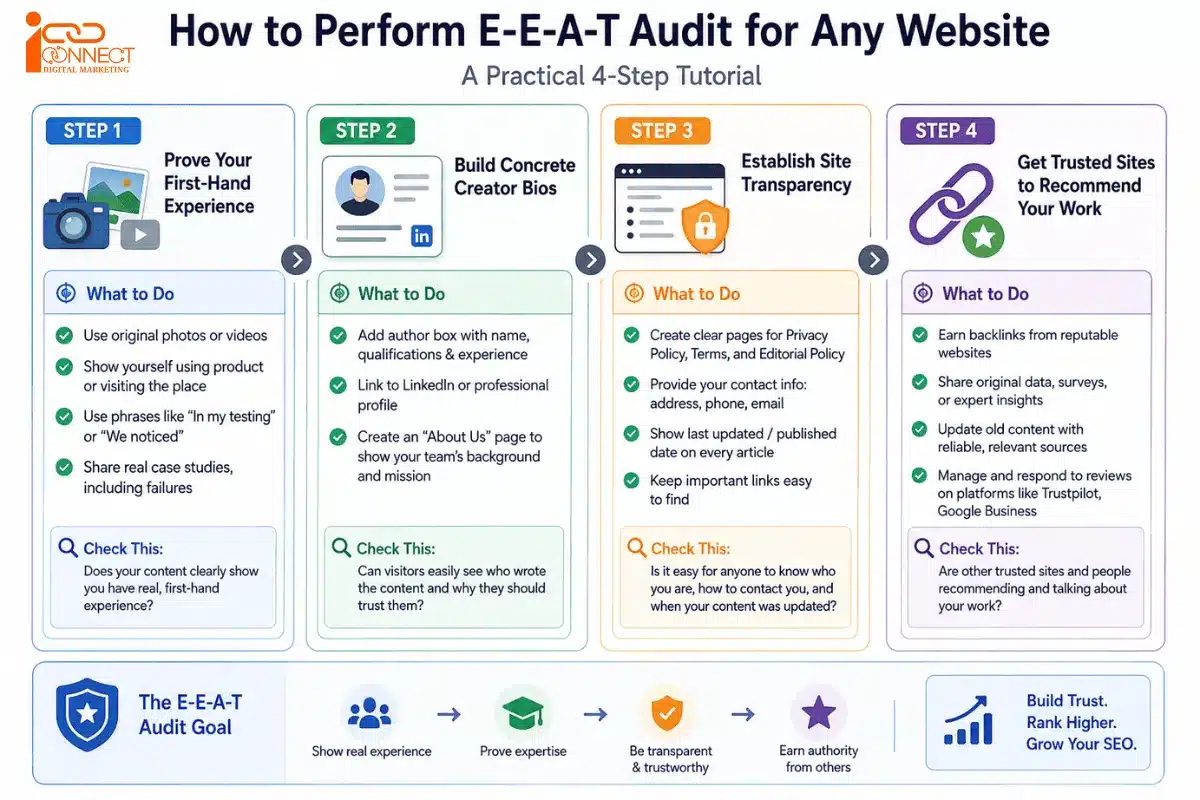
Step 1: Prove Your First-Hand Experience (Audit Experience)
Since generic, rewritten content is easy to spot, original input matters. Use original photos or video clips wherever feasible, preferably showing you actually using the product or visiting the place you’re discussing. Use natural phrases like “In my testing” or “We noticed” to show readers you are telling the truth. Additionally, document real case studies — including failures, not just wins — since these serve as strong experience signals.
Step 2: Build Concrete Creator Bios (Audit Expertise)
Every informational article needs an accountable author. Therefore, add an author box to each piece, listing degrees, certifications, or years of relevant experience. Wherever possible, link this bio to an active LinkedIn or professional profile. Finally, you can build a dedicated “About” page to explain your team’s collective background and mission.
Step 3: Establish Site Transparency (Audit Authoritativeness )
People must know who runs your website before they can trust you. Therefore, never hide your identity. Create easy-to-read pages for your privacy rules, user terms, and writing standards. Place these links where your visitors will see them immediately. In addition to that, give your physical address, phone number, and a contact form. Lastly, always include the exact date when you have written or updated the article. Outdated information ruins your reputation instantly, especially when you give advice about health or money.
Step 4: Get Trusted Sites to Recommend Your Work (Audit Trustworthiness)
Lastly, you build authority when other people endorse your work. Share your own original data, fresh surveys, or expert quotes with popular industry blogs so they link back to your site naturally. Next, read through your old articles and swap out broken, dead links for fresh sources that people trust. Don’t forget to track and answer reviews on sites like Trustpilot or Google Business. New visitors check those ratings before they ever trust your word.
The “Who, How, and Why” Framework
A very practical way to assess your content is Google’s “Who, How, and Why” strategy. These questions assist in figuring out if your content is clear, helpful, and person-focused.
Who Created the Content?
For example, an SEO article written by a digital marketing professional can include an author bio explaining relevant experience, subject expertise, and areas of practical work. However, the author bio should accurately represent the creator’s background. Do not use exaggerated titles or credentials simply to make content appear more authoritative.
How Was the Content Created?
The “How” refers to how the content was produced. For some types of content, explaining the process can help readers understand why they should trust the information.
For example, a digital marketing case study could explain:
- What website or campaign was analyzed
- What problem was identified
- What process was followed
- What changes were made
- What was measured
- What limitations affected the results
Why Was the Content Created?
The “Why” is arguably the most important question.
For example, if you operate a digital marketing website, publishing genuinely useful articles about SEO, Google Ads, Meta Ads, analytics, content strategy, and digital marketing careers can make sense because these topics are relevant to your intended audience.
On the other hand, publishing unrelated articles about celebrities, recipes, insurance, technology, or random trending topics simply because they have search volume would raise a different question:
“Why does this website need to publish this content?”
Therefore, your website should have a clear purpose and audience. There is nothing wrong with wanting your content to be discovered through Google. However, search traffic should not be the primary reason for creating content that provides little value to readers.
E-E-A-T Example for a Digital Marketing Website
A basic article might simply define:
- CPC
- CTR
- Conversion Rate
- CPA
- ROAS
- Quality Score
However, a more useful article could explain how these metrics are interpreted in actual campaign optimization.
Experience:
The author can explain practical campaign observations, testing approaches, common problems, or lessons learned from real campaign work, provided these are genuinely based on experience.
Expertise:
The article explains why a particular optimization decision may make sense rather than simply listing steps.
Authoritativeness:
The website consistently publishes useful digital marketing resources and clearly identifies the people responsible for its content.
Trustworthiness:
The article distinguishes official platform information from personal observations, avoids guaranteed-result claims, provides appropriate sources, and explains limitations.
As a result, the article becomes more useful without repeatedly inserting the phrase “E-E-A-T.”
Does an Author Bio Improve E-E-A-T?
Yes. Author bio can help in E-E-A-T because it provides the audience and the search engines with necessary information about the author of the content. For instance, a health blog post can include a bio of the author which contains the educational background or any experience that the author might have in the said field.
Also, a financial blog post can contain a bio of an author with experience in finance or any other relevant field. In addition to it, a good bio helps in increasing the level of transparency and helps the readers in understanding why the information should be believed. Nonetheless, author bio alone cannot ensure E-E-A-T as the information provided in the content should also be accurate.
For example, if an article is about SEO, an author bio can explain relevant SEO experience, professional background, practical areas of expertise, and links to an author page.
However, adding phrases such as “SEO Expert,” “Industry Leader,” or “Top Authority” without supporting evidence does not create genuine authority.
Should we Add the Date to an Article?
Yes, including a date on the article will help increase transparency. It will also readers some idea about how current the information in the article is. For instance, in the case of an article concerning SEO trends, the reader should be able to see the date of publication along with the date of the last update (whenever there is one), since search trends keep changing all the time.
Similarly, there is always an advantage of having a date in case of articles on technology, finance, or even current affairs because the reader requires up-to-date and reliable information. Additionally, it indicates that the writer keeps reviewing the article and updating it. But it would not be wise to update just for the sake of making it look current.
You may also be interested in: 👉 What is a Keyword in SEO?
Does Adding More Keywords Improve E-E-A-T?
Adding more keywords does not necessarily mean that E-E-A-T would be improved since E-E-A-T requires experience, expertise, authority, and trustworthiness. For instance, if an article about health is written, it does not automatically become trustworthy even if the author repeatedly writes “healthy diet,” or “the best healthy diet.”
On the other hand, the author is expected to write useful content. Also should have experience or expertise in writing, and include trustworthy sources if necessary. What is more, proper and natural usage of keywords could assist the search engines to get the idea of the topic. Consequently, it is better for authors to write quality content with trustworthy information and keywords used properly.
E-E-A-T, SEO, AEO and GEO: How Do They Fit Together?
All these factors, including E-E-A-T, SEO, AEO, and GEO, contribute to the development of valuable content. To begin with, SEO (Search Engine Optimization) is used to increase visibility of web pages in the traditional search result because it considers such criteria as relevance of topics, keywords, technical aspects, and user experience.
At the same time, E-E-A-T (Experience, Expertise, Authoritativeness, and Trustworthiness) is helpful when it comes to demonstrating credibility and providing credible information. In addition to the above, AEO (Answer Engine Optimization) is aimed at developing straightforward and clear answers which search engines and answer engines will be able to utilize. Likewise, GEO (Generative Engine Optimization) makes sure that the content appears in the answers produced by AI because it provides well-structured, credible information.
As an illustration, a well-researched article on digital marketing can benefit from all of the above strategies. It can attract visitors thanks to SEO; provide credible information thanks to E-E-A-T; answer common questions using AEO; and provide credible information for AI with GEO.
You May Also be Interested in |👉 What is Generative Engine Optimization (GEO)
Final Thoughts
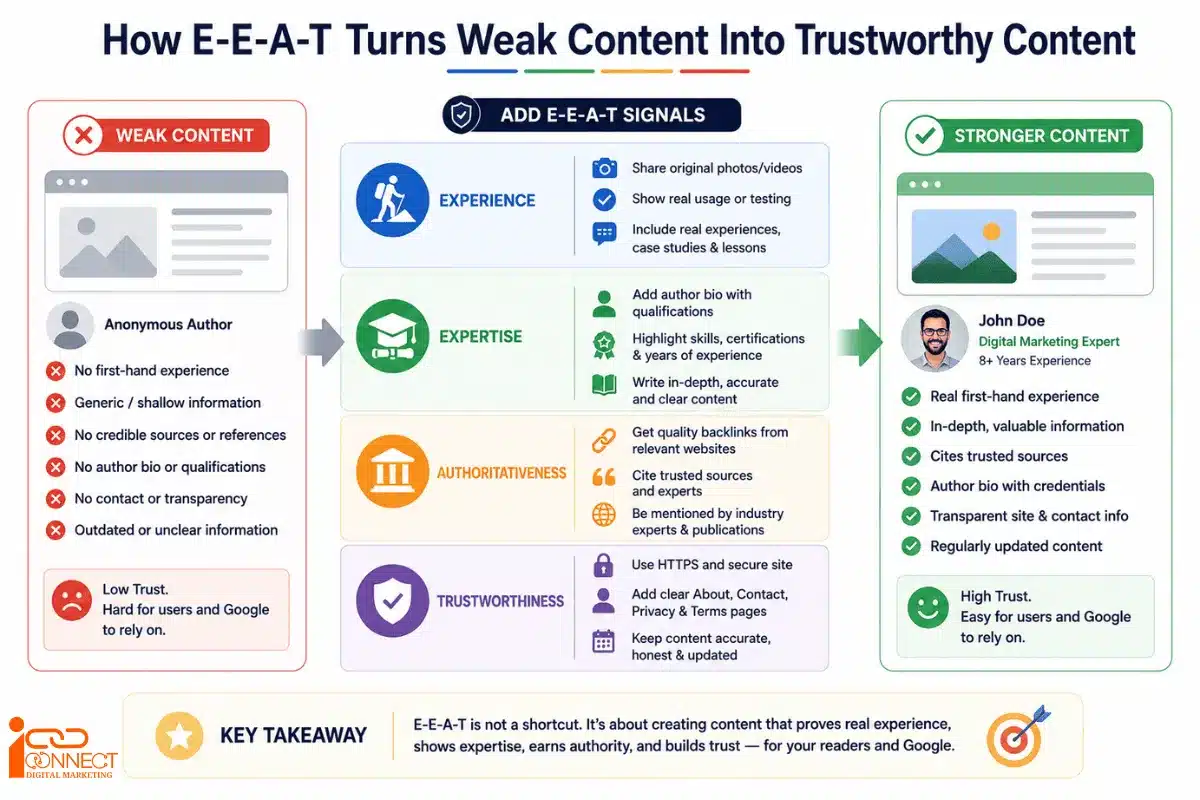
Google E-E-A-T is best understood as a framework for thinking about the quality and trustworthiness of content rather than as an SEO score or ranking shortcut. Most importantly, make sure the content provides enough value that the reader does not need to immediately return to Google to find a better answer.
Ultimately, strong E-E-A-T is not about making your website look authoritative. It is about giving people a genuine reason to trust the information you provide.
Learn Digital Marketing Through Practical Work
Understanding E-E-A-T, SEO, Google Ads, Meta Ads, Ecommerce Marketing, Google analytics, Content marketing, E-mail Marketing, Whatsapp Marketing, AI tools, and AI search optimization is only one part of becoming a digital marketer.
The next step is learning how these concepts are applied to actual websites, campaigns, analytics, and marketing problems. At iConnect Digital Marketing, our Digital Marketing Course in Ghaziabad focuses on practical, job-oriented learning across AISEO, Google Ads, Meta Ads, social media marketing, Google analytics, content marketing, AI tools, and other core areas of digital marketing.
The training includes practical assignments. In addition, website-based SEO activities, campaign exercises, and project-based learning so that students can understand how digital marketing concepts are applied beyond theory. This is not a guarantee of rankings, leads, or employment. Results depend on factors such as the learner’s effort, practice, market conditions, campaign budgets, business requirements, and individual performance.
If you want to learn digital marketing by applying these concepts to practical projects, you can explore our Digital Marketing Course Modules.

Mohit Vij is the Founder & Digital Marketing Trainer at iConnect Digital Marketing Training Hub & Agency (iConnectDM), based in Ghaziabad. With over 9+ years of experience in SEO, Google Ads, Meta Ads, Social Media Marketing, Search Intent, Content Marketing, and Lead Generation.
Over the past years, He has trained hundreds of students, job seekers, working professionals in building successful careers in digital marketing while helping businesses improve their search rankings, website traffic, brand visibility, and lead generation. His insights are based on hands-on industry experience, continuous learning, and proven digital marketing strategies that deliver measurable results.