

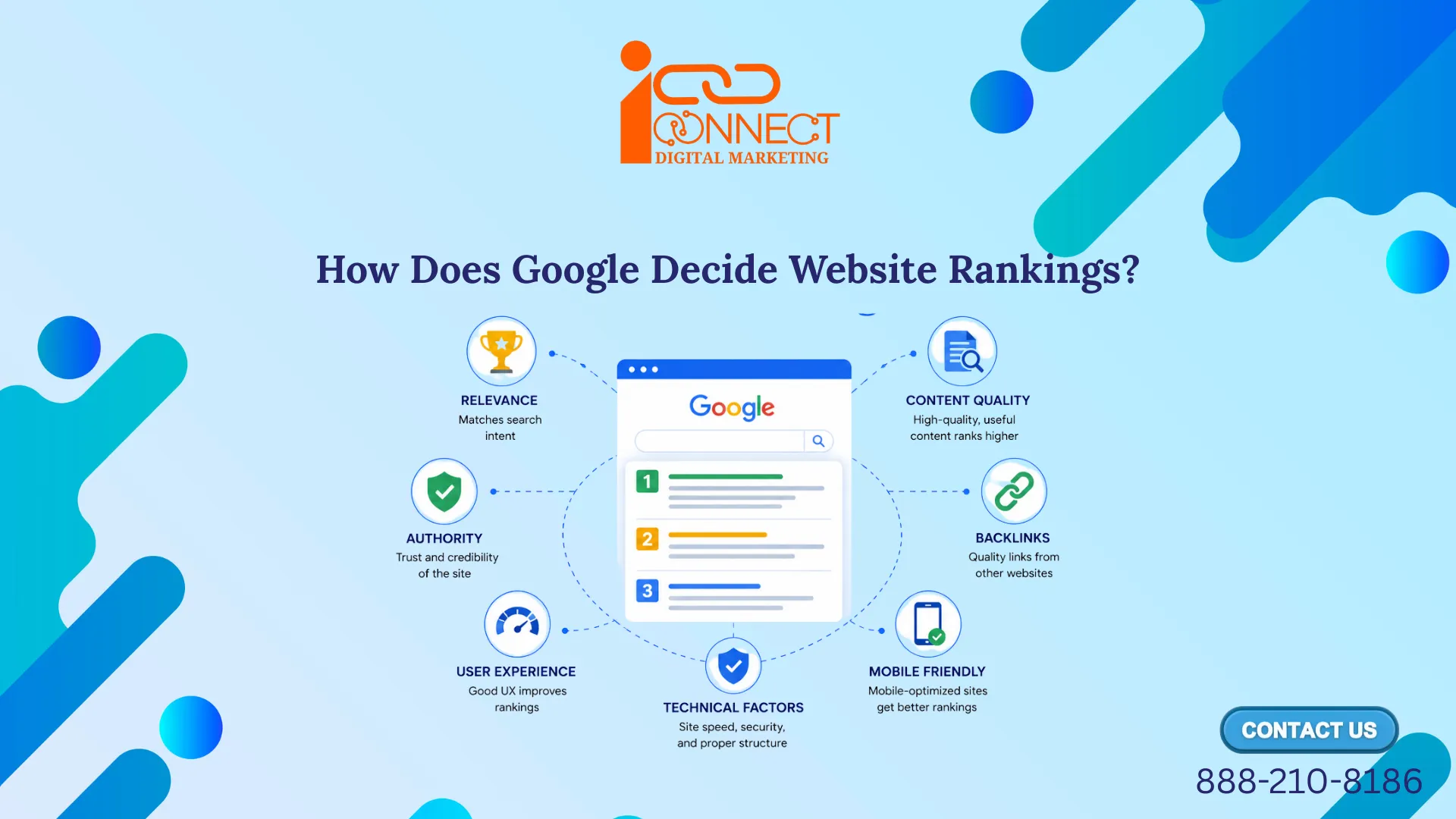
Google’s Search algorithm decides website rankings. By evaluating hundreds of billions of webpages to determine which page or prioritizes people-first content is most likely to satisfy a user’s search query. An interesting fact, Google responds to around 99,000 search queries every second in under 0.5 seconds.
To rank in Google search results, Google’s Search algorithm looks at many factors and signals. Such as relevance, quality, authority of a webpage content, backlinks, speed, mobile responsiveness, and trustworthiness. There is no one single criterion to determine the ranking of any given page but the overall assessment of all the criteria together. This evaluation happens every time when someone performs a search. They also consider whether other trusted sites link to it.
Table of contents
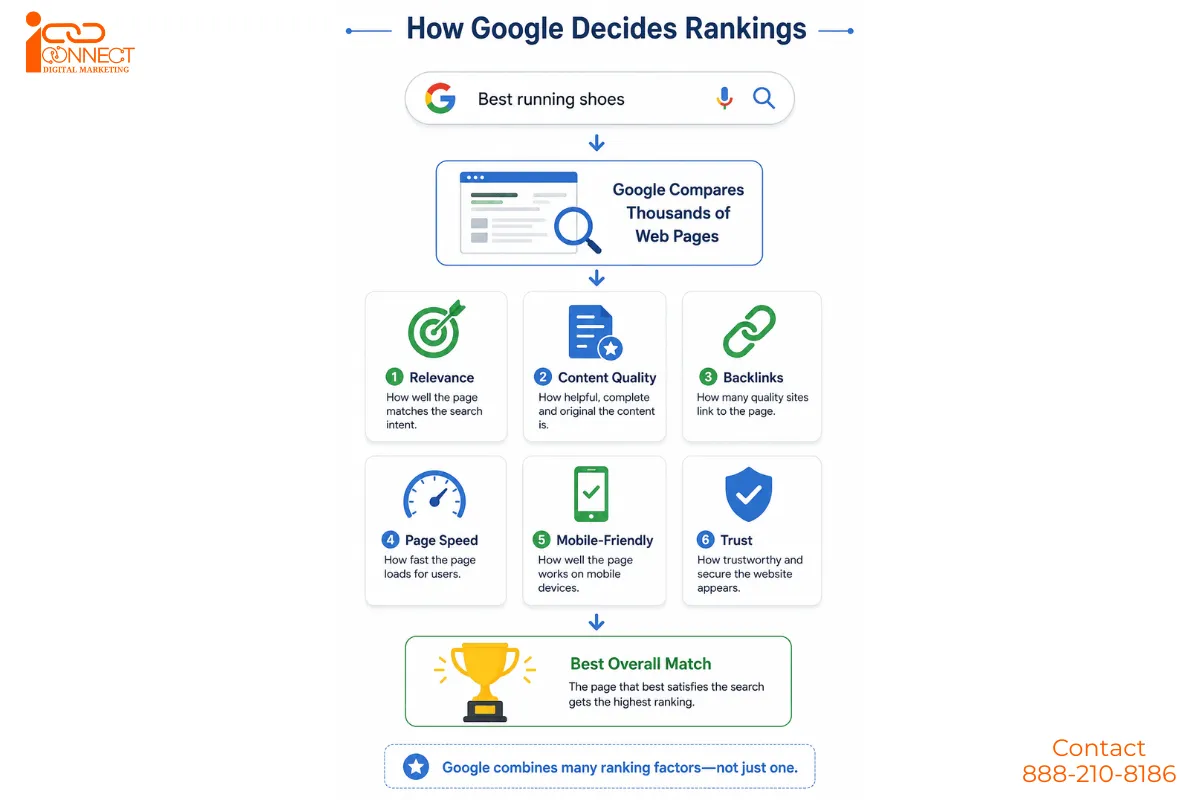
This infographic explains how Google ranks web pages by evaluating relevance, content quality, backlinks, page speed, mobile-friendliness, and website trust.
Why Does Relevance Matter Most in Google Rankings?
Well, relevance is one of Google’s most important ranking signals because before anything else a page must answer the user’s question before any other quality signals matter.
For Example, if someone searches “digital marketing course” and a page about social media marketing or SEO basics is unlikely to rank well, even if it is well written. It’s not answering the actual question being asked. Google prefers pages that directly satisfy the user’s search intent by providing information about digital marketing institutes, including courses, fees, placements, and student reviews.
Relevance works like an entry ticket. It gets us into the race. It doesn’t decide who wins. A page can be relevant and still lose out to a page that answers the same question more clearly, more completely, or more credibly.
You may also be interested in: 👉 What Are Search Engines and How Do They Work?
What Effect Does Content Quality Have on Search Results?
Once Google finds out which page is most appropriate to the search, it analyzes the quality of the content being offered on that page. The quality of the content is determined in terms of the completeness and preciseness of the information that satisfies the user’s requirement in the best possible way. The better the quality of the content, the better are the chances of keeping the user interested in visiting other pages and gaining his/her trust. Google also considers another factor that comes into play here is that of the credibility of the person or organization providing the information.
This evaluation is based on a model which is known as E-E-A-T. The acronym stands for Experience, Expertise, Authoritativeness, and Trustworthiness. Even though the concept seems complicated, its essence is very simple. However, publishing high-quality content alone does not guarantee top rankings.
Google tries to determine if the reader can rely on the information provided on your page. Is the information valid? Is it helpful? Will the reader find the answers to his or her questions or have to search for them again? Pages that have reliable, useful, and explanatory information are likely to get more trust from Google and better search results performance.
Do Backlinks Still Influence Google Rankings?
Absolutely, the high-quality and relevant backlinks are still extremely crucial in the ranking algorithm of Google and can still help improve rankings in 2026. Backlinks act as a signal indicating that the other websites think your content is important enough to be referenced. The only difference is that Google values the quality and relevance of backlinks more than their sheer volume.
Just a few backlinks from reputable and credible websites in your field may have more weight than a huge number of poor-quality links. Yet again, there are many ranking factors besides backlinks. Even sites that enjoy a healthy backlink profile need relevant and high-quality content and good user experience to rank well.
You may also be interested in: 👉 What Are Backlinks in Search Engine Optimization (SEO) and How to Create Them?
Why Does Website Speed and Mobile Experience Matter for Rankings?
Most importantly, Google also pays close attention to how a site actually behaves once someone lands on it.
- Does it load quickly?
- Does it work smoothly on a phone, since most searches now happen on mobile?
- Does the page stay stable, or does everything shift around annoyingly while it’s still loading?
This connects directly to technical SEO. Even genuinely great content can get held back by a slow, clunky, or poorly built website. Because Google factors in the actual experience of using the page, not just what’s written on it.
How Does Search Intent Shape Google’s Results?
First, Google tries to understand why someone performed a search before deciding which pages to display. In simple terms, Search Intent is the purpose or goal behind a user’s search query. It explains why someone typed a particular keyword into Google. This is known as search intent.
For Example, When you search — “weather in Delhi today“— you want to know the weather for that particular day. While the search “why does it rain?” is looking for an explanation rather than a weather update. It is for this reason that Google distinguishes between different searches and serves the relevant web pages accordingly.
Similarly, a search for “best running shoes for flat feet” is likely looking for product recommendations, while “what causes flat feet” seeks educational information. Because search intent differs, Google may rank different types of pages—even when they contain similar keywords.
It is possible for a shorter web page to rank above a long web page for a related topic. Since Google is not counting the words in a web page but serving the web page that will satisfy the expectations of the users from their searches.
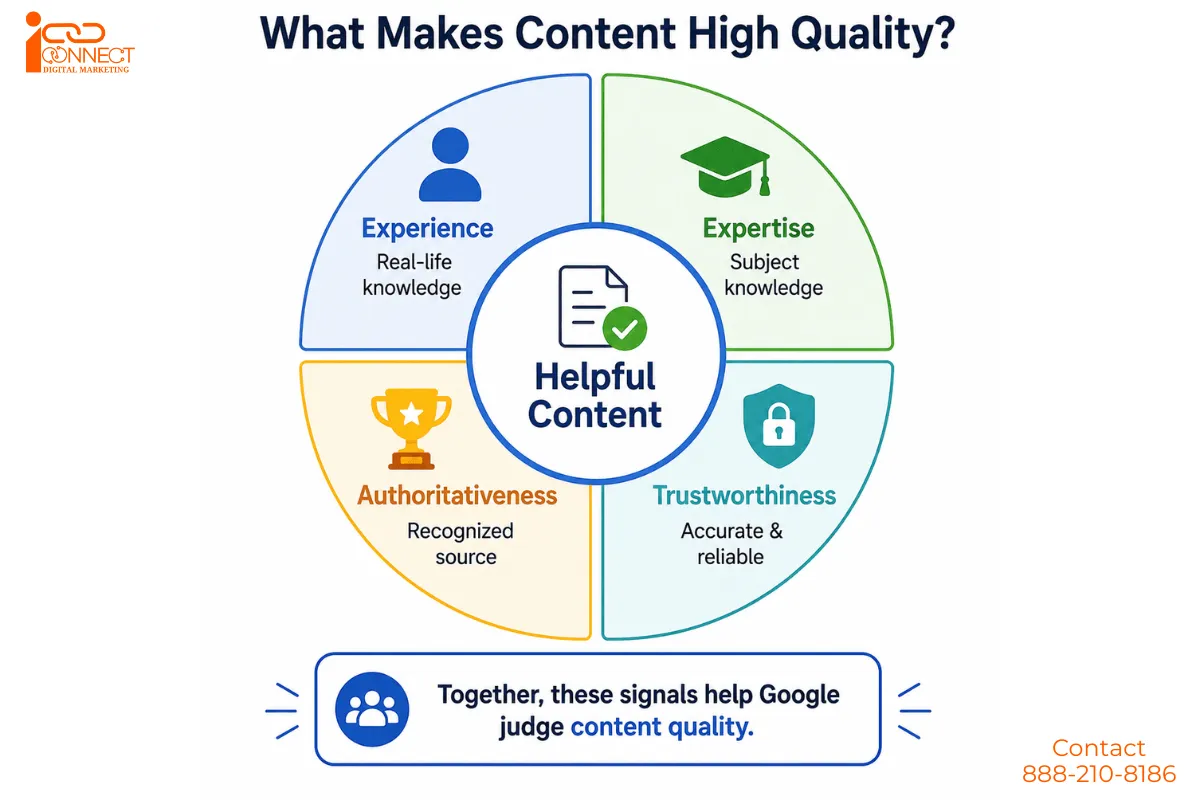
This infographic explains Google’s E-E-A-T framework, showing how Experience, Expertise, Authoritativeness, and Trustworthiness create high-quality, helpful content.
Does Content Freshness Affect Google Rankings?
Yes. Content freshness affects Google rankings in certain search terms where fresh data becomes essential. Google uses the Query Deserves Freshness (QDF) algorithm in order to determine whether updated data is required. However, not every topic demands regular updating.
However, not all subjects require updates regularly. In case the person types the search query “the latest smartphone releases in 2026,” . Google will favor pages containing the most recent data. Yet, if the search is about “photosynthesis,”. A good page may remain useful for many years due to the lack of any changes in the definition.
Thus, the need for frequent updates depends on the subject matter. While there are topics that require the most current information, others may actually be helped by not updating at all. Google favors sites that give reliable, well-researched, and updated information. In other words, it builds trust in a similar way as a person’s reputation is formed, which comes from being reliable over time, not from getting one thing right once.
You may also be interested in: 👉 Master AI SEO: Boost Your Website’s Performance and Rankings
What Is the Bigger Picture Behind Google’s Ranking System?
Important to know that Google does not depend on only one factor to rank your website. Rather, it analyzes several different factors to find out whether your page will be helpful to a person. If our website is helpful, fast, reliable, and matches what people are searching for, then Google will rank you higher.
There is no set formula that ensures better rankings. The ranking of a website is dependent upon various elements such as competitiveness, search intent, quality of content, authority of the website, and improvement over time. Concentrating on providing useful content and having a technically efficient website is important.
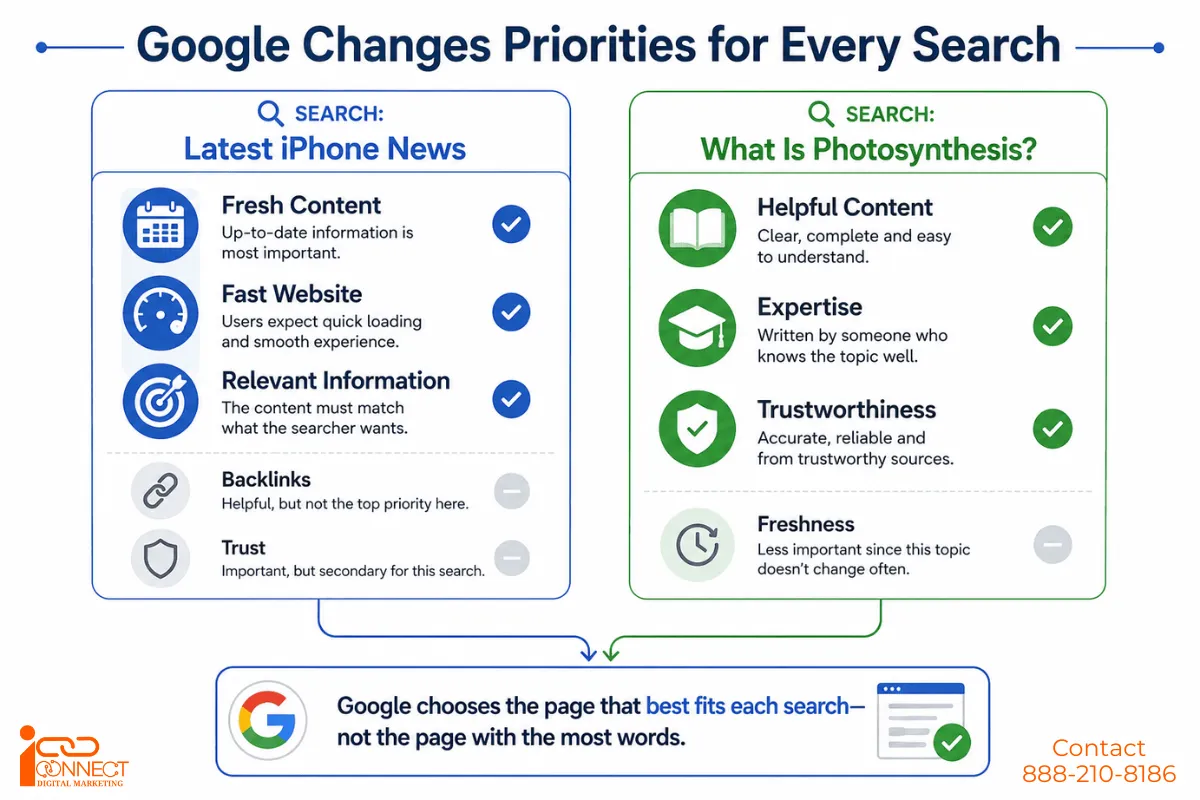
This infographic explains how Google changes ranking factors based on search intent, prioritizing freshness, relevance, expertise, trust, and helpful content.
Frequently Asked Questions:
Of course, Google takes into consideration the use of keywords to learn the topic of your web page, but keywords do not influence rankings by themselves. Moreover, Google does not take into account the “keywords” meta tag in the web search ranking algorithm; it just ignores it. Google analyzes relevance, intent, content quality, page experience, backlinks, and lots of other factors to find out which page would be the most beneficial for some particular search.
Of course, it is possible for a new site to be ranked by Google, however, it requires time like 3 to 6 months to achieve certain visibility. As far as some pages might rank within a week, others take several months before starting to receive traffic from Google search results because of various reasons like the niche and competitiveness. It is especially difficult to rank on competitive keywords. Useful and relevant content is helpful in ranking a website. There are several factors affecting the rate of ranking a website. Such as competitiveness, the quality of content, website design, internal linking, backlinks, and so on.
Yes, Google has acknowledged this fact for more than ten years now. This refers to the speed of loading web pages, which is a direct ranking factor for both desktop and mobile searches through Google. Through the guidance of Google PageSpeed Insights, we can determine the speed of loading, visual stability, and interactivity to assess the quality of the user experience. The faster-loading web page will give a good user experience. It will enable users to have access to the content easily and interact with the page without any unnecessary delays.
Well, just high-quality content itself is not enough to boost Google rankings. Although high-quality content is a key element for optimizing your content on search engines. There are other elements used by Google to rate quality and accurate content and generate search results. There are several factors including relevancy to search queries, backlinks, user experience, site architecture, and technical SEO. Sometimes, even the best content fails to rank on Google. Because of mismatching search intent and inability of Google to find and understand the page.

Mohit Vij is the Founder & Digital Marketing Trainer at iConnect Digital Marketing Training Hub & Agency (iConnectDM), based in Ghaziabad. With over 9+ years of experience in SEO, Google Ads, Meta Ads, Social Media Marketing, Search Intent, Content Marketing, and Lead Generation.
Over the past years, He has trained hundreds of students, job seekers, working professionals in building successful careers in digital marketing while helping businesses improve their search rankings, website traffic, brand visibility, and lead generation. His insights are based on hands-on industry experience, continuous learning, and proven digital marketing strategies that deliver measurable results.