

You type a question into Google or ask ChatGPT something late at night, and a detailed answer shows up within seconds, almost instantly. Behind that quick response is content created by millions of people across websites, articles, blogs, forums/discussions, and information with research papers shared across the internet over many years.
To provide answers people actually find helpful. AI systems need access to large amounts of publicly available information. This is where AI crawlers and bots come into play.These automated systems continuously discover, read, and collect content from across the web, helping search engines and artificial intelligence platforms understand information at scale.
Table of contents
- What Is an AI Crawler? (Quick Answer)
- What Is a Bot?
- What Is an AI Crawler Specifically?
- AI Crawler vs Search Engine Crawler
- Major AI Crawlers and Bots with the Platforms Behind Them
- How Does a Crawler Actually Work? (Step by Step)
- The Architecture Behind It All
- How Websites Can Control AI Crawlers and Bots
- Frequently Asked Questions About AI Crawlers and Bots
So in this guide, we will discuss and learn what AI crawlers are, how they work, how websites can manage crawler access, and why website owners, students, developers, and SEO professionals should understand them.
You may also be interested in: 👉 What Is Google AI Mode and How Does It Work?

Now, let’s understand AI crawlers and bots step by step.
What Is an AI Crawler? (Quick Answer)
An AI crawler is a program, driven by automation, which is designed to browse public web pages, gather information, follow links, and download information that can then be used to enhance an AI. Crawlers make publicly available information searchable to an AI and allow it to determine the various methods people write, speak, and share information online.
What Is a Bot?
A bot, in the most basic sense, is any software that executes tasks automatically without a person to prompt each and every individual step. It can be viewed as much like any factory machine. In that it can repeat the exact same instructions over and over: go to one Web page, gather the data, jump to one of the links, and continue repeating that process time and time again.
And, to tell you the truth, bots are not harmful. In fact,they are a fundamental part of how the modern internet operates. Search engines, social media platforms, website monitoring tools, and AI systems all rely on automated bots to perform various tasks efficiently.
For example, Google has a crawler bot that they name “Googlebot”, which is one which crawls web pages available across all over the internet and gathers information from these so that the web pages can be seen by other users who search on google for anything. Similar to this, OpenAI also has such a bot which they call the “GPTBot”, who are authorized to gather publicly accessible data which might be utilized to enhance A.I. Models such as ChatGPT. These are publicly documented tools rather than secret programs, and website owners can identify their activity through server logs and crawler documentation.
You may also be interested in: 👉What is ChatGPT in Digital Marketing?
What Is an AI Crawler Specifically?
An AI crawler, in its simplest definition, is an automated bot designed to collect information from websites for the purpose of training or improving artificial intelligence systems. You could consider it similar to a search engine crawler moving from page to page across the internet. Reading text, gathering publicly available content, storing information, and repeating the same process continuously on a massive scale.
The main thing that distinguishes a traditional search crawler from an AI crawler is the motivation of information collection. While a traditional search crawler moves from page to page, grabs pieces of information and then arranges the whole thing so that web pages can be indexed and later show up in search results, an AI crawler does something a little different. It gathers public domain text documents, articles, conversations, and other material to help AI systems figure out more about how people write, talk, respond with answers, and interpret language.
AI Crawler vs Search Engine Crawler
Although they use similar technology, AI crawlers and search engine crawlers often have different objectives.
| Search Engine Crawler | AI Crawler |
| Collects pages for search indexing | Collects content for AI improvement and training |
| Helps pages appear in search results | Helps AI systems understand language and information |
| Example: Googlebot | Example: GPTBot |
| Focused on search discovery | Focused on knowledge collection |
In practice, both types of crawlers may visit the same website, but the information they collect may be used differently.
Major AI Crawlers and Bots with the Platforms Behind Them
Here are real AI crawlers currently active on the internet:
- GPTBot (OpenAI) — collects text to train ChatGPT models
- ClaudeBot (Anthropic) — helps train Claude AI
- Google-Extended (Google DeepMind) — collects data separately for Google’s AI products like Gemini
- PerplexityBot — powers Perplexity AI’s real-time answers
- Meta-ExternalAgent (Meta) — trains Meta’s Llama models
You can monitor your server logs to see if a crawler has accessed your site. These bots actually report their presence through a string, called a User-Agent string that the bots place on every single one of their queries.
A Practical Example from Website Management
When reviewing website server logs for SEO and technical audits, it is now common to see requests from crawlers such as GPTBot, ClaudeBot, PerplexityBot, and Googlebot alongside traditional search engine bots. This reflects how AI systems are increasingly discovering and accessing publicly available web content as part of their data collection and improvement processes.
How Big Is This Actually?
This is not a small thing happening quietly in the background. According to Cloudflare’s 2025 data (source), AI and search crawler traffic grew 18% from May 2024 to May 2025. GPTBot alone grew 305% in just one year. Googlebot grew 96% in the same period.
By 2025, AI bots were generating 4.2% of all HTML page requests across Cloudflare’s network — which handles over 81 million HTTP requests per second globally.
To put this in Indian terms: if the entire internet were a busy Mumbai local train, AI crawlers are now filling up roughly 4 out of every 100 seats — and they’re growing fast.
How Does a Crawler Actually Work? (Step by Step)
Here is the process, in plain language:
Step 1 — Start with a Seed List
Every crawler begins with a starting list of URLs — say, Wikipedia’s homepage, major news sites, or government portals. These are the “seeds.”
What Is Robots.txt?
Robots.txt is a small text file placed in the root directory of a website. It provides instructions to automated crawlers about which sections of a website they may access and which areas should be avoided.
Step 2 — Check robots.txt
Before you read any page, a well behaved crawler first checks a small file called robots.txt (for example, https://thehindu.com/robots.txt). That file basically tells crawlers what they can see or can not see; it’s a rule set for what’s allowed to be read and what’s not. Website owners write rules here. As of 2025, 14% of top domains had added specific rules for AI crawlers in their robots.txt files (source).
Step 3 — Request the Page
The crawler will then perform an HTTP GET request to the web server, asking something like, “Could you send me the contents of this webpage?”. The web server will then send the HTML for the requested page.
Step 4 — Process the Page
The crawler reads the HTML, and extracts out relevant information, like text that would make up titles and headings, article body text, links that are on the page.
Step 5 — Add New Links to Queue
Those freshly discovered links are added to a crawl queue. The crawler then visits each one and repeats the same process — this is called link following or graph traversal.
Step 6 — Store the Content
Collected text is stored in large data warehouses. For AI training, this raw text later goes through cleaning, filtering, and deduplication before being used.
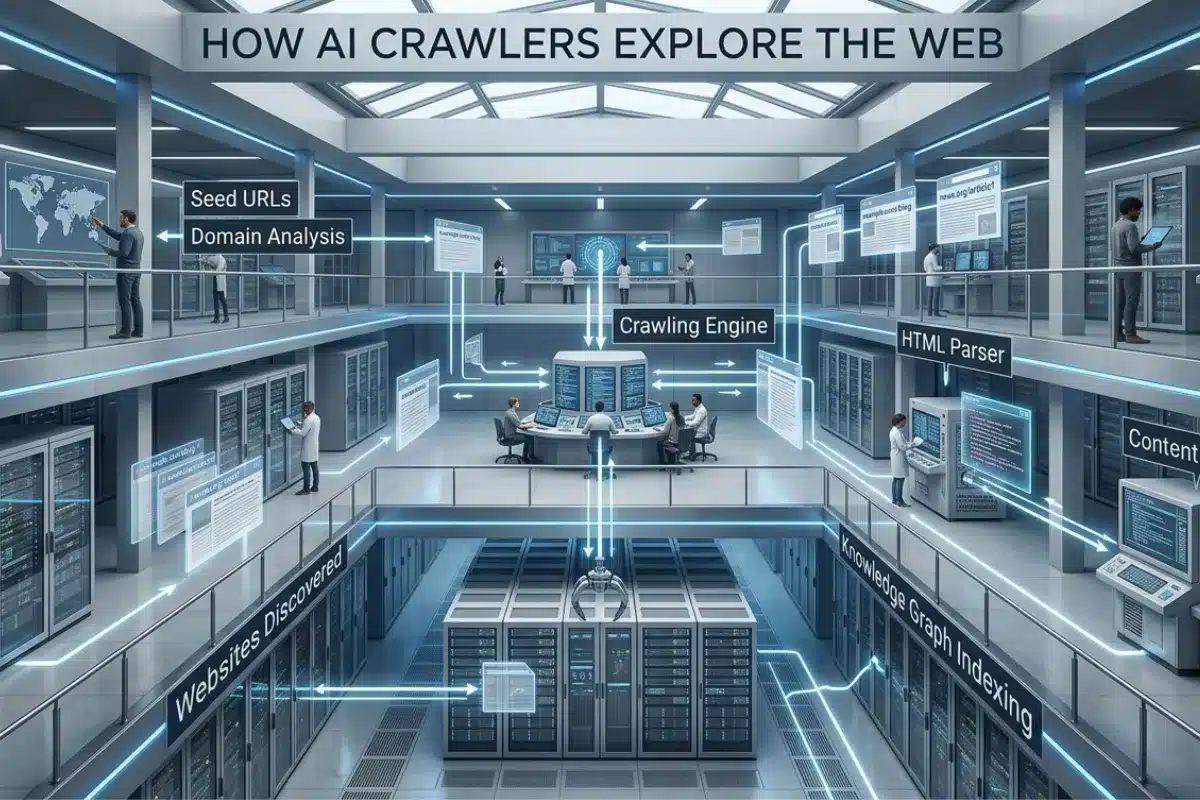
The Architecture Behind It All
A single bot crawling billions of pages alone would take years. So in reality, AI crawlers use a distributed architecture — many machines working simultaneously.
Here’s a simplified version of how it looks:
Large scale projects like Common Crawl scan huge slices of the internet, with hundreds of machines working together all at once. Every day, really enormous amounts of webpages, articles, forums, and public information get pulled in and saved quietly in the background.
You may also be interested in: 👉 How to Optimize Content for AI Search and Discovery?
How Websites Can Control AI Crawlers and Bots
Website owners all over the world have tools to control which bots can access their content:
1. robots.txt — A plain text file that works like a rulebook for crawlers. It can allow or block specific bots by name.
2. Meta tags — Little instructions added inside the HTML of a webpage. It can tell crawlers not to index certain pages.
3. HTTP headers — Additional rules sent by the server, often used for files like PDFs and other documents.
Even major Indian publishers such as The Hindu and Hindustan Times have begun refining their crawler rules with more care, deciding which automated systems may access parts of their websites and which ones should stay outside.
Why Should You Care About This?
If you run a website, blog, or business online in India, AI crawlers are pretty much surely visiting your content right now. Your articles, product descriptions, and FAQs may already be part of training data for one or more AI systems — without you being directly notified.
This raises real questions about who owns the content, who holds the copyright, and what counts as fair use — discussions that are, you know, actively happening in Indian and global courts right now.
For students and developers, understanding crawlers is also essential groundwork, in general, for careers in machine learning, data engineering, and SEO.
Frequently Asked Questions About AI Crawlers and Bots
What is the difference between Googlebot and GPTBot?
Both Googlebot and GPTBot are web crawlers; however, they perform separate functions and are operated individually. Googlebot is a web crawler that operates the search engine of Google and works to discover, crawl and index web pages. This makes pages discoverable to be included when users are performing searches through Google Search. GPTBot is a web crawler that is operated by OpenAI and discovers information online by browsing publicly available web data. This information is used by OpenAI to train and improve its models. Both web crawlers have limitations that website owners can apply through the use of a ‘robots.txt’ file.
Can AI crawlers access my website?
AI crawlers are capable of accessing your website if the content you provide is publicly accessible, with no access restrictions imposed on it. For instance, AI crawlers like GPTBot, among other AI-related bots, could potentially visit web pages in order to obtain content and train an AI or for indexing purposes or data retrieval. Website owners have the ability to control or prevent access by the use of robots.txt files, firewalls or other bot management tools. Most respected AI crawlers abide by the rules set in the robots.txt file, therefore enabling site owners to define if their content is accessible to AI crawlers or not.
How can I block AI crawlers?
To prevent AI bots, such as AI crawlers, from accessing your site, you can add some rules to the robots.txt file of your site, directing particular bots not to access the content of your site. For instance, you could specify a disallow directive for those bots, such as GPTBot, ClaudeBot and other AI bots, within your robots.txt. Other forms of protection could be used with rules for your firewall, IP address blocks, bot management systems or any password requirement needed. Although recognized AI companies would tend to adhere to the directives defined within robots.txt files, implementing multi-layer access control techniques offers better protection.
Are AI crawlers legal?
The legality of AI crawlers can vary according to a range of factors, including local law and regulations, website terms and conditions, copyright issues, and how the data collected is being used. Crawling publicly available web content is often legal within jurisdictions, but can cause conflict if it goes against the website’s rules, access is obtained for content that shouldn’t be available, and material is used without copyright being infringed. Legislation around the use of AI and data collection is an area that is continually being addressed in courts and by regulators, as well as by website owners limiting access via technical and policy means.
AI crawlers discover new websites in several ways, including following links from already known pages, analyzing website sitemaps, monitoring public web directories, and receiving URL submissions. They may also identify new content through search engine indexes, social media links, and references from other websites. Once a new site is found, the crawler visits it, evaluates its content, and follows additional links to discover more pages. This process helps AI systems continuously expand their knowledge of publicly available web content.
The Bottom Line
AI crawlers are the data gatherers of the AI era. They essentially act like a set of incredibly fast, incredibly thorough readers—crawling trillions of webpages, linking from one page to another, and archiving information as they go. All of the data collected by crawlers will be used as the training material for language models like ChatGPT, Gemini, and Perplexity.
Although the internet was created to be an open space, the act of AI-scale harvesting has created a public dialogue around online ownership. Whether you are a student, a programmer, or simply a website owner, this is something that you should know about—and it’s affecting the answers to the questions that you ask your AI assistants today.
Learn SEO and AI Search Optimization
Understanding AI crawlers, Googlebot, robots.txt, technical SEO, and AI search visibility has become an important skill for digital marketers.
If you’re interested in learning these concepts practically, explore our:
- Digital Marketing Course in Ghaziabad
- SEO Training Program
- Google My Business Course

Mohit Vij is the Founder & Digital Marketing Trainer at iConnect Digital Marketing Training Hub & Agency (iConnectDM), based in Ghaziabad. With over 9+ years of experience in SEO, Google Ads, Meta Ads, Social Media Marketing, Search Intent, Content Marketing, and Lead Generation.
Over the past years, He has trained hundreds of students, job seekers, working professionals in building successful careers in digital marketing while helping businesses improve their search rankings, website traffic, brand visibility, and lead generation. His insights are based on hands-on industry experience, continuous learning, and proven digital marketing strategies that deliver measurable results.