


The days of keyword optimization being all about finding the exact keywords that our customers were searching for are quickly disappearing. With AI search, keyword research is becoming more strategic as we are no longer concerned with exact match keyword analysis. We’re talking about intent level, depth of knowledge, conversational search queries, and answer-based content. We are not searching for keywords; instead, we should be focused on discovering searcher intent.
Table of contents
- The Old Keyword Research Playbook Is No Longer Enough
- What Is AI-Powered Search?
- How AI Search Understands Search Intent Instead of Keywords
- Why AI Overviews Are Reshaping Search Results in India or anywhere else
- Frequently Asked Questions : How AI Search Is Changing Keyword Research
- Key Takeaways : How AI Search Is Changing Keyword Research
This is actually perhaps the biggest thing a student learning Digital Marketing today needs to comprehend, mainly because search engines no longer rank on keywords alone. Search engines today do so much more, by considering not only keywords, but the context of the keywords.
For students learning digital marketing, understanding modern keyword research is becoming an essential SEO skill. If you are currently pursuing a Digital Marketing Course or learning SEO professionally, this shift is important to understand.
Website: https://www.iconnectdm.com/
The Old Keyword Research Playbook Is No Longer Enough
For many years, the strategy of keyword research followed a simple formula. Consider how you used to search on Google a few years ago. Find out the keyword with enough volume, check out competition, make the page related to the keyword and just optimize the content to rank. This formula worked because search engines relied heavily on matching the words users typed with the words found on webpages.
A student looking for a laptop might search:
- Best laptop under ₹50000
- Best Laptop for students in India
- Best Battery Backup Laptop
Today, search behavior looks different. The same person is more likely to search:
Which laptop under ₹50,000 is best for a college student who needs long battery life and can handle daily assignments?
It is the biggest signal that AI search has fundamentally broken the old rules of keyword research. For anyone trying to learn digital marketing right now, it is both a challenge and a huge opportunity. Hence, those students and also the professionals who understand how this shift is moving early are the ones clients will trust the most.
As a result, keyword research is no longer just about finding search terms. It is about understanding what users actually want to achieve.
What Is AI-Powered Search?
AI-powered search uses machine learning and natural language processing to understand meaning rather than focusing only on exact words.
Modern search systems can interpret:
- User intent
- Context
- Topic relationships
- Conversational language
- Follow-up questions
- Search history patterns
Google has gradually introduced technologies such as:
- RankBrain
- BERT
- MUM
- Gemini-powered search experiences
- AI Overviews
- AI Mode
These systems help search engines understand why someone is searching, not just what they typed. For digital marketers, this means content optimization is becoming more about solving problems than matching keywords.
How AI Search Understands Search Intent Instead of Keywords
Consider two search queries:
- What is digital marketing?
- How can a small business use digital marketing to get more customers?
The first query from the user seeks from google search definition of digital marketing.
The second query seeks practical guidance.
Traditional keyword research might treat both as variations of the same topic. AI-powered search understands that the intent behind each query is different. This process is often called intent mapping.
Instead of focusing only on search volume like before, digital marketers in 2026 now need to identify:
- What information users are looking at while searching on google?
- What stage of the journey they are in while they search.
- What problem they are trying to solve by taking the help of search engine results page
- What action they may take next to find out the best results.
Understanding intent helps create content that aligns more closely with user expectations, which ultimately improves engagement and relevance.
Why AI Overviews Are Reshaping Search Results in India or anywhere else
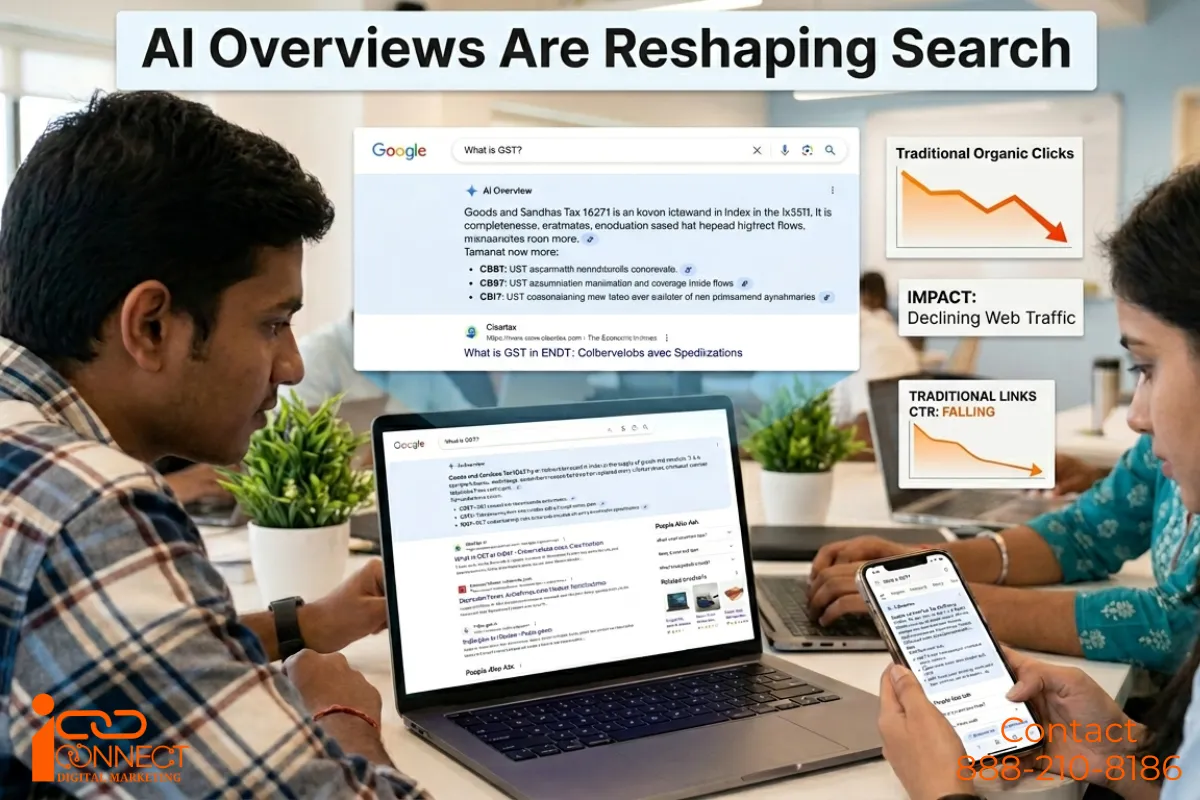
One of the biggest changes in recent years has been the expansion or the importance of AI-generated answers which directly come up first in search results. When users ask informational questions, search engines provide a summarized answer with all suggestions before displaying traditional organic listings. This changes the way people interact with search results.
For example, like any simple informational query asked by the user, at first AI Overview comes up and users get the answer without clicking through to a website.
For example:
- What is GST?
- What is SEO?
- How does SIP investment work?
- What is cloud computing?
These topics can often be summarized directly within search results. As a result, websites that previously relied heavily on basic informational traffic may see changes in click-through behavior. So, what does that actually mean in practice? If your pages were already showing up for those info-type searches like “what is GST” or “how to file ITR”, you might now find yourself going head to head with Google’s own AI-generated response, and it can feel kind of weird at first.
In our own content analysis during 2025–2026, informational queries such as “what is digital marketing” generated impressions but saw lower click-through rates once AI Overviews appeared for those searches.
The New Keyword Architecture: Think in Topics, Not Single Words
A more vital process change in keyword research happening today is moving from single keywords to topic clusters with intent layers. Instead of targeting one keyword, marketers should build content around a complete topic and its related search intents.
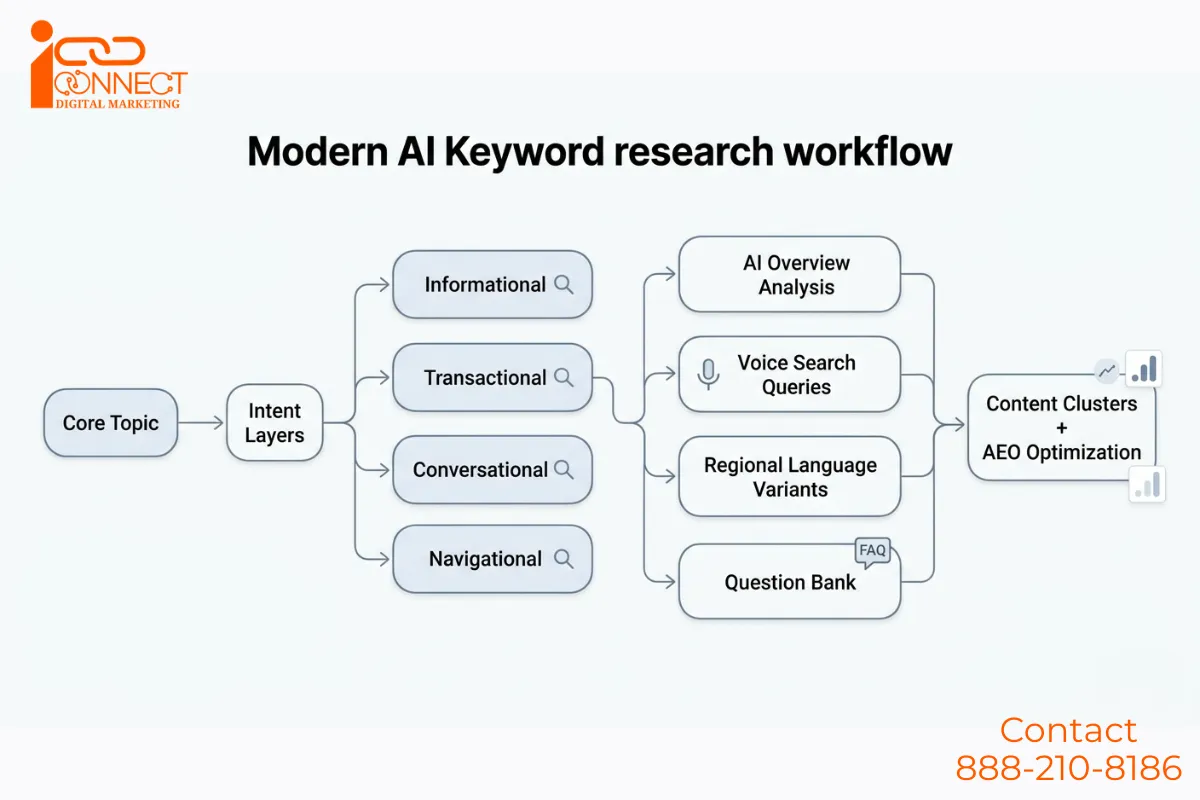
Let’s see how it works step by step:
Example Topic “Personal Finance for students in India”
Informational Searches
- How to save money as a student
- How compound interest works
- What is SIP for beginners
Commercial Searches
- Best mutual funds for beginners
- Best student savings account
- Best zero balance account for students
Conversational Searches
- How much should a college student save every month?
- Where can students invest money in India?
- How can I earn and save while studying?
Problem-Based Searches
- How to build financial discipline as a student
- How can students avoid unnecessary expenses?
- I am always short of money before month-end
This cluster approach allows content to address multiple user needs while building topical authority.
You May Also be Interested in |👉 What Every Beginner Must Learn Before Calling Themselves a Digital Marketer
Long-Tail Keywords Matter More Than Ever, AI Overviews Don’t Cover
Nearly 80% of keywords that trigger AI Overviews fall into the 0%–40% keyword difficulty range. This means easier, niche content faces the highest AI disruption risk. Therefore, your target should now focus more toward medium-to-high difficulty, specific, experience-based keywords that AI cannot easily summarize.
For India, this matters a lot. Like, someone in Pune could type – “SIP investment Marathi tips” while another person in Hyderabad is asking “mutual fund beginners Telugu”. Those hyper-local and bilingual long-tail searches. They are almost never properly addressed by AI Overviews, not really.
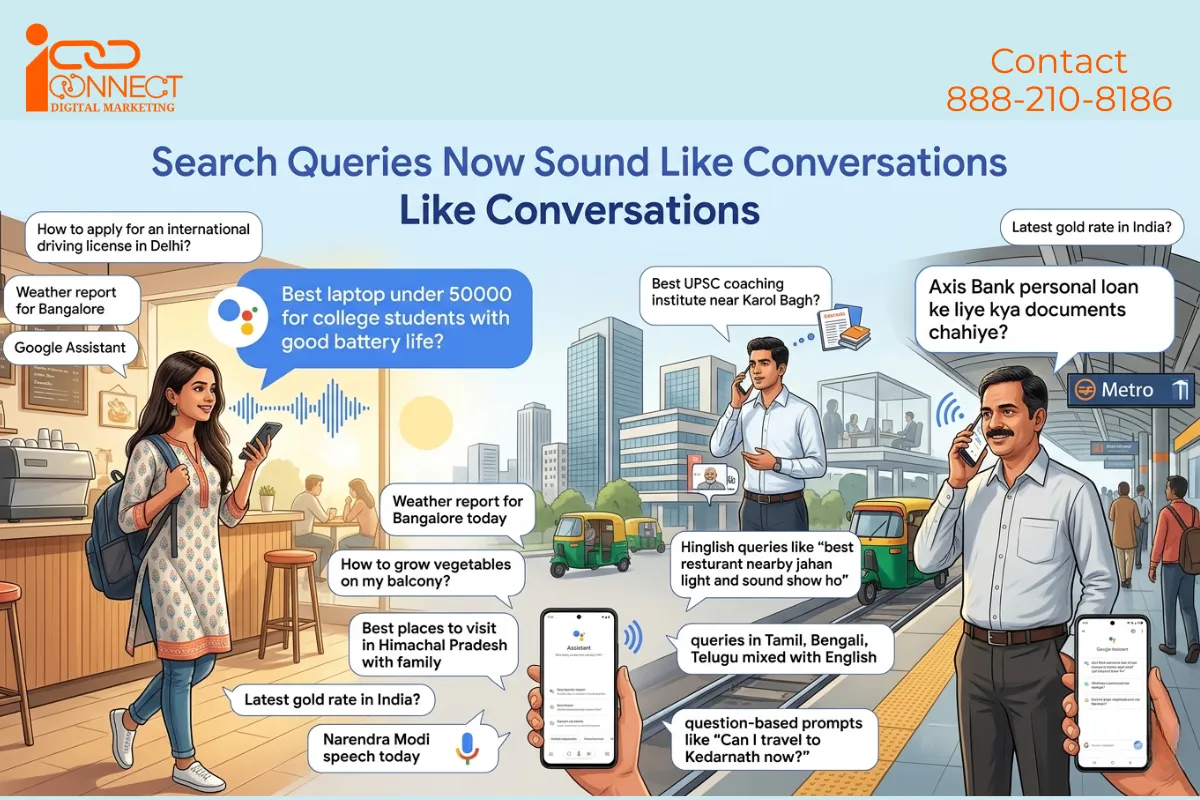
Why Voice Search Is Changing Keyword Research Formats in India
Voice search has introduced another shift in search behavior. India’s voice search usage grew 3× faster than text-based search, and this is directly reshaping what keywords actually look like. When someone uses Google Assistant on their Android phone (which is most Indians), they do not say “best coaching Pune UPSC.” They say “Which UPSC coaching institute in Pune is affordable and has good results?”
That conversational phrasing is your new keyword. Long-tail keywords perform 2.5× better for voice search optimization, and 70% of all search traffic comes from long-tail keywords — a number that will only grow as voice search expands in Tier 2 and Tier 3 Indian cities where typing in English is less comfortable than speaking. (Gracker.ai)
The practical implication: build a “Questions Bank” for your content. Whenever you write any piece of content, it should naturally answer at least three questions your audience would literally ask out loud in a conversation. Tools like AnswerThePublic, AlsoAsked, and Google’s People Also Ask section are kind of goldmines for this; you can pull real wording from there, and then you build your content around it.
Entity-Based SEO Is Becoming More Important
Most SEO guides tell you to “focus on intent” and “use long-tail keywords.” That is true but incomplete. Modern search engines do not simply analyze keywords. They also analyze entities.
An entity can be:
- A person
- A company
- A place
- A product
- A concept
For example, an article about keyword research may naturally include entities such as:
- Google Search
- RankBrain
- BERT
- Gemini
- Google Search Console
- Ahrefs
- Semrush
- Google Trends
These related entities help search engines understand the overall topic and improve contextual relevance. Instead of forcing keywords repeatedly, focus on covering related concepts comprehensively.
The Process Shift: How to Practical Research Keywords in the AI Era
Step 1: Start With Audience Questions
Always look for real questions from:
- Reddit communities
- Quora discussions
- YouTube comments
- Facebook groups
- Customer support conversations
These conversations reveal the language real people use.
Step 2: Build Topic Clusters
Choose a primary topic and map related questions, concerns, and search intents.
Step 3: Analyze Search Intent
Identify whether each query is:
- Informational
- Commercial
- Transactional
- Navigational
Step 4: Identify Content Gaps
Look for questions competitors are not answering effectively.
Step 5: Create Answer-Focused Content
Structure content so users can quickly find answers without reading unnecessary information.
Step 6: Continuously Update Content
AI-powered search evolves rapidly. Content should be reviewed and updated regularly to maintain relevance.
How AI Search Changes Keyword Research for Digital Marketing Students
Students entering digital marketing today need a different mindset than marketers had a decade ago. Previously, keyword research often focused on:
- Search volume
- Competition
- Keyword placement
Today, successful keyword research requires understanding:
- Search intent
- User psychology
- Content structure
- Question mapping
- Topic relationships
- Customer journeys
A keyword is no longer just a search phrase. It is a clue about what someone wants to achieve. Students who learn to interpret those clues will be better prepared for the future of SEO.
You May Also be Interested in |👉10 Digital Skills for Students That Can Make Them Employable in 2026
Frequently Asked Questions: How AI Search Is Changing Keyword Research
Well AI won’t take away keyword research, it has radically changed it. AI is really good at helping you to come up with topic ideas, uncovering search intent, finding long-tail conversational keywords, and structuring your topics into clusters. However that said, make sure to use actual search data, competitor research and business acumen to inform your final keyword decisions.
SEO Search Engine Optimization improves your website visibility on search engines so that people visit your website organically. AEO Answer Engine Optimization goes a bit further by optimizing the content so it delivers directly and accurately to the question that is being answered by voice search, answer engines and the AI search assistants. By 2026, it will likely be beneficial to incorporate SEO and AEO. Produce high-quality, authoritative, and helpful content that has the ability to perform well on search results and be read/cited by answer engines.
While the presence of AI Overviews does not directly alter Google’s page ranking of natural search results. But they can influence click-through rates because users may receive answers without visiting a website. The most reliable content-especially pieces that are structured logically and written by knowledgeable and reputable sources-are more often utilized for AI-generated content. In 2026, optimizing for a successful presence in organic results and for inclusion in AI Overviews can assist in maximizing your visibility and presence on search.
Yes, short tail keywords are still important in 2026 for establishing authority, especially, if the main aim is to focus on broader search intent. While short tail keywords can create visibility and traffic in 2026 they tend to have higher competition and might not convert well like their long tail keywords. In other words a mix of short tail and long tail queries should be utilized to establish topical authority and to ensure search engine visibility along with the traffic from specific intents.
Voice search is one of the ways that has shifted keyword research. In addition, the content needs to become conversational and intent driven. Instead of trying to stuff short, exact-match keywords into your content, businesses have needed to use natural speech patterns, pose questions within their content, and include longer-tail keyword phrases. Ensuring your content provides valuable and to-the-point answers to an identified question is a benefit across all avenues of search visibility-voice search, AI search and even standard Google searches in 2026.
Key Takeaways: How AI Search Is Changing Keyword Research
- AI search focuses more on meaning and intent rather than exact keywords.
- Topic clusters are more effective than targeting isolated keywords.
- The value of long-tail keywords Long-tail searches tell us what users want.
- Voice search is increasing the importance of conversational queries.
- Entity-based optimization helps search engines understand context.
- Your content needs to provide definitive and accurate answers to the queries made.
- Search success increasingly depends on usefulness rather than keyword repetition.
- The users’ goal to use a search engine and digital marketers whose success depends on interpreting the underlying intent of the users will benefit most from this transition in the way we optimize for search.
Conclusion
So to say, keyword research is not disappearing. It is evolving or changing. The biggest change is that keywords are no longer the final goal. They are starting points for understanding the queries of users who are searching on search engines.
Modern search engines are becoming better at interpreting language, context, and intent. As a result, successful marketers must think beyond search volume and focus on the questions, problems, and goals behind every query.
For 2026 digital marketing students and professionals, this shift creates an opportunity. Those who understand how people search, what they need, and how to provide helpful answers will be better positioned to succeed in an AI-driven search environment.
The future of keyword research belongs to marketers who understand conversations, not just keywords.

Mohit Vij is the Founder & Digital Marketing Trainer at iConnect Digital Marketing Training Hub & Agency (iConnectDM), based in Ghaziabad. With over 9+ years of experience in SEO, Google Ads, Meta Ads, Social Media Marketing, Search Intent, Content Marketing, and Lead Generation.
Over the past years, He has trained hundreds of students, job seekers, working professionals in building successful careers in digital marketing while helping businesses improve their search rankings, website traffic, brand visibility, and lead generation. His insights are based on hands-on industry experience, continuous learning, and proven digital marketing strategies that deliver measurable results.