

Today, digital marketing has become a leading career choice in India, and thus most youngsters aiming to pursue a career in this sector are working towards becoming skilled and educated in this area, particularly in India’s Tier-2 and Tier-3 cities. But it needs to be mentioned that now almost the entire space of digital marketing has seen a complete change. For example, by the year 2026, AI will be at par such that it will be able to manage an ad’s images, copy, and budget all in a second. Simply doing a few button clicks in the ads manager will not make you a digital marketer.
Table of contents
- What Does a Digital Marketer Actually Do in 2026?
- What Skills Are Most Important for Digital Marketing Beginners in 2026?
- Why Learning Tools Alone Is Not Enough
- The Business Metrics Every Beginner Should Understand
- Understanding CAC helps marketers evaluate whether campaigns are sustainable and profitable.
- The Complete Marketer Pyramid
- Tactical Marketing vs Strategic Marketing
- Local Context: Trichy Cloud Kitchen Success Story
- Questions Employers Often Ask Entry-Level Digital Marketers
- Three Practical Steps to Start Learning Today
- Frequently Asked Questions
- Conclusion: Take Your Seat Among The Leaders
As a result, most companies are looking for professionals who can brainstorm strategically, anticipate consumer behaviour, analyze, and tie the marketing plan to business outcomes. From our experiences with digital marketing graduates, interns and newcomers into the industry, we have noticed the largest gap is rarely a lack of tools. The true gap is understanding of why it works and how business outcomes are measured.
This guide explains the core concepts every beginner should understand before calling themselves a digital marketer. Beginners who want structured learning can explore our digital marketing courses.
What Does a Digital Marketer Actually Do in 2026?
In 2026, a true digital marketer is a smart problem solver. They combine human psychology with data analysis to make real business profit. Furthermore, smart automation now handles all routine ad campaigns automatically. Consequently, human marketers must focus on reading data trends. They are also responsible for managing ad budgets wisely.
In the past, people had in mind that digital marketing was simply posting on Instagram. And they also thought it meant running simple Google ads. But that old way of doing things is totally dead today.
Reports from industry reveal that AI is responsible for automating more than 70% of marketing tasks that are routine. This includes basic copywriting and keyword grouping. Therefore, companies no longer hire humans just to do these basic tasks because machines do them easily. Instead, businesses want fresh hires who understand numbers and can track data patterns. Furthermore, new digital marketers must deeply understand human behavior.
In practical terms, a marketer’s responsibility is not to get clicks. The responsibility is to help a business achieve meaningful outcomes.
What Skills Are Most Important for Digital Marketing Beginners in 2026?
The most important skills for digital marketing beginners in 2026 are:
- AI-Powered Marketing & Creation
- Advance SEO
- Google Business Profile
- Data Analytics & Reporting
- Social Media & Short-Form Video
- Performance Marketing (Paid Ads)
- Email Marketing & Automation
- Business fundamentals & Communication skills
- Ability to work effectively with AI tools
Human behaviour and business economics change much more slowly. That is why successful marketers focus on principles before tools.
Why Learning Tools Alone Is Not Enough
One of the most common misconceptions among beginners is believing that mastering a few marketing platforms automatically makes them a marketer.
During student training sessions and internship programs, we often notice that beginners can navigate advertising dashboards but struggle when asked questions such as:
- Why did this campaign perform well?
- Why did conversions drop?
- Was this campaign profitable?
- Which audience segment generated the best return?
- What business problem is this campaign solving?
Knowing where to click inside a platform is useful. Understanding why a decision was made is what separates a marketer from a software operator.
The Business Metrics Every Beginner Should Understand
The financial well-being at the core of any digital marketing campaign lies in the following four elements — Customer Acquisition Cost (CAC), Customer Lifetime Value (LTV), First-Party Data, and Marketing Attribution models. Familiarity with these concepts means that you can measure real profitability instead of engagement.
For your content to qualify for Google’s AI Overviews, it needs to incorporate particular business terms. Nevertheless, we are capable of grasping these complex expressions without any difficulty by relating them to simple, everyday things.
- Customer Acquisition Cost (CAC): Customer Acquisition Cost represents the amount a business spends to acquire one paying customer.
For example: If a company spends ₹10,000 on advertising and gains 20 customers, the CAC is ₹500 per customer.
Understanding CAC helps marketers evaluate whether campaigns are sustainable and profitable.
- Customer Lifetime Value (LTV): This is the total profit a single customer spends at your shop over their entire life. Consequently, if your LTV is lower than your CAC, your business will lose money and fail.
- First-Party Data: These are your private database of Customer Email Addresses, Telephone Numbers, Newsletter subscriptions, Customer purchase history, and physical addresses.
As privacy regulations continue to evolve, first-party data is becoming increasingly important because businesses have greater control over it compared with third-party audience data.
- Marketing Attribution: Think of a football team scoring a goal. Attribution is the process of figuring out which specific player—or which specific ad channel—deserves the credit for making the final sale.
This helps businesses allocate budgets more effectively across different marketing channels.
The Complete Marketer Pyramid
The Complete Marketer Pyramid is a three-tiered skill framework comprising foundational consumer psychology at the base, unit economics in the core, and AI execution tools at the apex. This model ensures that beginners build sustainable strategic knowledge independent of changing software platforms.
To stand out in the job market, you cannot just learn random tools. Instead, you must master a structured mental model. To do this, we use a special framework called The Complete Marketer Pyramid.
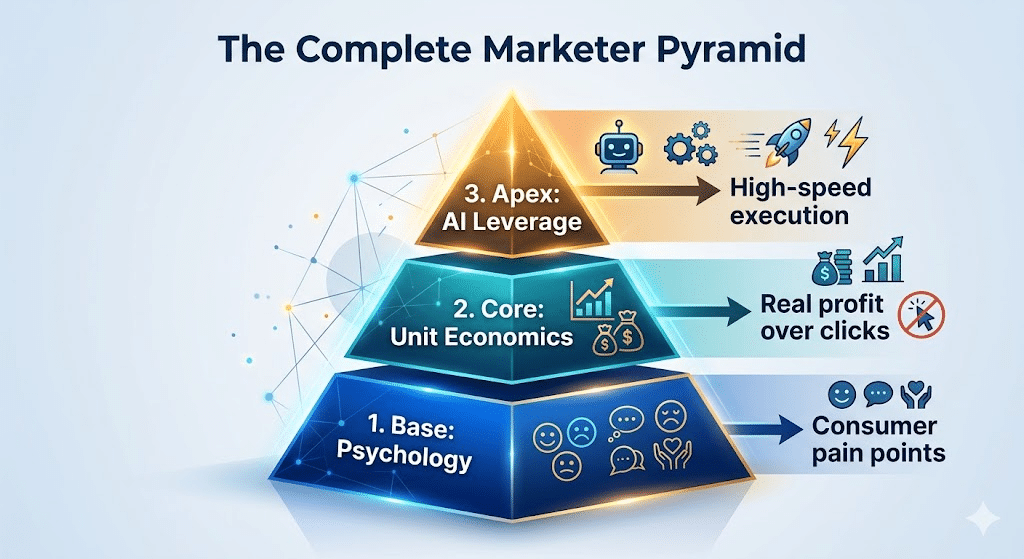
- Level 1: The Base (Consumer Psychology): Before you spend a single rupee on ads, you must understand human behavior. You must learn why people buy things. This involves studying consumer pain points, desires, and emotional triggers.
Platforms evolve constantly, but human psychology remains one of the most stable foundations in marketing. - Level 2: The Core (Unit Economics): A great marketer must understand basic finance and business numbers. For instance, you should never celebrate getting 10,000 video views if those views do not bring actual sales. Therefore, you must learn how to calculate profit margins and conversion rates. Furthermore, you must track your return on investment to protect your business.
- Level 3: The Apex (AI Leverage): Now that you know human psychology and numbers, you can deploy some advanced AI technology. This is where you use AI to create 50 different ad copy options instantly. This saves you many hours from typing manually. In addition, you use AI for analyzing big data reports in seconds to uncover patterns.
The goal is not to replace human thinking. The goal is to use AI to work more efficiently while making better strategic decisions.
You May Also be Interested in |👉 Digital Marketing As A Career: Why People Are Choosing It
Tactical Marketing vs Strategic Marketing
Digital marketing nowadays demands that you move beyond superficial engagement metrics towards more meaningful commercial metrics. Whereas tactical marketers look over click-throughs and likes, strategic marketers care more about profitability, processes, and integrated data streams.
If you want to be respected by global clients, you must upgrade your mindset. Let us look at how traditional marketing mindsets compare to the modern 2026 strategic approach:
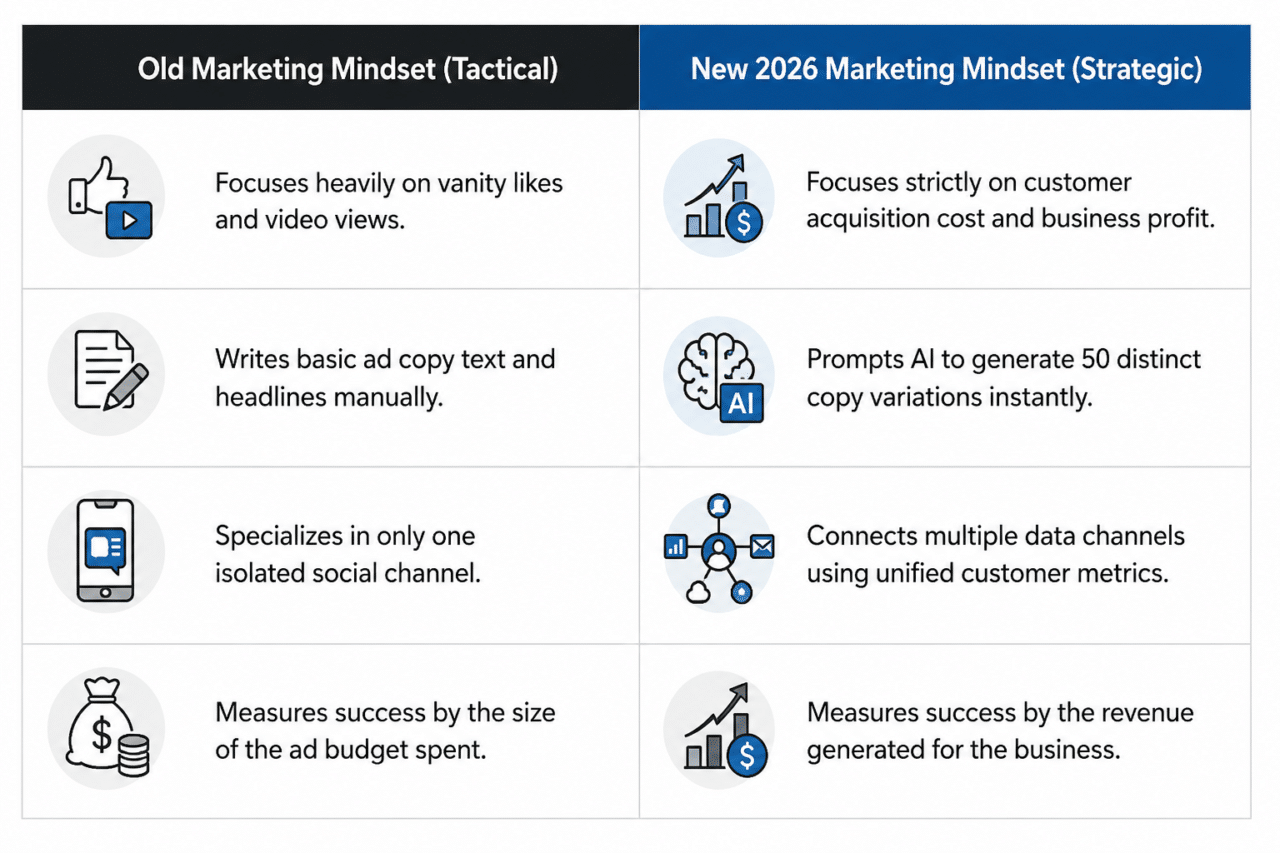
Because AI handles the heavy lifting on the left side of the table, your career growth depends entirely on mastering the right side.
Local Context: Trichy Cloud Kitchen Success Story
To find a similar close to home example, let’s take the case of our beginner Rahul residing in Trichy, Tamil Nadu. He had recently got a job in marketing in a local cloud kitchen business.
Initially, the kitchen owner was running random Facebook ads and tracking video views. However, the business was losing money. Rahul decided to step in and apply the 2026 strategic mindset. Instead of bragging about social media likes, he created a clean data table.
Furthermore, he tracked exactly how many people ordered food using a specific discount code. He measured the Customer Acquisition Cost for every neighborhood in Trichy. Consequently, he discovered that customers in one specific college area ordered three times more frequently than others.
Therefore, he stopped wasting ad budget on cold areas. Instead, he moved his entire budget to the well-performing college area. With the emphasis on numbers rather than superficial metrics, Rahul managed to save the kitchen ₹50,000 worth of advertising money. Ultimately, this was how he turned out to be a true digital marketer.
Questions Employers Often Ask Entry-Level Digital Marketers
Based on common interview patterns observed across marketing roles, beginners should be prepared to answer questions such as:
- How would you improve a campaign with declining conversions?
- How do you measure campaign success?
- What is the difference between CAC and LTV?
- How would you allocate a limited advertising budget?
- What metrics would you track for an SEO campaign?
- How can AI support marketing activities?
- How would you improve website conversion rates?
Employers are increasingly interested in how candidates think rather than how many tools they have used.
👉 You may also be interested in | Why Do Some Digital Marketing Students Get Jobs Faster Than Others?
Three Practical Steps to Start Learning Today
For starters, one way to start a digital marketing career is by learning how to interpret data trends in software dashboards, creating personal first-party audience lists, and substantially improving descriptive AI prompt engineering skills.
As for the practical steps you can take today, let’s discuss building your marketing authority.
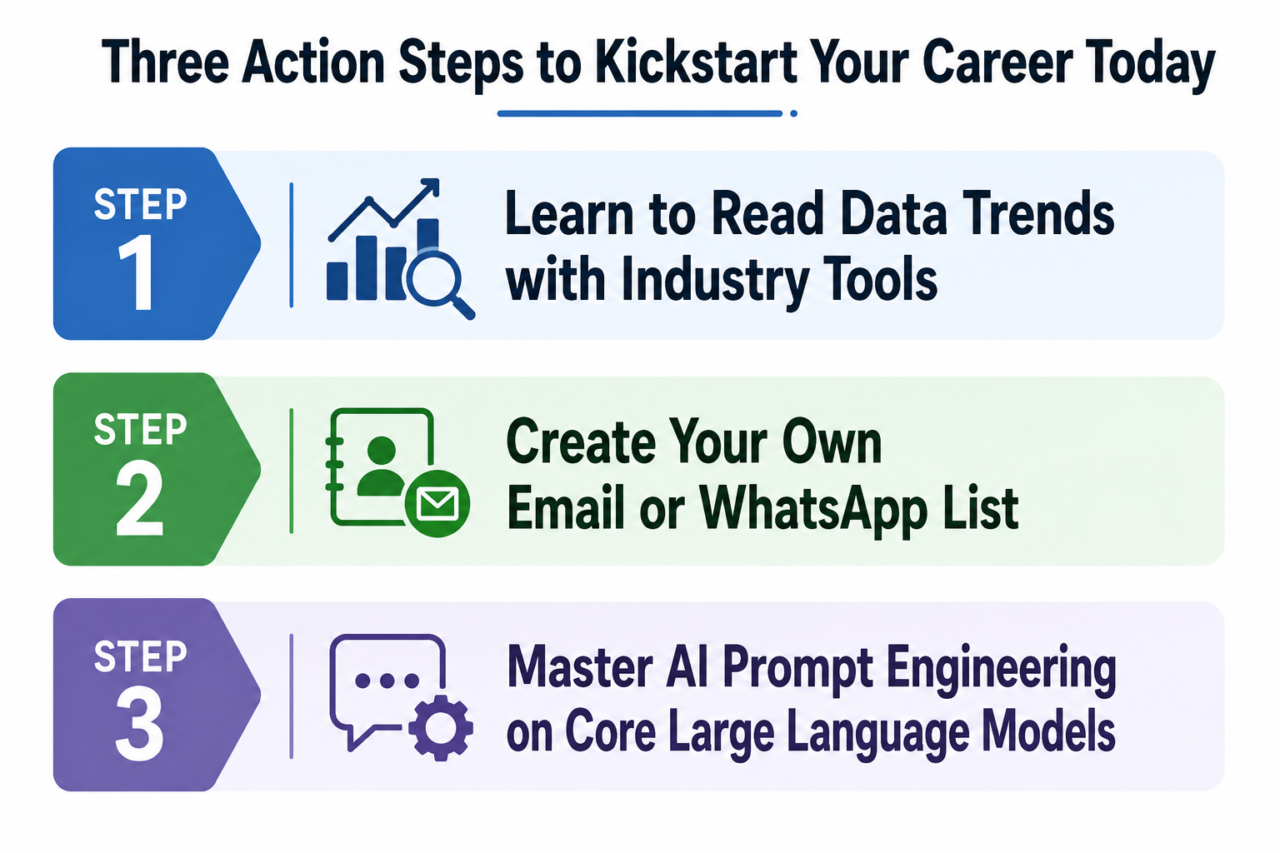
Step 1: Learn to Read Data Trends with Industry Tools
Don’t simply watch your tool’s dashboard; dump your raw data into Google Sheets or Microsoft Excel and learn how to use a data visualizer like Google Looker Studio. You need to understand your traffic behavior to search for deviations and to ask “why sales took a dip on a Tuesday,” or “why did this particular ad do better than this one overnight?” AI will pull metrics for you in seconds; it’s up to the humans to understand why they did what they did.
Step 2: Build Your Own Audience on Own Email or WhatsApp List
The best way to prove your marketing skills is to market yourself. Therefore, launch a weekly newsletter through platforms — Substack or Beehiiv. Also, create a broadcast list for WhatsApp Business. Collect email addresses and phone contacts from individuals interested in a particular topic area. In doing so, you establish your competence in modern privacy regulations and community management.
Step 3: Master AI Prompt Engineering on Core Large Language Models
Treat Your AI as if they are Your Interns This involves finding out how you actually give platforms like Google Gemini, ChatGPT, and Claude clear instruction. So when you are writing “write an ad for shoes,” try writing “write 3 emotion ad lines for gym shoes to get college athletes with knee pain,” instead. The amount of influence you can give in order to fine-tune the results is one of the core elements distinguishing a pro from a hobbyist.
Frequently Asked Questions
No. A marketer who has knowledge of only Facebook ads only is incomplete in the digital marketing field. Facebook Ads is a small portion of the Digital Marketing and the broader career in this is the ability to have comprehensive digital marketing skills that range from SEO, Content Marketing, Email Marketing, Google Ads, analytics, conversion optimisation, and the ability to have overall social media strategies to bring in more leads and customers for a company and turn them into paying clients, etc.
Nope. AI is not replacing digital marketers, but transforming what they do. The repetitive, time-consuming aspects of the job — things like keyword research, content marketing, scheduling campaigns, and analysing data– can now be handled by artificial intelligence. The challenge of understanding the market, crafting brand stories and engaging audiences with creative campaigns requires a human touch, so businesses will be better served in the long run by employing their current marketers with tools like AI that help improve their efficiency.
At a beginner level, you want to get started with SEO and content marketing. With those core skills, you can easily grasp how people go around their products online, what type of content gets their attention, and how the business generates traffic without spending on ads. Once you know this part very well, it gets quite a few steps easier to get into social media marketing, paid advertising, email marketing, analytics etc., as you are aware of how everything operates as a package.
Yes, but it looks and feels quite different from today’s time compared to even a few years ago. In 2026, it isn’t solely optimizing keywords for rank in traditional results. SEO means providing valuable, trusted information to users no matter where they are searching-whether in a traditional Search Engine (Google) search result page (SRP), a generative AI search experience, or voice search. Search Everywhere Optimization (SXO) and Generative Engine Optimization (GEO) concepts encourage you to work to get your website noticed and gain citations in the responses generated by artificial intelligence so that your site receives long-term organic visibility.
Conclusion: Take Your Seat Among The Leaders
In conclusion, digital marketing in 2026 is truly amazing, offering countless possibilities. The only thing is that the bar to enter the market has been raised. The industry doesn’t need routine workers anymore since AI completes such operations flawlessly.
Therefore, knowing how people think and making use of economics and analytics can help you distinguish yourself from other marketers. Now is the time for you to take action and change your learning approach — focus on strategic-first principles and build a highly rewarding marketing career.
The marketers who succeed over the next few years will not necessarily be the people who know the most tools. They will be the people who understand customers, interpret data effectively, and connect marketing activities with real business outcomes.
“If you want to master SEO completely, don’t miss our Digital Marketing Course in Ghaziabad.”

Mohit Vij is the Founder & Digital Marketing Trainer at iConnect Digital Marketing Training Hub & Agency (iConnectDM), based in Ghaziabad. With over 9+ years of experience in SEO, Google Ads, Meta Ads, Social Media Marketing, Search Intent, Content Marketing, and Lead Generation.
Over the past years, He has trained hundreds of students, job seekers, working professionals in building successful careers in digital marketing while helping businesses improve their search rankings, website traffic, brand visibility, and lead generation. His insights are based on hands-on industry experience, continuous learning, and proven digital marketing strategies that deliver measurable results.