

Every year, thousands of students complete digital marketing courses and start applying for paid or unpaid internships and after completing internships with high hopes. They start looking for employment opportunities as full-time job roles. While, some students manage to successfully pass the interview process and obtain job offers within two weeks. While others continue applying for months without seeing the same results.
Table of contents
The difference is not always education level, course duration, or the number of certificates earned by the students. In many cases, employers pay closer attention to practical experience, problem-solving ability, communication skills, and evidence of working on live projects they have done during their course or internship.
Over the years, one common pattern has become visible across digital marketing agencies, startups, and in-house marketing teams. Students who can demonstrate how they have applied their knowledge often stand out faster than students who can only explain concepts theoretically.
So, let’s see in detail with the help of this article which explores the practical factors that often influence hiring decisions and explains why do some digital marketing students get jobs faster than others.
👉 You may also be interested in | How to Choose the Best Digital Marketing Institute in Ghaziabad
Are Digital Marketing Certificates Enough to Get a Job?
These certificates can prove that an individual is engaged in learning and working hard toward gaining new skill sets. But it’s common for many employers to base the hiring decision upon a broader understanding of the applicant’s expertise, which comes from interviews, not simply a set of certificates. Employers typically consider whether an applicant has relevant experience via a portfolio, internships, actual projects, relevant job experience, communicative capacity, and analytical thinking skills, etc., before hiring an individual.
What Do Employers Usually Look for in Entry-Level Digital Marketing Candidates?
Job descriptions for digital marketers frequently seek candidates with practical knowledge of Search Engine Optimization (SEO), paid advertising, content creation and marketing, google analytics & search console reporting and a strong understanding of digital marketing tools. It usually benefits employers more when candidates illustrate how each of their marketing efforts leads towards overall business objectives rather than a dictionary definition. Also, how digital marketing initiatives can help support business outcomes.
Top Reasons why do some digital marketing students get jobs faster
Students who gain practical training experience, develop portfolios, complete proper internships, and develop their job-ready skills are often hired faster than students who rely only on theoretical learning. Employers generally want evidence that a candidate can apply marketing concepts to real business situations.
After observing how students approach learning and job searching, a common pattern has now appeared in the field of digital marketing. Students who begin practicing their skills while learning frequently, they progress faster than those who wait until their full course is completed before working on real projects.
Nowadays, employers are usually trying to reduce their hiring risk. Well, it becomes quite easier for them when a candidate can show a project where they build a website on their own, an SEO project they have worked on and good ranking on SERP, a campaign they created and got results out of it, the report they created for that same campaign, or a portfolio containing real examples, more easier it becomes easier for employers to understand the candidate’s capabilities.
This is why hiring decisions are often influenced by practical proof of work rather than certificates alone. Some students get jobs faster because they start practicing while they are still learning. They create projects, develop portfolios, participate in internships, and build skills that employers actively look for.
Most of the time, it is not about grades, diplomas, or the number of certificates earned. It is about demonstrating skills through actual work. Students who can show a website, campaign report, portfolio, case study, or project often stand out during interviews.
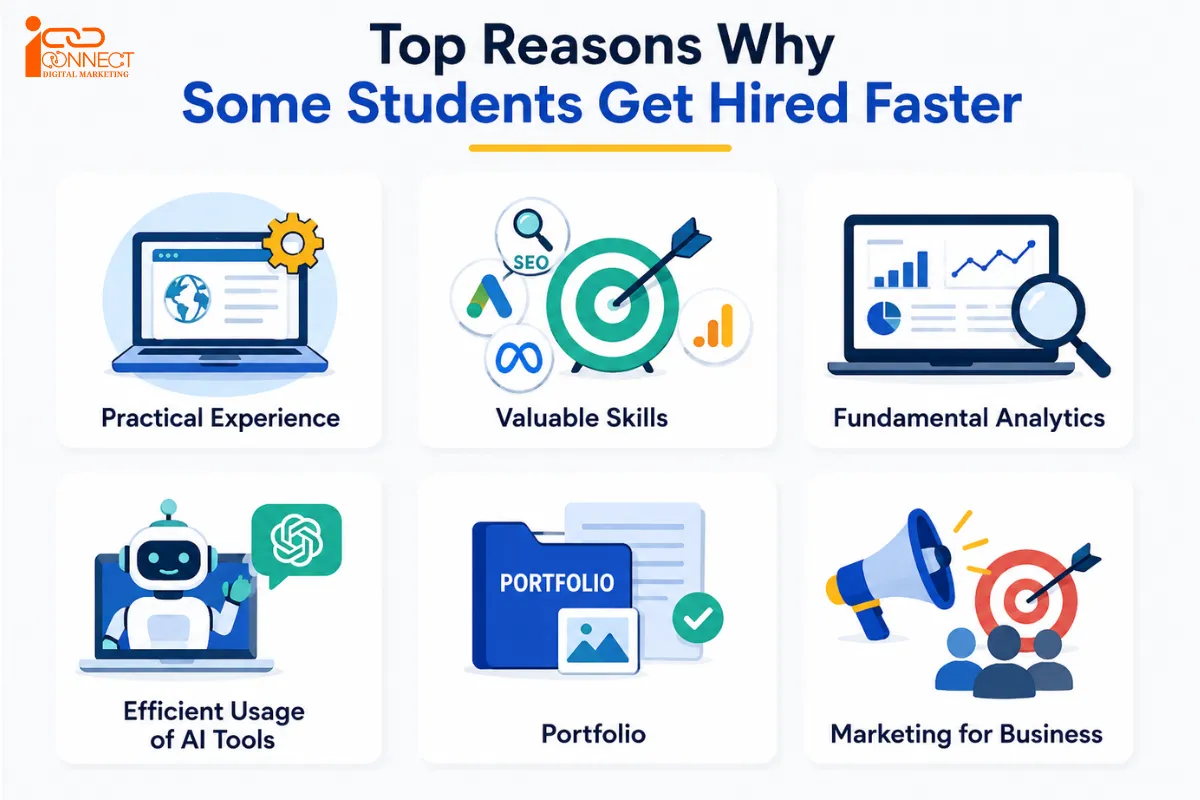
And here is why students get hired in less time as compared to others:
- Practical Experience: Already worked on different kinds of projects, including websites, SEO, content, or advertising campaigns, instead of just focusing on the theory part.
- Valuable Skills: Focus is on building skills that are really needed in the market. They are well-versed in — SEO, Google Ads, Meta Ads, GA4, or Performance Marketing while simultaneously implementing them in problem-solving.
- Fundamental Analytics: Gain understanding about measuring website traffic, user behavior, and campaign performance.
- Efficient Usage of AI Tools: Use trending AI-based tools such as ChatGPT to improve efficiency, perform research, and speed up task completion.
- Portfolio: Have concrete things to present besides resume and certificates.
- Marketing for Business: They know how marketing works in order to bring new customers and sell products or services.
All of this makes employers view them as ready-to-work candidates.
Core Differentiators in Hiring Speed
Sometimes, the difference between getting hired immediately and searching for months is just a few crucial things.
| Feature | Students Who Often Take Longer to Get Hired | Students Who Often Get Hired Faster |
| Proof of Work | List certificates and course names. | Show live projects and real results. |
| Skill Focus | Learn everything broadly. | Master one or two valuable skills deeply. |
| Communication | Memorize definitions. | Explain business impact and outcomes. |
| Job Search | Apply randomly everywhere. | Use precise, targeted outreach and networking. |
| Experience | Mostly theoretical learning. | Internship and practical exposure. |
1. Live Websites vs. Plain Resumes
Building a real portfolio is a quick way of getting a job. This is something that most owners of digital marketing agencies observe every month. They get hundreds of applications for various job vacancies. Every single one of them has course certifications listed in their resumes, yet very few have an actual project to showcase.
Imagine two students finishing the same marketing course:
- Student A: Only has paper certificates from their institute.
- Student B: Creates a simple website, ranks it on Google using SEO techniques, and records the results.
Employers would most likely contact the second student to take him/her to the interview, as there is obvious evidence of work.
In many hiring situations, a simple project can create a stronger impression than multiple certificates. A blog, local SEO project, social media campaign, website audit, or content portfolio can help candidates demonstrate initiative and practical understanding during interviews.
That’s why successful students don’t limit themselves to attending classes. They create projects on their own, offer free services to local small businesses, or participate in internships to gain some experience. Your portfolio doesn’t have to be complex. It can even be a blog, social media campaign, or creation of a Google map entry for a local business.
You may also be interested in: 👉 How to Find and Get SEO Clients: Strategies for Students and Freelancers
2. Deep Specialization vs. Generalization
The field of digital marketing is huge. It includes such practices as SEO, paid advertising, Google my business, creating content and marketing, social media management, analytics reporting, automated email campaigns, website development, and website sales.
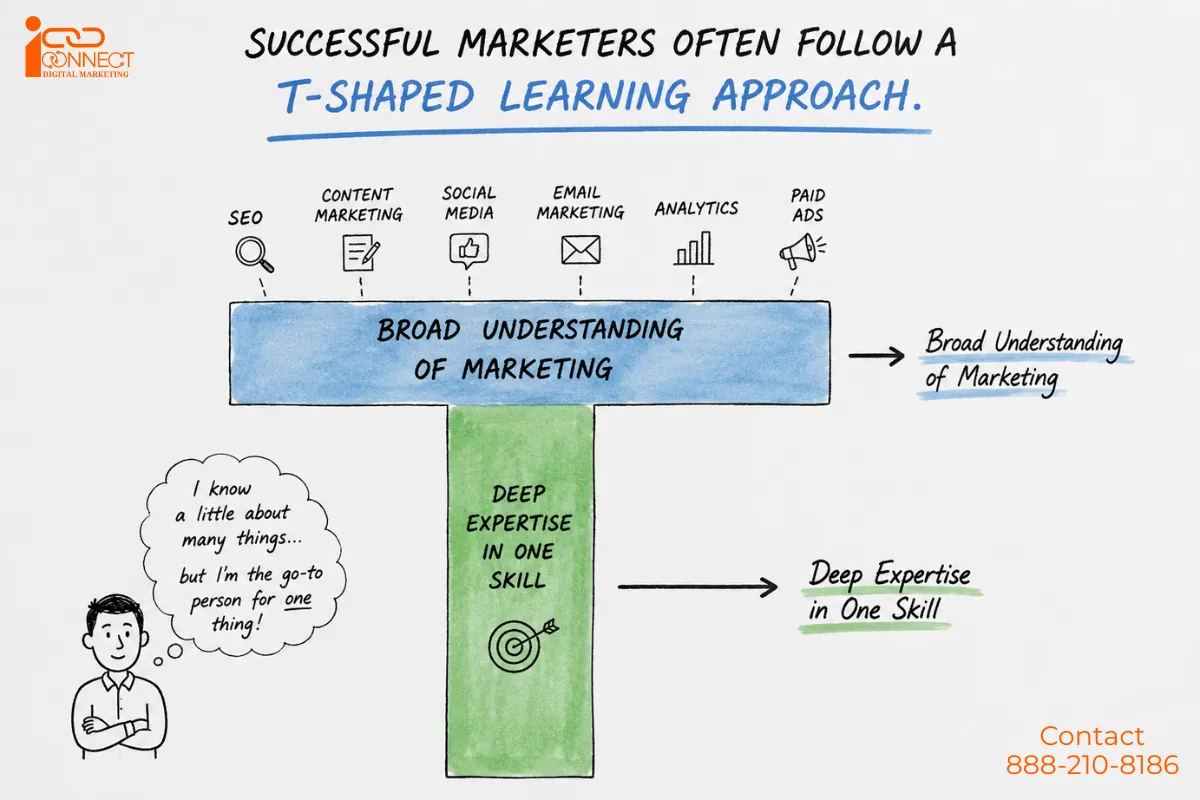
As the field is so extensive, it would be difficult for a newbie to master every practice properly from the very beginning. Many hiring managers prefer candidates who understand the fundamentals of digital marketing while also demonstrating deeper expertise in one specific area. This approach is commonly referred to as T-shaped learning. It means that you become familiar with the fundamentals of all marketing practices, but choose only one to specialize in.
A good example could be someone with a working knowledge of SEO, content marketing, social media marketing, analytics, and paid media, but someone with a stronger skill level for SEO and Google Ads would stand a much greater chance as the role the employer is filling will generally come across more clearly in that role.
Successful marketers often follow a T-shaped learning approach. This means understanding multiple marketing channels while developing strong expertise in one specific area. As a result, employers can clearly identify the value you bring to their team.
Digital Marketing Skills That Employers Frequently Look For
Despite many changes happening in the digital marketing field, there are certain skills that remain highly sought-after irrespective of which marketing company, startup, or large corporation a person joins in India. Anyone who is proficient in even one or two of these skills gets recruited way faster as compared to others.
High-Demand Skills Include:
- SEO: You learn how to bring free customers to a website when they search on Google.
- GA4 (Google Analytics 4): This is about checking website traffic reports to see exactly where your online sales are coming from.
- Performance Marketing: You will gain knowledge of managing campaigns of paid advertisements on platforms like — Facebook, Instagram, and Google.
- Content Marketing: You learn about — writing blogs, social media posts, and even videos that bring in new buyers.
- CRO (Conversion Rate Optimization): Involves modifying website colors, buttons, or text that will help in converting casual visitors into paying customers.
- Marketing Automation & Email Marketing: Creating automatic welcome messages or notifications about discounts in order to save company time.
- AI-Assisted Marketing: Making use of advanced technology like ChatGPT or Midjourney as personal assistants who will carry out marketing jobs three times faster.
It’s never wise to try to learn everything at once, but to start by specializing in one particular technical skill. Once you get your first job, you can gradually develop your skills.
You may also be interested in: 👉 How ChatGPT and AI Tools Are Transforming Digital Marketing in 2026
3. Speaking the Language of Business Profit
Many candidates make a big mistake during interviews. They only talk about social media “likes”, video views, and follower counts. While these things look good on screen, Indian business owners cannot pay their rent or salaries with likes. Ultimately, every business cares about real sales, customer leads, and profit growth.
Therefore, companies always prefer hiring candidates who understand business numbers.
Important Marketing Numbers to Learn:
- Cost per Acquiring Customer (CAC): Denotes the exact cost involved in acquiring a new paying customer.
- Return on Advertising Spend (ROAS): Refers to the amount of profit generated by the firm for every single rupee spent on online marketing.
- Conversion Rate (CR): Refers to the exact percentage of website visitors who end up making a purchase or filling up an online form.
- Cost Per Lead (CPL): This is the actual cost of getting one interested customer’s contact information.
- Customer Lifetime Value (CLV): This is the precise value of a customer over his or her entire lifetime.
For example:
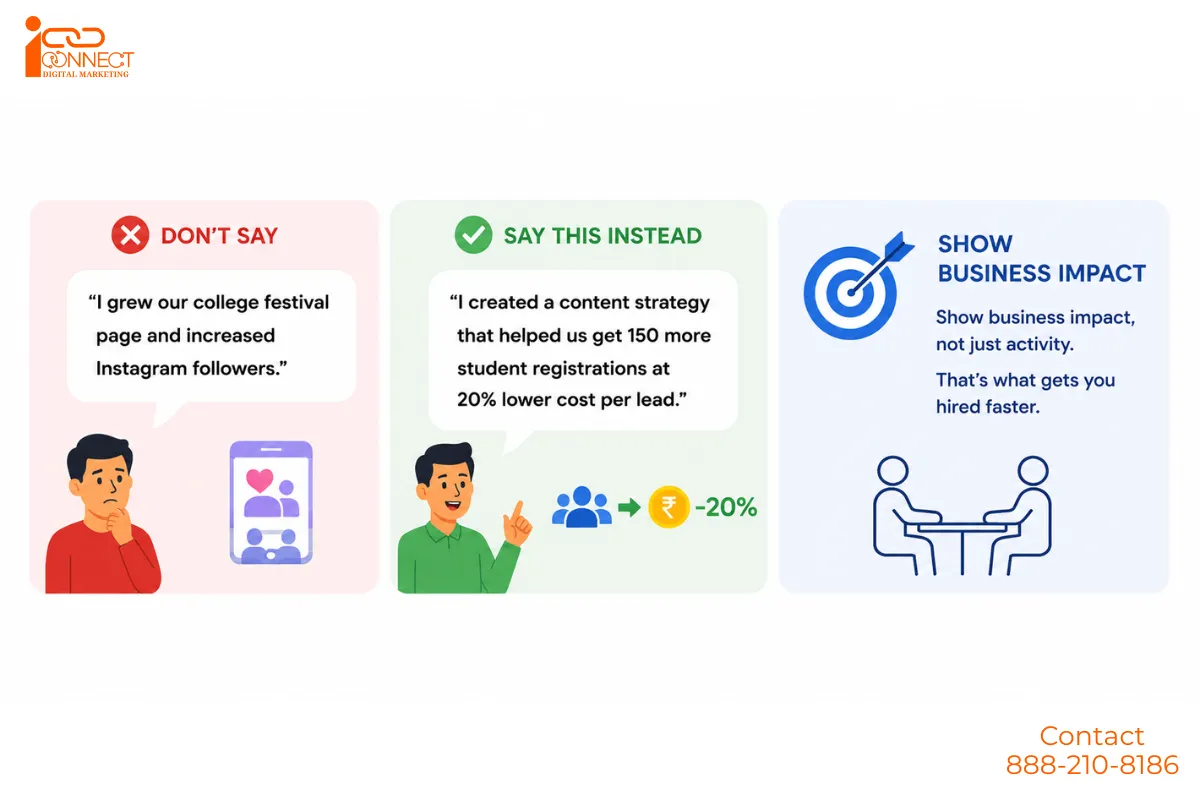
That’s all. This small change will demonstrate your business understanding to the interviewer rather than how you use the app.
Important Marketing Metrics to Understand
Customer Acquisition Cost (CAC)
The cost required to acquire a new paying customer.
Return on Ad Spend (ROAS)
The revenue generated for every rupee spent on advertising.
Conversion Rate (CR)
The percentage of website visitors who complete a desired action, such as making a purchase or submitting an enquiry form.
Cost Per Lead (CPL)
The amount spent to generate a qualified lead.
Customer Lifetime Value (CLV)
The total value a customer generates over the duration of their relationship with a business.
For example, instead of saying:
“I ran a Facebook campaign that received 20,000 impressions.”
A stronger explanation might be:
“The campaign generated 45 enquiries at an average cost per lead of ₹180.”
This small shift demonstrates business understanding rather than simply platform knowledge.
4. Proactive Sourcing and Smart Job Hunting
The way students search for jobs also affects hiring speed. Many candidates submit hundreds of applications through job portals and wait for responses. Unfortunately, this strategy often creates heavy competition.
Fast-hired students take a different approach.
- First, they identify companies they want to work with.
- Second, they research those businesses.
- Third, they share ideas, audits, or suggestions that demonstrate their skills.
For example, a student might look at a firm’s website and analyze its SEO performance, site speed, call-to-action, or even the missing content. Such an exchange of ideas in professional terms will be beneficial in getting noticed by employers.
Such a proactive mindset often creates opportunities that are never publicly advertised.
5. Using AI Tools as a Multiplier Effect
AI is revolutionizing digital marketing. Processes that once took too many hours to complete can now be done in much less time comparatively using AI tools. But the employers are not looking for someone who knows how to use AI. They are looking for marketers who have the skills of using AI along with strategy.
For example, AI can help
- Generate content ideas
- Analyze customer feedback
- Create reports
- Research keywords
- Improve overall productivity
However, employers are generally not looking for candidates who simply know how to use AI tools. They are looking for marketers who understand how to combine AI-assisted workflows with strategic thinking, creativity, critical analysis, and business objectives.
AI can support productivity, but marketers still need to evaluate information, make decisions, understand audiences, and create effective strategies. Students who learn how to use AI responsibly while developing strong marketing fundamentals often gain a competitive advantage in the job market.
Why Internships Make a Big Difference
Many students complete digital marketing training but never work on real campaigns. As a result, they have difficulties answering practical questions during interviews by their potential employers.
An internship helps in filling this gap. Students will understand how campaigns are organized, how reports are written, how to deal with clients’ requirements, and how marketing issues are handled in practice. Students will be much more prepared and confident because of that.
Even a short digital marketing internship can provide valuable practical experience and examples that students can discuss during interviews.
More importantly, internships often help students understand the difference between learning a concept and applying it in a real business environment.
Continuous Learning Separates Fast-Growing Marketers
The field of digital marketing changes fast. New tools, platform developments, and algorithm updates keep appearing all year long. So, those who continue educating themselves usually outshine other people in the market.
Those students who read about the latest industry trends, try out different tools, and implement innovative approaches show good adaptability. It not only helps to improve their competencies but also shows that they are curious and proactive.
Educating oneself is not only something one should do while studying. On the contrary, many effective marketers make it their lifelong habit.
Employers often value candidates who demonstrate curiosity, adaptability, and a willingness to keep developing their skills.
What We Have Observed While Working With Students
Every individual’s learning process is unique but when looking at the trajectory of learners in preparing for careers in digital marketing a common trend appears. Those learners who start “applying” what they’ve learned – through projects, internships, website creation experiments, producing content, analysis of marketing campaigns, marketing of local businesses-begin to find higher levels of comfort in interviews.
Practical exposure gives students real examples to discuss when employers ask questions about challenges, decisions, campaign performance, problem-solving, or learning outcomes. As a result, these students are often better prepared to explain their thinking process and demonstrate how they approach marketing tasks in real situations.
This does not mean students need large budgets or commercial clients to gain experience. Even small personal projects can help build practical understanding and confidence.
Frequently Asked Questions
A. Digital marketing certificates can be useful to prove you know marketing concepts, but most of the time, they are not the best way to get a job by themselves. Your potential employer wants you to have real client project work done or at least an internship or personal portfolio to show your skills. So in most situations, you may want to have certificates in combination with real-world experience. For instance, you might be able to demonstrate relevant experience by taking iConnectDM, among other digital marketing training programs with hands-on practice for real projects.
Top In-Demand Digital Marketing Job Skills: what a marketer actually needs to work in digital marketing, knowing skills like search engine optimization (SEO), content marketing, social media management, digital advertising, email marketing, WhatsApp marketing and broadcasting, e-commerce marketing, data analysis and marketing strategy are important. Some other important skills valued by employers include excellent communication skills, creativity, problem-solving ability and the ability to think logically.
Yes, an internship increases your possibilities to find a job as a digital marketer. Once you fully complete your digital marketing internship, you get practical experience working with live client projects, advertising tools, and moreover, how to report to the client for their projects and share the performance report. Many students use this chance to establish real-time abilities, obtain a better understanding of their interests, and build networks in the market that can aid them in obtaining their first job. Many organizations such as iConnectDM, make use of trainees to train them and also provide practical exposure with tasks.
A. Students can develop a digital marketing portfolio by working on practical projects during internship or even pursuing their digital marketing course. Students can also take freelance projects for businesses and companies and work as freelancers for their digital campaigns. The digital portfolio can include SEO audits, social media content and campaigns, paid advertising, website development and redesign, blog & article content, and analytics reports, among other types of work. When including work in your portfolio, don’t be afraid to highlight the measurable results of your projects as well as your thought process behind each campaign.
Many employers look for candidates with real-world experience in digital marketing because the field is highly applied. Your real experience confirms you’ve done it before; that you can run campaigns, make business-impacting decisions using data, solve problems in this environment and that you are familiar with all the required digital marketing tools. Practical experience also lets the employer verify that a candidate is going to bring business value right away.
Conclusion
In conclusion, the biggest mistake students make is their expectation of finishing the course first before gaining any experience. But the quickest way to get hired is to practice while learning. Create some simple projects, do some testing, and get real-life experience. As a result, during the interview, one can provide live links instead of making only claims in his paper resume.
The job market at the moment is very competitive; a certificate might help, but it is no longer sufficient. The companies need people capable of solving real problems and increasing business revenue. So if you want to quickly find yourself a job, start your practice on a real website or a local small store right away.
For students entering the field, one of the most effective approaches is to learn and practice at the same time. Even small projects completed during the learning process can help build confidence, improve interview performance, and demonstrate value to future employers.
📍 Location: Ghaziabad, Uttar Pradesh
📞 Phone: +91 8882108186
🌐 Website: https://iconnectdm.com
👉 View our Google Business Profile

Mohit Vij is the Founder & Digital Marketing Trainer at iConnect Digital Marketing Training Hub & Agency (iConnectDM), based in Ghaziabad. With over 9+ years of experience in SEO, Google Ads, Meta Ads, Social Media Marketing, Search Intent, Content Marketing, and Lead Generation.
Over the past years, He has trained hundreds of students, job seekers, working professionals in building successful careers in digital marketing while helping businesses improve their search rankings, website traffic, brand visibility, and lead generation. His insights are based on hands-on industry experience, continuous learning, and proven digital marketing strategies that deliver measurable results.