

Search Engines scan millions of web pages every day. However, users decide whether to click or not on your page title within seconds. SEO titles and Meta descriptions are HTML elements that show up in search engine results pages to tell people and search engines what a web page is all about.
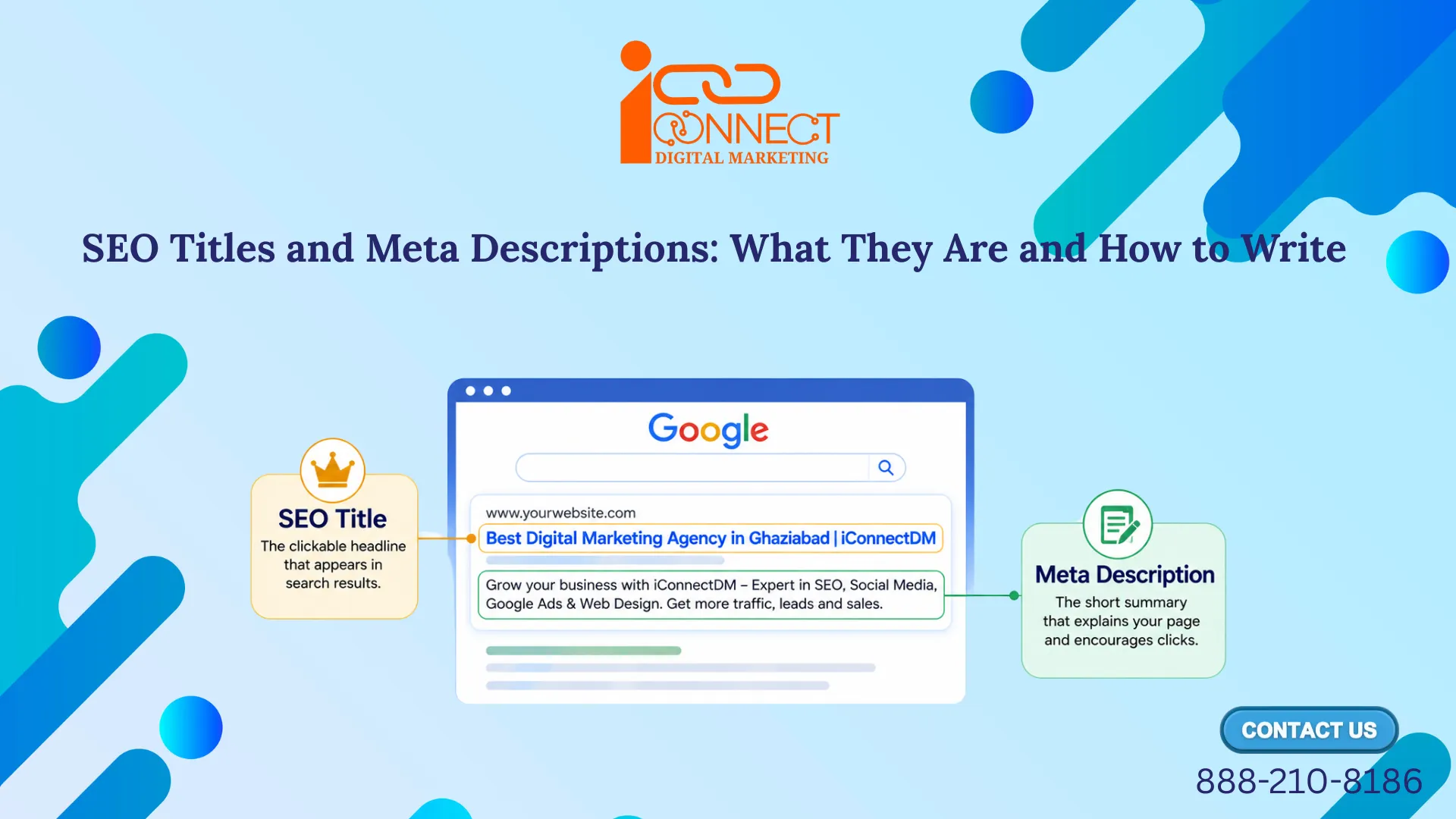
Your SEO title and meta description often create that first impression. The big blue clickable headline that you see is the SEO Title and the short gray text summary below it is the meta description. When they clearly explain your content and match user intent, they increase click-through rates and attract the right audience. Together, they help people quickly decide whether your page is worth clicking.
Table of contents
For any student who is looking to make a career within SEO and digital marketing, need to know how these two HTML elements work. Google also emphasizes user-first or helpful content. Instead, the content should target users and not just search engines. So learning to make proper HTML title and description tags must be among your core digital marketing skill set.
Most of you must have searched on Google before, and you’ve already observed this format many times. Every search result usually has:
- A big blue clickable headline → the SEO title
- A short gray text summary → the meta description
- The website address → the page URL
What is an SEO Title?
An SEO title (which is also called a title tag) is the clickable title that search engines like Google display in search results and that appears in your browser tab. It is meant for both the search engines and the users to get an understanding of what the page contains. For instance, if you have a page on digital marketing:
Weak: Learn Everything About Digital Marketing Today — sounds important but doesn’t clearly explain what the page covers.
Better: What Is SEO? A Beginner’s Guide to Search Engine Optimization — clearly tells users what the page is about and is more likely to earn clicks.
You may also be interested in: 👉 What is SEO? Why It’s So Important
What is a Meta Description?
A meta description is a short gray HTML text summary that appears beneath the SEO title in search engine results. It helps users decide to click and gives a preview of the page’s content and encourages them to click. Meta descriptions provides a brief summary of your page. It’s one of the most important meta fields and is not a direct Google ranking factor. Although Google sometimes rewrites descriptions, writing your own gives Google useful information about your page.
Let’s see the example of a bookstore: the cover attracts you first. The short description on the back tells you what the book is about. A meta description works just like that.
Weak: Learn all about digital marketing here. Click to find out more—vague and doesn’t explain what users will learn.
Better: Learn the basics of digital marketing, including SEO, content marketing, social media, and email marketing, with this easy-to-follow beginner’s guide. — clearly explains what users will learn and encourages clicks.
A strong meta description should be clear, concise, relevant to the page, and around 150–160 characters long.
Why Do SEO Titles Matter?
SEO titles are important because they are the first thing users see in search engine results. People read it and set clear expectations and a clear, relevant title helps search engines understand what your page is about and encourages users to click on it. A meta description matters because it gives users a quick summary of your page before they click.
Here are the main reasons they matter:
- Improve click-through rate (CTR)
- Help search engines understand your page
- Boost your page’s visibility
- Supports visibility across traditional search and AI-powered search experiences
- Matches search intent
A Quick Way to Think About Both Together
Your title gets someone to notice you in a crowded results page. Your description gets them to trust you enough to actually click. One without the other isn’t as effective — a great title with a weak description makes people hesitate, and a great description under a vague title never gets seen in the first place. So write them as a pair, not two separate tasks. Read over everything you wrote before. This is to make sure a complete stranger would understand what this page was about within 5 seconds of reading.
How to Write a Good SEO Title
A good SEO title should be between 40-60 characters in length (or about 580–600 pixels wide) search engines do not cut them off and include your main keyword placed near the beginning of the title. While including keywords at the beginning enhances clarity and readability it should look natural and not sound like the usual search engine keyword stuffing garbage people expect. Use power words and search phrases like ‘The Best’, ‘A Guide to’, or [the current year 2026] for increased clicks.
Better: SEO Tips for Beginners: 10 Easy Ways to Improve Rankings
The main keyword “SEO Tips for Beginners” appears at the start.
Weaker: 10 Easy Ways to Improve Rankings Using the Best Strategies for SEO Tips for Beginners
The main keyword appears too late and the title feels less natural.
How to Write a Good Meta Description
To write a good meta description should typically be around 150–160 characters long (or roughly 900–920 pixels wide) to reduce the chances of being cut off in search results.
Some basic points to cover:
- Each page should have a unique meta description that accurately summarizes its content and encourages users to click.
- Avoid using the same meta description across multiple pages.
- Avoid repeating the keyword multiple times.
- Use phrases like: Learn how, Discover, Understand, Find out, Explore
Common Mistakes to Avoid to Avoid While Writing these
- Using the same keyword repeatedly in your title or description makes it look unnatural and can hurt the user experience.
- Using the same SEO title for multiple pages makes it difficult for search engines and users to understand how pages differ.
- Each page should have a unique meta description that accurately explains its content and purpose.
- Avoid writing titles that promise something your page does not deliver. Misleading users can increase bounce rates and reduce trust.
- Titles that are too long may be cut off in search results, hiding important information.
- Every important page should have an SEO title. Missing title tags can make it harder for search engines and users to understand the page topic.
- A missing or empty meta description gives search engines less information to display in search results. Write a clear, relevant description for each important page.
- A good title grabs attention. A good description earns the click. Get both right, and more of the right people choose your page over everyone else’s.
Google’s People-First Approach
The People First philosophy of Google refers to optimizing content for search engines while keeping the user’s needs, questions, and experience as the main priority rather than content created to manipulate search engine rankings. The idea is to create helpful and reliable information that truly responds to the user’s questions or solves their problems. One of the ways of doing so is through E-E-A-T criteria: Experience, Expertise, Authoritativeness, and Trustworthiness.
Google’s guidance also explains that you do not need separate writing strategies for Answer Engine Optimization (AEO) or Generative Engine Optimization (GEO). Helpful, original, well-structured content remains the foundation for visibility across both traditional search and AI-powered experiences.
Frequently Asked Questions: SEO Titles and Meta Descriptions
An SEO title and meta title usually mean the same thing. Your SEO title (also called “meta title”) refers to the HTML <title> tag — a clickable headline appearing in Google’s search results and in the browser tab. It should explain the topic of your page clearly while also being relevant enough for users to want to click through.
Google rewrites your SEO titles and meta descriptions when it believes another version better matches the user’s search intent. This means that if there is content on your page that would be a better fit, Google might choose to display this instead of using what you’ve provided (as long as your title/description isn’t clear on how the page covers that particular topic). This behavior should not concern you — it’s just part of normal operations at scale. And remember, the goal with your snippets should always be to provide accurate, helpful, and user-focused content.
You should review and update your SEO titles and meta descriptions on an ongoing basis, every 3-6 months ideally. However, there’s no need to update these elements regularly if they’re working great as they are. If you’ve noticed your site suffering from declining traffic, lower CTRs, or other changes due to evolving search trends, dig into your analytics data first — and ensure that your primary keyword remains within the title and content of the page.
Write SEO titles & meta descriptions – These should describe the value of your page clearly while matching with users’ intent. Usually good titles and descriptions can help boost Click through rates (CTR). Meta Titles must be clear, focused on keywords, and engaging too. They need to be kept within 55-60 Characters. Meta Descriptions have to be less than 140-160 Characters long. Not just better search engine optimization but this also adds value for your readers.
Yes and the best way to get your keywords used in your content is to put your keywords right on top of your title. This makes it easy to not only have the user be aware of what your page is all about, but it makes it easy for the search engine too. Putting your keyword on your title tag will help your page to become more visible.
Final Thoughts
SEO titles and meta descriptions are something small, but at the same time, they have a big impact on how your website is found by users and chosen by them. SEO titles bring relevant visitors to you, and good meta descriptions convince them to click on your page. What is most important about them – they should match the good and unique content.
As you continue learning SEO, practice writing unique titles and descriptions for every page. Over time, you will develop the ability to match user intent, improve search visibility, and create a better experience for both readers and search engines.

Mohit Vij is the Founder & Digital Marketing Trainer at iConnect Digital Marketing Training Hub & Agency (iConnectDM), based in Ghaziabad. With over 9+ years of experience in SEO, Google Ads, Meta Ads, Social Media Marketing, Search Intent, Content Marketing, and Lead Generation.
Over the past years, He has trained hundreds of students, job seekers, working professionals in building successful careers in digital marketing while helping businesses improve their search rankings, website traffic, brand visibility, and lead generation. His insights are based on hands-on industry experience, continuous learning, and proven digital marketing strategies that deliver measurable results.