

AI-powered tools such as ChatGPT, Google Gemini, Claude, and Perplexity are changing the way like how users find information on the internet. Users can simply type their questions into the AI chat box and get a direct answer. Instead of looking into traditional search engines, users often expect immediate answers from AI. This means that digital marketers have to adapt their content marketing not only to search engines, but to AI-driven discovery engines and AI-generated answers as well.
Digital marketing is undergoing a lot of change these days as compared to the past. Today, in 2026, standard Google searches are not the only means through which people can access information on the internet. Instead, millions of individuals have started asking questions directly from conversational AI models like — ChatGPT, Claude, and Google Gemini. Therefore, if you are either a student or a professional working in this field, adapting to this massive change would be your best opportunity for a successful career.
You may also be interested in: 👉 What Is Google AI Mode and How Does It Work?
In this article, we will help you understand how ChatGPT and other AI tools are changing the digital marketing field in 2026 and what marketers can do to stay relevant.
From Traditional SEO to the Growing Role of GEO
For many years In the past, digital marketing relied heavily on traditional Search Engine Optimization (SEO). This meant placing specific keywords into your blog and article so that search engines like Google would display your website link on the first page in the search engine results page.
While SEO remains important, the rise of AI-generated answers has introduced a complementary concept known as Generative Engine Optimization (GEO).
What is Generative Engine Optimization (GEO)?
In simpler terms, Generative Engine Optimization (GEO) refers to the process of creating and structuring content so that AI systems can easily understand, summarize, and potentially reference it when generating answers for the users and even give a direct link to your site within their answers in chats.
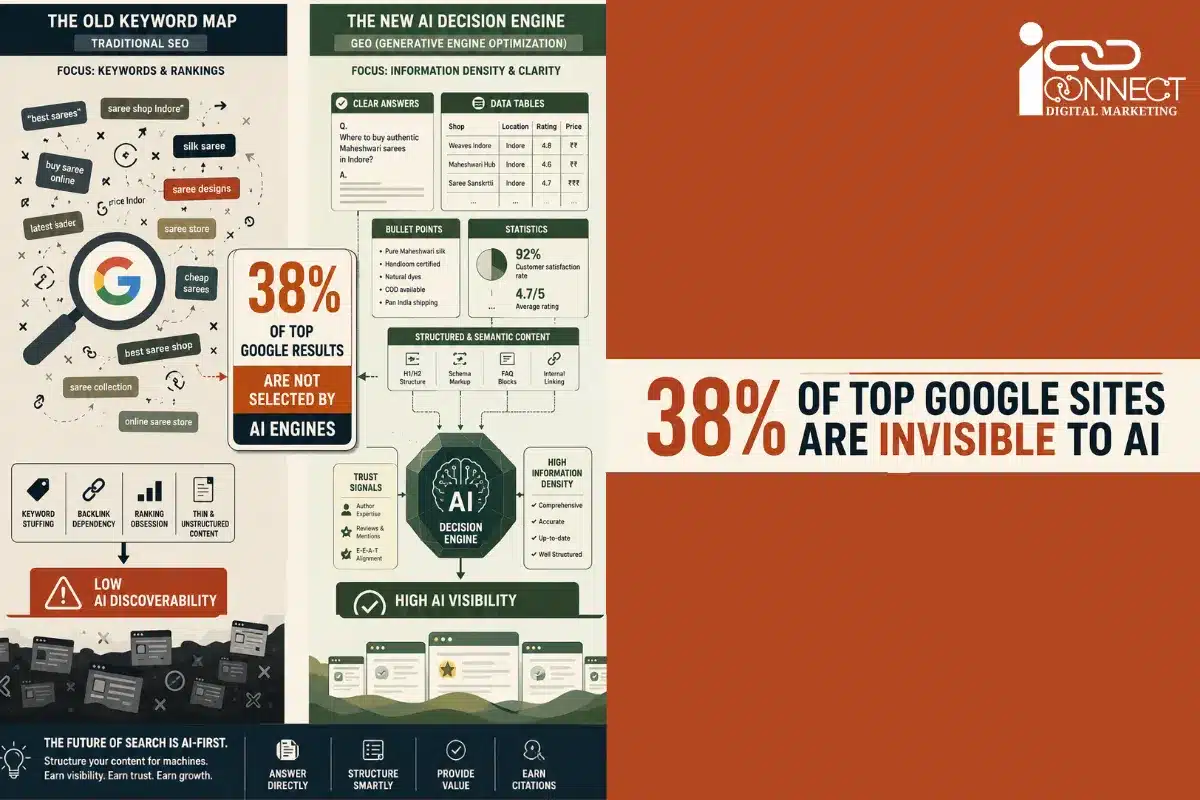
Surprisingly enough, data shows that only 38% of the sources cited in Google’s AI Overviews come from the top 10 traditional search results. Consequently, the other 62% of AI citations are pulled from completely different websites. This means ranking #1 on old Google no longer guarantees that AI engines will find or mention your brand. (Source: Ahrefs)
According to industry analyses, AI-generated answers often cite sources that do not necessarily rank among the top results in traditional search. This suggests that AI systems evaluate content differently and may prioritise clarity, relevance, and information quality in addition to traditional ranking signals.
This is because, apart from finding keywords, AI searches perform different tasks. They look for high information density, direct answers, and clear data tables. Therefore, if your content contains too much conversational fluff, the AI will simply ignore your website.
This does not mean SEO is becoming obsolete. Instead, GEO should be viewed as an extension of modern content optimization.
Why Content Structure Matters More Than Ever
Modern AI systems analyze content differently from traditional search engines. Rather than focusing solely on keywords, they often look for:
- Clear explanations
- Direct answers
- Supporting evidence
- Structured information
- Relevant context
Moreover, content filled with unnecessary filler or vague statements may be less useful to both readers and AI systems. Content that answers questions clearly is generally more likely to be referenced.
How AI Gathers Information — “The Fan-Out Query”
For us to comprehend this concept more clearly, we need to go deeper into its specifics. In cases when the user introduces a complicated prompt to ChatGPT, the AI algorithm doesn’t conduct a singular search. Rather, it performs what experts call a “fan-out query.” This means the AI splits a single prompt into three or four separate background searches to collect different facts.
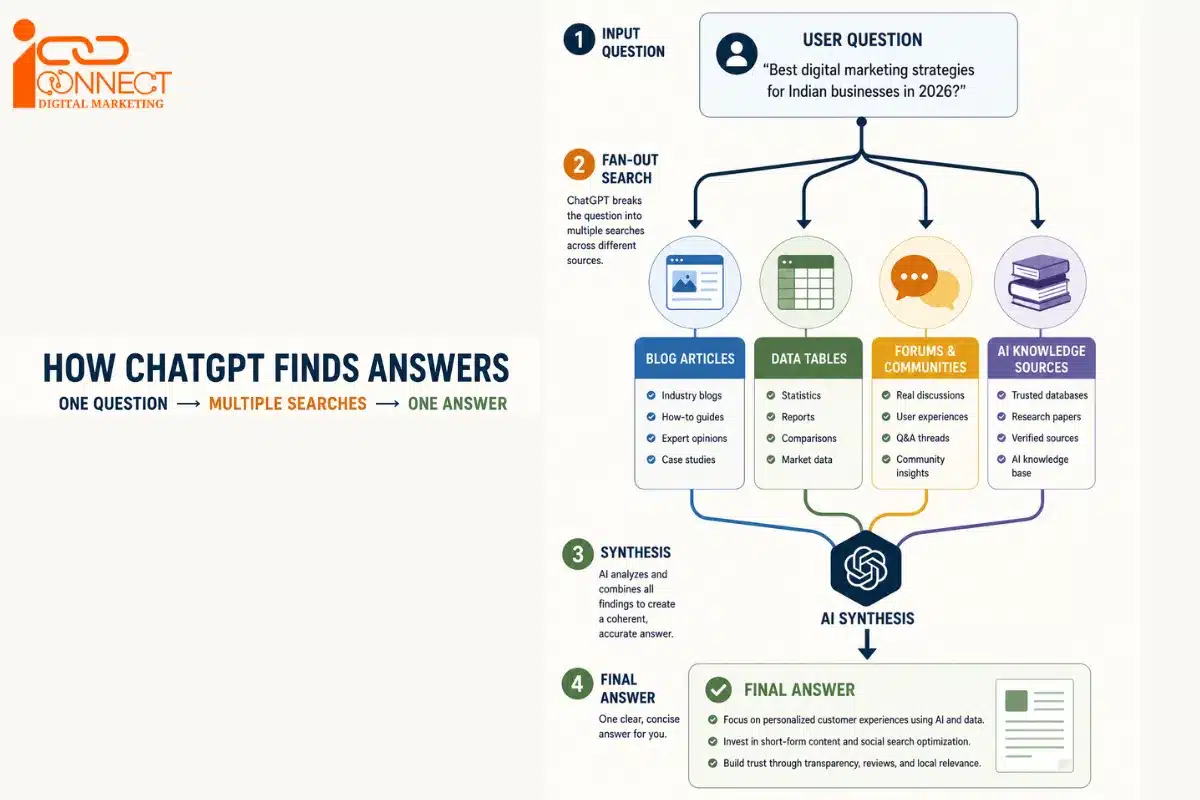
- Step 1: The user asks a complex question.
- Step 2: The AI instantly breaks it down into mini-queries.
- Step 3: The AI scans separate blogs, forums, and data tables.
- Step 4: It combines everything into one simple summary.
For example, if someone asks:
“Which is the best Digital Marketing Training Institute to learn digital marketing in 2026?”
An AI system may separately research:
- Current marketing trends
- Hiring demand
- AI-related skills
- Salary data
- Industry reports
It then combines those findings into a concise response.
You may also be interested in: 👉 How to Choose the Best Digital Marketing Institute in Ghaziabad
This is one reason why comprehensive, well-structured content often performs better in AI-powered discovery environments.
Thus, to succeed in 2026, you need your content to provide all these hidden mini-queries with concise answers.
Important AI Search Concepts Marketers Should Understand
To secure a spot in Google’s AI Overviews, your content should make use of particular technical setups. However, we can easily comprehend such difficult terms through practical examples from our day-to-day life.
- Retrieval-Augmented Generation (RAG): This is similar to what an open-book exam is. The AI is not solely reliant on its previous training. Rather, it looks up the most recent articles from the live Internet. Also, it reads them right away and then gives factual answers.
- LLM Agents: These are specialized AI assistants designed to perform specific jobs. For example, instead of just writing text, an agent can check product prices, compare reviews, and create a final comparison chart automatically.
- Information Gain: This is a scoring system used by search engines to reward unique content. If your blog post simply repeats what everyone else is saying, your score drops. Instead, if you share unique local examples, your score goes up, making the AI more likely to cite your website.
This aligns closely with Google’s emphasis on helpful, people-first content and Experience, Expertise, Authoritativeness, and Trustworthiness (E-E-A-T).
Real-World Success Stories: Proof That AI Works
You might wonder if companies are actually using these AI workflows successfully. To answer that, let us analyze two powerful, authentic case studies from the industry.
Global Scale: CarMax (The Human-in-the-Loop Content Creation Framework)
You must have heard of CarMax — it is a huge company that sells used cars. They needed to build thousands of research pages for their buyers. Writing every page manually would take 11 years. Therefore, they used advanced AI tools to write the drafts quickly.
However, they did not put the AI text on their website randomly. Rather, they followed the Human-in-the-Loop Framework (HITL) for publishing the text. In simpler words, the process involves human editors reviewing the AI drafts. Because of this great teamwork, humans approved 80% of the AI text on the very first try. This proves that AI does not replace human marketers. Instead, it acts as a highly efficient assistant.
Local Business Example: The Indore Saree Venture
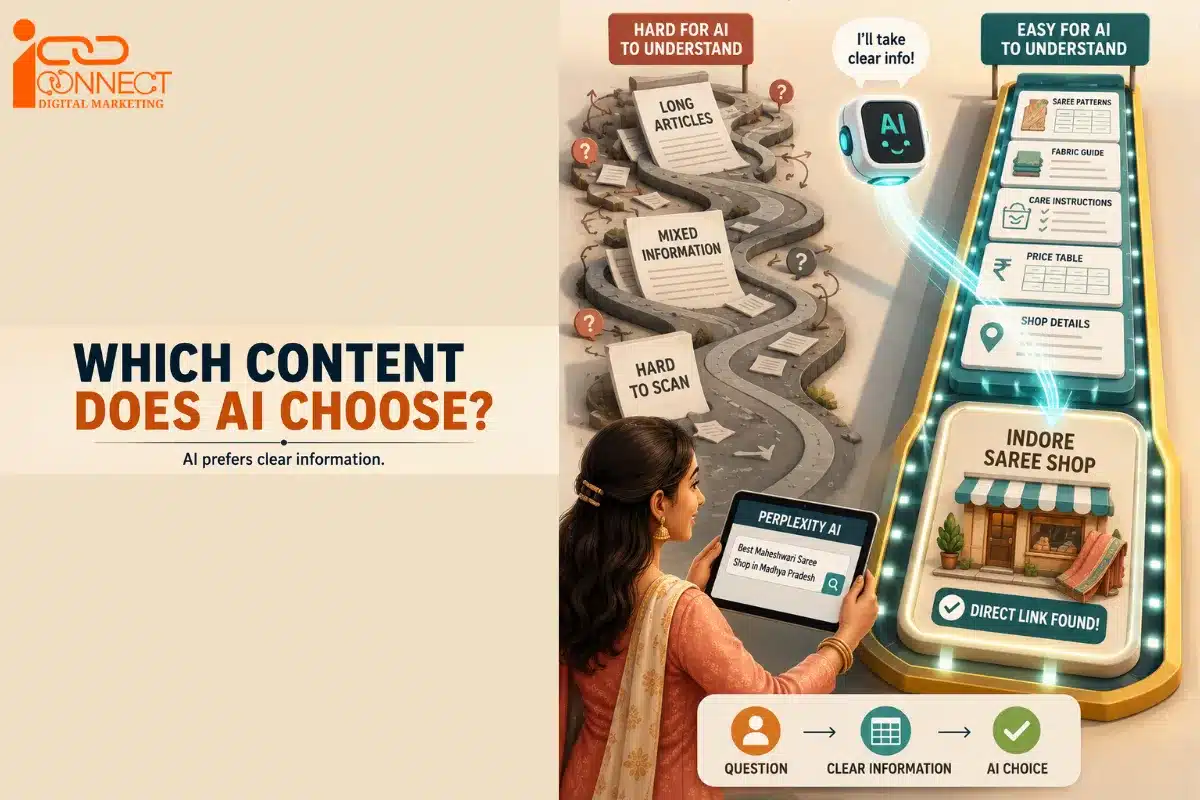
Let us look at a local textile business in Indore, Madhya Pradesh. The owners wanted to sell traditional Maheshwari sarees to young buyers. Therefore, they avoided writing long, boring blogs. Instead, they created simple guides about saree patterns, history, and fabric care.
Furthermore, they put this information into clean data tables. Consequently, young buyers asked Perplexity AI for “authentic saree shops in Madhya Pradesh.” The AI engine instantly skipped old directory websites. Instead, it pulled data directly from the Indore shop’s tables. This made the local shop highly visible as a trusted authority.
This example illustrates how useful, topic-focused content can strengthen digital visibility regardless of business size.
You may also be interested in: 👉 Top GMB Experts in Ghaziabad for Local Business Ranking (2026)
2026 Market Share: Who Rules the AI World?
If you want to start optimizing your digital marketing assets for AI, you must know where the actual user traffic is moving. Recent market data shows a very clear picture of consumer habits:
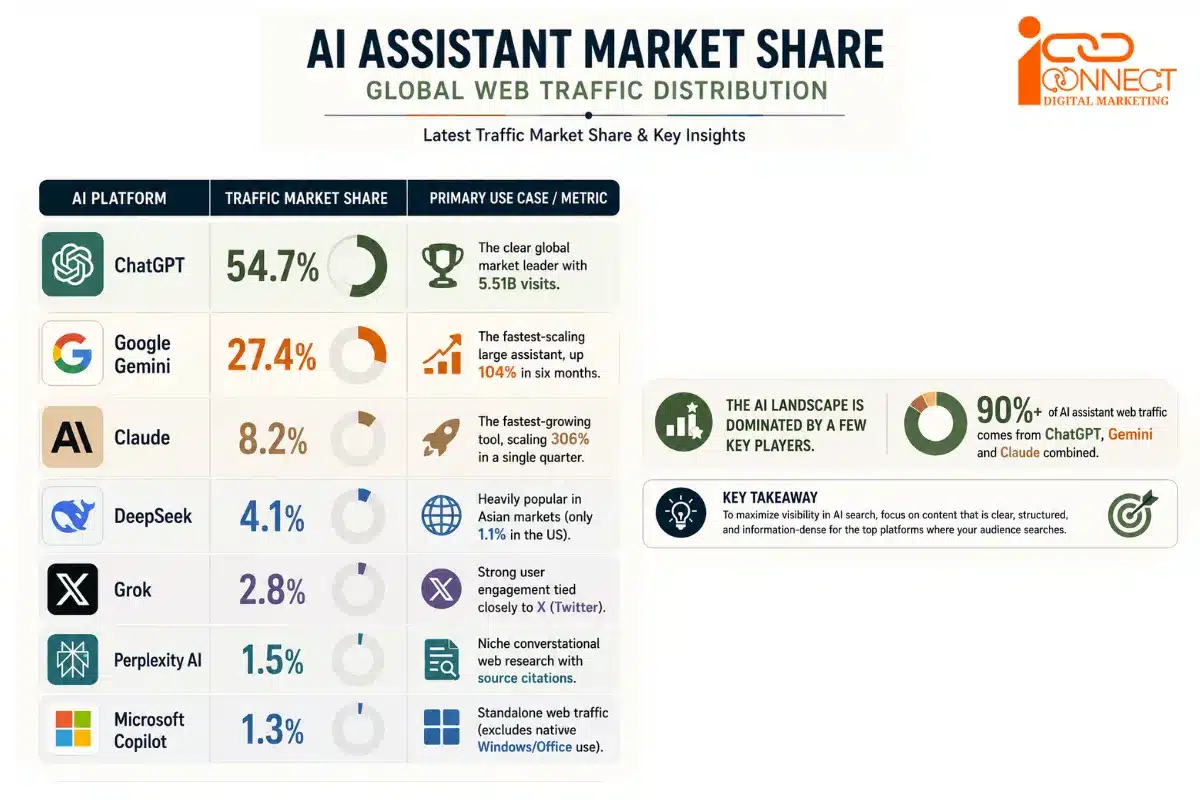
Source: Momentic Marketing analysis of Similarweb web traffic data (April 2026). Figures represent web traffic share among selected AI assistant websites and do not reflect total AI market share.
Because ChatGPT owns the vast majority of the market share. For marketers, the key takeaway is not to optimize for a single platform. Instead, focus on creating content that is accurate, helpful, easy to understand, and easy to reference.
Step-by-Step Blueprint to Get Featured in AI Overviews
Now, let us discuss the exact practical steps you can take today to make your content visible to AI tools, ChatGPT summaries, and Google AI Overviews.
Step 1: Write Direct Answers — “The AI Hook-Answer Questions Early”
Whenever you write an article, always place a clear 2-to-3 sentence answer at the very top of the page under the main heading. Do not use complex English vocabulary. Instead, write in a direct, conversational manner. AI tools love to clip these simple definitions and display them directly to the user as a summary.
For example:
Question:
What is GEO?
Answer:
GEO is the practice of structuring content so AI systems can understand, summarize, and potentially cite it in AI-generated responses.
You may also be interested in: 👉 AI Search Optimization: How to Optimize Content for AI Search and Discovery?
Step 2: Structure Your Content for Machines Clearly
AI engines are trained to read structured data much faster than long paragraphs. Therefore, you should always organize your information using:
Furthermore, you can guide the AI by using these simple tools:
- Markdown Headers: Use clean headers like ## and ### to break chapters.
- Bullet Points: Keep every point sharp and crisp to deliver maximum impact.
- Data Tables: Put numbers within a table to make the AI understand their significance.
Step 3: Build Off-Page AI Co-Citations
AI engines do not just look at your website. In addition, they constantly crawl public discussion forums, community platforms, and YouTube comments. They want to see what real people are saying. Therefore, you must encourage your community to mention your brand online.
Furthermore, they should use your brand name along with your specific industry keywords. Consequently, the AI will see your brand mentioned multiple times across the web. It will then start citing your business as a trusted authority.
Content based on genuine experience is often more valuable than content created solely for rankings.
Step 4: Build Trust Beyond Your Website
AI systems evaluate information from multiple sources.
Helpful trust signals may include:
- Industry mentions
- Expert interviews
- Community discussions
- Positive brand references
- Educational content contributions
The goal is not simply to be visible but to become a credible source of information.
What This Means for Digital Marketing Professionals
In practical digital marketing work, GEO should not replace SEO. Instead, marketers should combine traditional SEO fundamentals with AI-focused content practices.
Core skills that remain important include:
- Search Engine Optimization
- Content strategy
- Analytics
- Conversion optimization
- Technical SEO
- User experience
- AI-assisted content workflows
Marketers who understand both traditional search and AI-driven discovery will likely be better positioned for future opportunities.
Frequently Asked Questions
Generative Engine Optimisation (GEO) refers to optimising content so that any AI search engines and generative engines can read, easily pull from, and recommend it. It’s very similar in spirit to what the original search engine optimization (SEO) was, with a different focus; instead of focusing on where a piece of content lands on search results, GEO focuses on getting cited and mentioned in the responses of AI search engines, like ChatGPT and any other new and trending generative search engines and platforms.
Absolutely, SEO still plays a big role even as searches powered by artificial intelligence become more integrated. For the most part, search engines use relevance, quality content, and authority to guide rankings, and SEO helps your business gain a credible presence that is more likely to be used in both conventional search and artificial intelligence-generated answers. Companies that incorporate GEO marketing will enhance the value of their SEO as they are well-equipped to dominate both worlds.
Of course. There are many ways ChatGPT can help businesses in securing greater visibility by helping in generating content for engaging audiences, uncovering keywords, and obtaining information. Companies that create factual, engaging and authoritative content will naturally be mentioned more in an AI answer. ChatGPT can be used to prompt marketers into coming up with blog titles or website copy, can support the generation of FAQ content and can also improve the quality of content. The tool can also be incorporated into your SEO and GEO strategies to achieve a greater sense of brand awareness.
In 2026, digital marketers should develop expertise in technology, creativity, and data-driven approaches to digital marketing. Specific skills to develop in the future of digital marketing, in our opinion, include: AI content optimization, GEO, Advanced SEO, Data analytics, Marketing automation, Content strategy, Prompt engineering, and knowing how AI search engines will determine and display information would also be useful.
AI will not displace online marketing altogether, but will profoundly alter the practice of digital marketing. AI automates repetitive work such as the creation of content, preparation of reports, data analysis, and optimisation of campaigns, so digital marketers will need to do less in more productive ways. But some human aspects, such as creativity, planning strategies, telling brand stories, emotional intelligence, and critical thinking, still require human abilities. Digital marketers will find their greatest asset is the ability to team up with and deploy AI technology in their marketing strategy, thereby bringing their productivity to new heights with insightful perspectives.
Conclusion: Future Belongs to AI-Ready Marketers
Digital marketing in 2026 is no longer focused totally on ranking for keywords. Nowadays, success increasingly depends on creating useful, trustworthy, and well-structured information that helps users while finding any information on search engine result pages.
AI assistants such as ChatGPT, Gemini, Claude, and Perplexity are changing how people discover information, but the underlying principle remains the same: helpful content wins. Businesses and marketers who focus on clarity, expertise, user experience, and trustworthy information will be better positioned to succeed across both traditional search engines and AI-powered discovery platforms.
Rather than choosing between SEO and GEO, the most effective approach is to combine both. Create content for people first, structure it clearly, support it with genuine expertise, and make it easy for both users and AI systems to understand.
This is especially true for Indian students entering the job market. It also applies to professionals looking for a promotion. Hence, it is time to transform your digital content. Format it properly in a manner that AI can understand, and you will be amazed to see the increase in your online visibility.

Mohit Vij is the Founder & Digital Marketing Trainer at iConnect Digital Marketing Training Hub & Agency (iConnectDM), based in Ghaziabad. With over 9+ years of experience in SEO, Google Ads, Meta Ads, Social Media Marketing, Search Intent, Content Marketing, and Lead Generation.
Over the past years, He has trained hundreds of students, job seekers, working professionals in building successful careers in digital marketing while helping businesses improve their search rankings, website traffic, brand visibility, and lead generation. His insights are based on hands-on industry experience, continuous learning, and proven digital marketing strategies that deliver measurable results.