

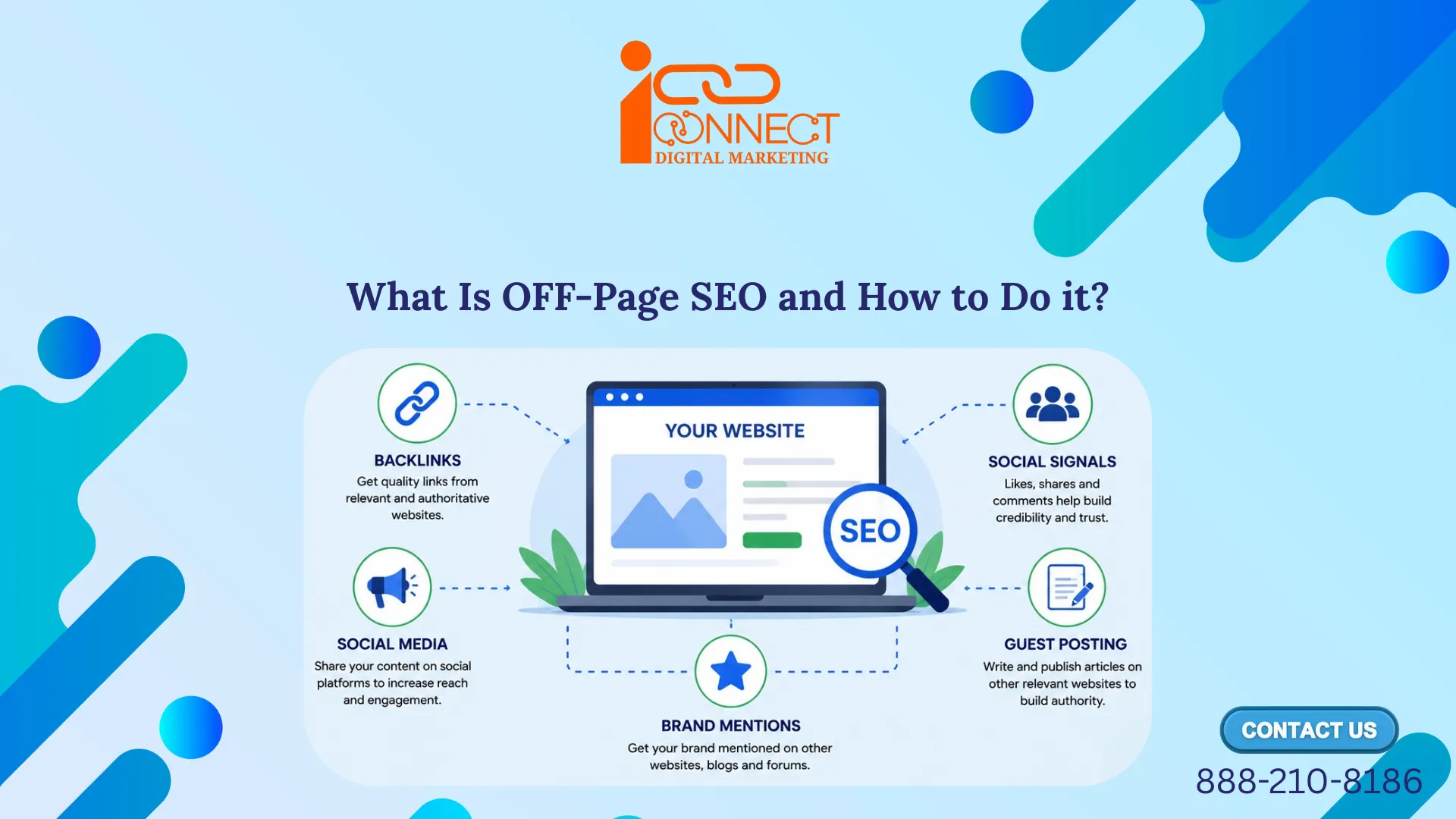
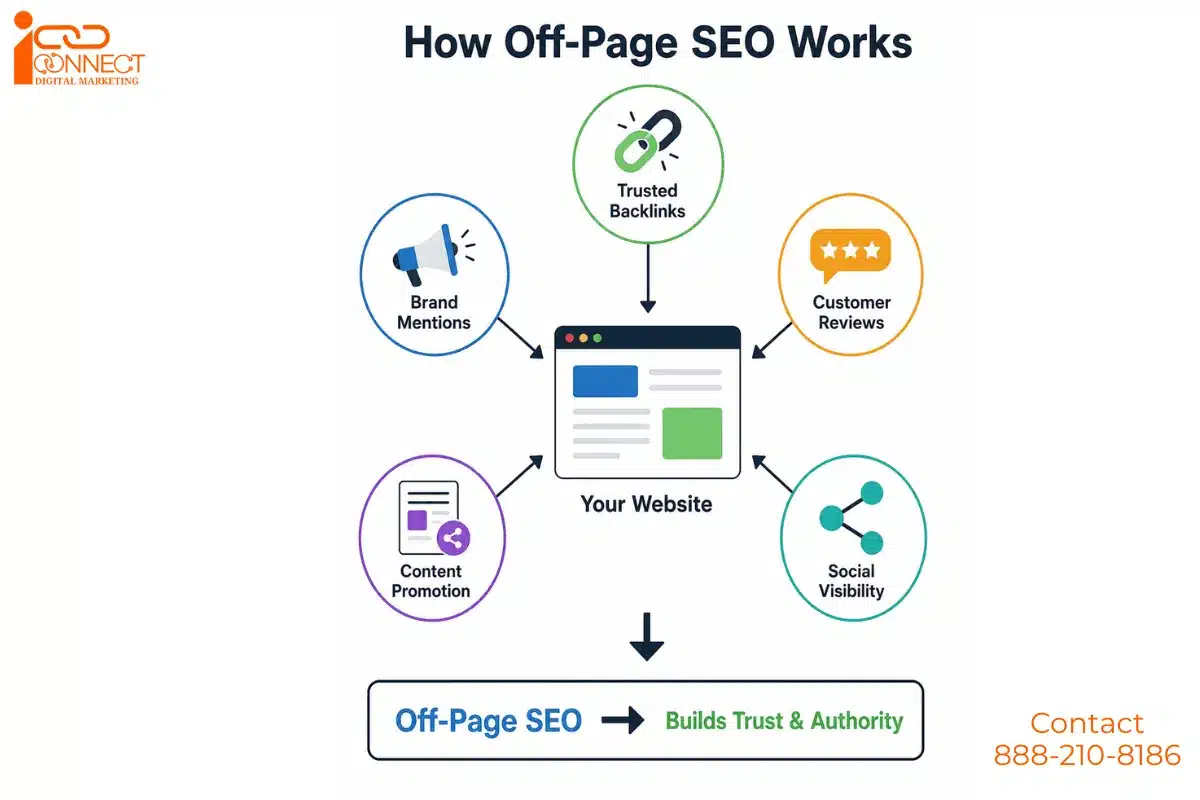
Off-Page SEO (search engine optimization) refers to the activities that we perform outside of our website to improve its search engine visibility and ranking. We do not make changes directly to our website during these activities as we do in On-Page SEO. Instead, we focus on building the website’s authority, reputation, and visibility outside the website. For example, getting quality backlinks and earning positive mentions are common Off-Page SEO activities.
There are various methods of doing this SEO. Such as building quality backlinks, getting brand mentions, collecting genuine customer reviews, and promoting content on other websites and online platforms.
In addition, On-Page SEO is all about making changes to our own website. It include elements like content structure, proper headings, keywords research and placement, internal linking, optimized images, short and clean URL, page design, and the overall user experience. Off-Page SEO, on the other hand, is all about building the trust and reputation of a website.
When a relevant and trustworthy website links to your content, it can help increase your website’s authority, credibility, and visibility. Since this activity happens outside your own website, it is considered Off-Page SEO.
In more simple words:
👉 Other website links to your website → You get a quality backlink → Your website can gain more authority and visibility → This is Off-Page SEO.
How to Do Off-Page SEO?
There is no single off-page SEO technique that works for every website. The right approach depends on the type of website, industry, audience, content, and business goals.
Some common ways to do Off-Page SEO are:
Step 1: Build Quality Backlinks
A backlink refers to a link on some other site that directs to your site. It can be viewed as someone else linking to you or directing their customers or visitors to your website. Backlinks are treated by search engines as evidence of other websites thinking your website useful and credible, but all backlinks are not equal. Backlinks from credible websites are much more valuable than backlinks from sites lacking credibility.
Let’s understand about backlink with a Good Example of Off-Page SEO:
Suppose you have a website about digital marketing. You publish an article called “10 Easy SEO Tips for Beginners.”
Now, another website that also talks about digital marketing finds your article useful. They adds a link to it in one of its own articles. This link is called a backlink.
Another Example: A technology website publishes an article or a blog on technology about smartphone photography and links to your webpage on smartphone photography guide because it provides useful information, then this will be considered a backlink.
Step 2: Create Content That Attracts Links Naturally
Create relevant, useful, and informative content that other websites find valuable enough to reference or link to. This can include original research, detailed guides, useful statistics, case studies, or explanations of difficult topics.
The main focus should be on helping the audience, not just getting backlinks. If content is created only for the purpose of getting links, other websites are less likely to find it valuable enough to reference.
For Example:
If you publish an original study about “SEO Trends for Small Businesses” with useful data and findings. Other websites may reference your research in their own articles and link back to your study.
This version is better because it teaches the student what to create + what makes content link-worthy + what mistake to avoid + a practical example.
You may also be interested in: 👉Is AI Content Good for Your Business SEO?
Step 3: Build Brand Visibility and Earn Relevant Mentions
A brand mention can be understood as any mentioning of your company, product, or website on other platforms without having any link. This could include a blog article, which mentions your company while talking about industry trends.
Such brand mentions are recorded by search engines as a measure of recognition of your brand, along with backlinks.
Step 4: Collect Genuine Customer Reviews
The role of reviews is especially vital for local businesses in the process of ranking. Because they can influence how potential customers evaluate a business before contacting or visiting it.
The presence of positive reviews on Google My Business or other similar platforms shows that there is some interaction going on. It builds trust between the business and the client. It is vital to make sure that the reviews come from real people only.
For Example: A customer searching for a local digital marketing training centre may compare businesses based on their reviews, ratings, responses, services, and other information available in local search results.
We should always respond professionally to legitimate reviews, including negative ones. A thoughtful with professional response can show potential customers that the business takes feedback seriously.
Step 5: Promote Content on Relevant Platforms
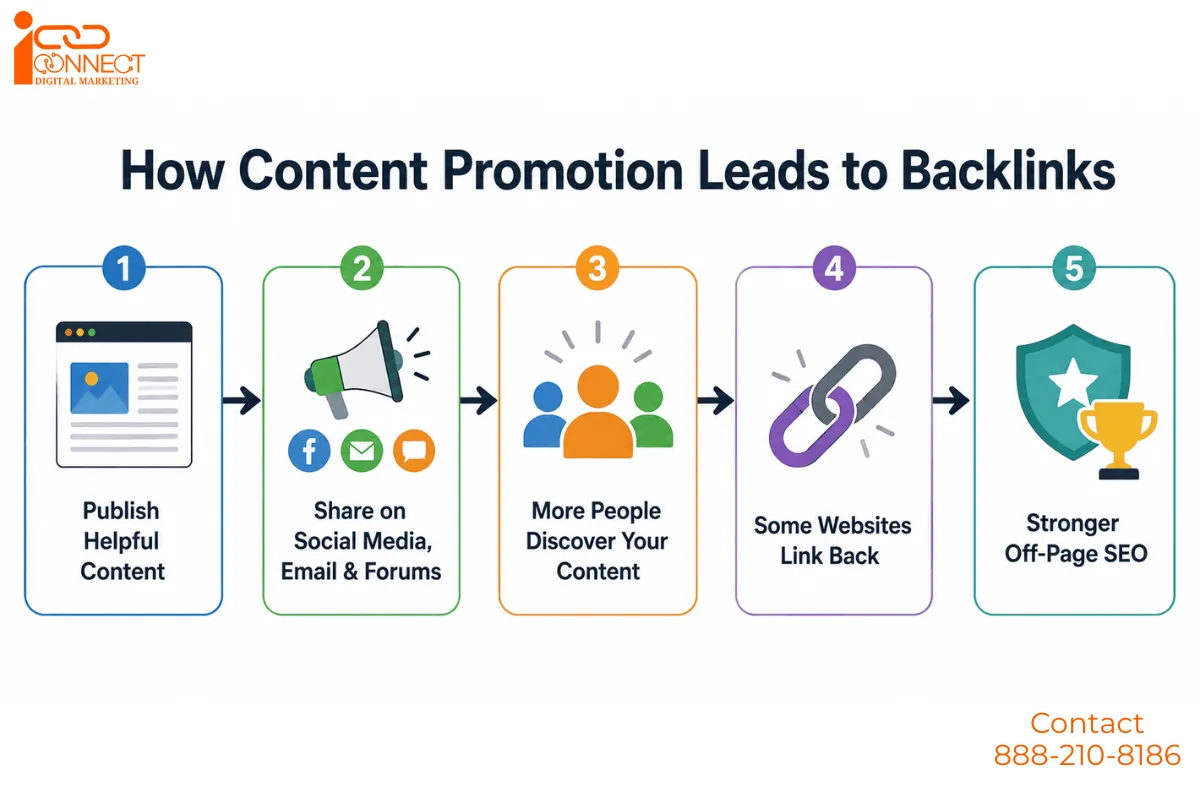
Publication of the content is where you begin your journey, not the destination. There should be a platform through which people can reach your content. Hence, post it on Social Media, through Email newsletters, relevant forums, Community websites or anything that makes it visible.
It is important to understand here that social media shares will not directly impact your ranking. But there is no doubt that your shares on social media will help you in creating awareness about your content. This means that with more people knowing about your content, it becomes easier to get backlinks from them.
Content → Audience discovery → Discussion or sharing → Potential references → Referral traffic and broader visibility.
Step 6: Focus on Link Quality, Not Quantity
Everyone seems to think that just because you have more backlinks your rankings will be higher. This is not true at all. Also, neither do search engines work like that.
Not all backlinks are equal. Search engines consider the quality and relevancy of the website making the backlink to your site. Fewer backlinks from an authoritative and relevant website perform better than many backlinks from an irrelevant and low-quality site.
For Example:
Website A: 500 unrelated backlinks
Website B: 20 relevant, naturally earned editorial links
The first website having more links does not automatically mean it has better off-page SEO.
Step 7: Understand Link Attributes and Paid Links
Google provides link attributes that can help website owners communicate the nature of certain links. Not every backlink has the same purpose or SEO value. When building backlinks, it is important to understand common link attributes. Such as “nofollow”, “sponsored”, and “ugc”. These attributes help search engines understand the relationship between your website and the linked content.
Nofollow: It is used when you don’t want to associate the link with your site or passing ranking credit through the link.
Sponsored: It is used for links that are part of advertisements, sponsorships, or other paid placements.
UGC (User-Generated Content): It is used for links within content created by users, such as comments or forum posts.
Let’s have a recap of off-page SEO
Step 1: Gain backlinks from reputable sources
Step 2: Make sure you make valuable content that brings in backlinks naturally
Step 3: Establish your brand by making online mentions
Step 4: Get genuine customer reviews
Step 5: Promote your content on appropriate channels
Step 6: Emphasize the quality of the backlinks over their quantity
Step 7: Understand Link Attributes and Paid Links
On-page SEO will help in making your website more understandable. While off-page SEO will assist in making your website a credible one for the search engine.
Frequently Asked Questions About Off-Page SEO
Off-Page SEO refers to activities performed outside of our website to improve its online presence, authority, and search visibility. Some common activities include earning quality backlinks, building brand mentions, getting genuine reviews, digital PR, and promoting useful content on relevant platforms.
To do Off-Page SEO, focus on activities that build your website’s reputation and authority outside your own website. This can include earning relevant backlinks, creating content worth referencing, building brand mentions, getting genuine customer reviews, participating in relevant communities, and promoting your content through appropriate channels.
It is essential to have Off-Page SEO for a website because it helps both search engines and the audience realize the credibility of the site and trustworthiness. It could lead to increased referral traffic by improving the visibility of the website through quality backlinks and brand mentions.
In 2026, Off-Page SEO optimization means improving a website’s presence and reputation through activities performed outside the website itself. It includes earning quality backlinks, building brand mentions, managing genuine reviews, digital PR, and other relevant external activities.
There are ways of acquiring good backlinks in a newly created website, such as the creation of content that would be beneficial for other websites to link to. One can use digital public relations, industry connections, and guest content among others in order to acquire links. In this case, the emphasis is more on the quality of links than on the number.
In Conclusion,
To know more about Off-Page SEO, it is not just simply about getting more backlinks. A practical approach focuses on creating useful content, earning relevant references, building genuine online visibility, maintaining a trustworthy reputation, and promoting content through channels where it can reach the right audience.
It is also important to understand that Off Page SEO works together with other components of SEO. Such as On-Page SEO, Technical SEO, Local SEO, Content writing, and so forth, which altogether form an SEO strategy. No one single technique can provide good results on its own.
For students and beginners, learning these concepts through practical examples can make it easier to understand how SEO works on real websites rather than treating each technique as an isolated topic.
Learn Digital Marketing and SEO with iConnect Digital Marketing
If you are a student, beginner, job seeker, or professional looking to learn digital marketing and SEO practically on live client projects, you can explore the Digital Marketing Courses that can give you Job-Ready Results. You can also review the Course Modules to understand what topics are covered in the practical training.
If you have any questions about the curriculum, training format, practical learning approach, or available learning options, you can contact iConnect Digital Marketing before deciding whether the course is suitable for you.

Mohit Vij is the Founder & Digital Marketing Trainer at iConnect Digital Marketing Training Hub & Agency (iConnectDM), based in Ghaziabad. With over 9+ years of experience in SEO, Google Ads, Meta Ads, Social Media Marketing, Search Intent, Content Marketing, and Lead Generation.
Over the past years, He has trained hundreds of students, job seekers, working professionals in building successful careers in digital marketing while helping businesses improve their search rankings, website traffic, brand visibility, and lead generation. His insights are based on hands-on industry experience, continuous learning, and proven digital marketing strategies that deliver measurable results.