


There is a feeling of quiet frustration spreading amongst content writing teams, which is something that needs to be noted. Articles are being published quickly; it has never been as cost-effective, and yet the traffic numbers just won’t rise. Sometimes, they are falling. The main problem was not the employment of the AI in general, but the fact that there was no human intervention after that.
This is not a criticism of AI writing assistants. Used well, they save enormous amounts of time. The problem is that many teams are treating AI output as a finished product rather than a first draft. Google can tell the difference — and so can readers.
In this article, we’ll learn AI Content Ranking Factors, why AI content frequently fails to perform well in search, and then we’ll learn how you can easily fix this problem. These tips have been gathered from experience with content from various industries, as well as from information provided by Google about what it rewards in the content.
You may also be interested in: 👉What Are AI Crawlers and Bots? How Do They Discover, Collect, and Process Web Content?
Does Google Penalize AI-Written Content?
No. Google does not penalize content simply because it was created using AI. This is a common myth. Since February 2023, Google’s official policy has stated that AI-generated content is not against its guidelines, and content is evaluated on quality, not production method.
It is all about the relevance of the content when it comes to Google’s ranking algorithms. The Search Central from Google clarifies that the proper use of the AI or automation tool does not violate any of the guidelines while the content made for manipulation purposes does violate them. In other words, it all depends on the content itself.
However, Google demotes low-value, unoriginal, inaccurate, mass-produced, or search-engine-only content. This can be referred to as “scaled content abuse,” which refers to posting a lot of thin content produced by artificial intelligence just to manipulate the rankings.
The Core Problem: AI Content Is Statistically Average
Language models usually create content by predicting the sequence of words that are most probable based on patterns learned from a vast amount of data already in existence.
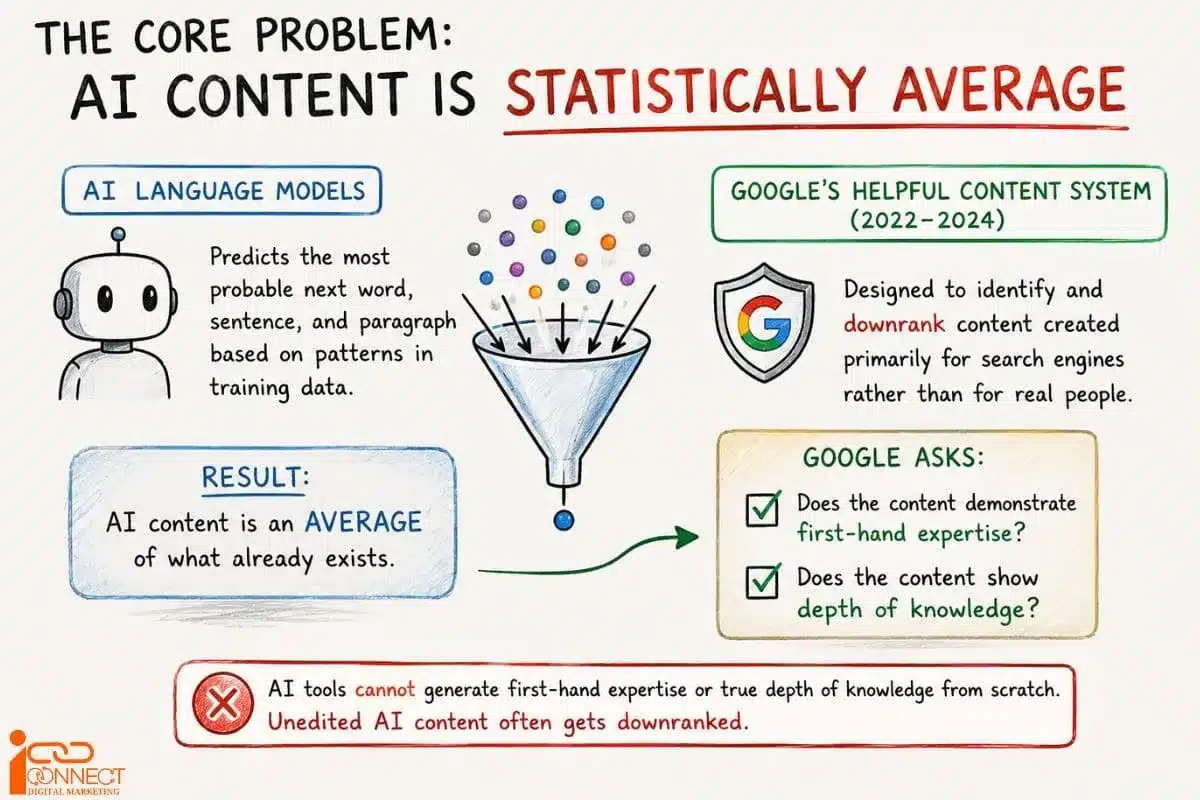
AI can assist content creation, but useful content should add original value, demonstrate expertise and meet the needs of real users.
Consequently, a lot of the content the AI gives back is a combination of things that were already written down, instead of adding something genuinely new. It can help organize and streamline information into more coherent sentences, but it can’t really create original research, firsthand experience, or anything that counts as new knowledge, not without you as the input there.
For most blog topics, this produces text that is:
- Accurate only at a surface level
- Structurally similar to competing articles
- Broad rather than genuinely insightful
- Missing firsthand experience
- Short on original examples or evidence
- Based on information that already exists elsewhere
- Unable to demonstrate how a professional actually applies the information
This creates a problem of information gain. Google’s Helpful Content system, rolled out and significantly updated between 2022 and 2024, is specifically designed to identify and downrank content that was created primarily for search engines rather than for real people. Unedited AI content often falls directly into this category.
According to Google’s own documentation, the system asks whether content demonstrates “first-hand expertise and depth of knowledge” — qualities that AI tools simply cannot generate from scratch.
E-E-A-T: The Four Signals AI-Assisted Content Often Misses
The four components that Google’s Search Quality Rater Guidelines considers when assessing content quality are:
E-E-A-T — Experience, Expertise, Authoritativeness, and Trustworthiness as a framework for evaluating content quality, with trust being particularly important. Although artificial intelligence is capable of generating legible content quite rapidly, it frequently fails to provide these four indicators.
Experience:
Experience is gained through the actual activity undertaken by the individual when he or she participates in the activity, for instance, using a certain product, applying a certain solution, or dealing with a particular problem. AI can momentarily converse about experience but cannot truly share it. And that is usually where AI-written text starts to feel a bit generic, like it’s missing the depth and intensity that truly describe the content. Human editors can improve the content by adding genuine observations, examples, mistakes, results, screenshots, workflows, and lessons learned.
Expertise:
Expertise goes beyond knowing definitions. While AI can provide great definitions, actually having the expertise is more than definition mastery. It consists of application-based knowledge, industry experience, and how professionals struggle in real-life situations.
For Example: A knowledgeable SEO professional understands not only what canonical tags, redirects, crawling, indexing, and structured data are, but also when to use them, when not to use them, and what can go wrong during implementation.
Authoritativeness
Authority develops over time through reputation and recognition. It flows from reputable authors, Original research, trusted citations, industry authority, and authoritative content that others link to and High-quality backlinks and mentions. Content without these signals is unlikely to earn authority. This includes AI-generated ones.
Simply adding an author name does not automatically make an article authoritative. The author’s background and the website’s broader reputation should give readers legitimate reasons to trust the information.
Trustworthiness
Trust is especially important. Credibility is defined by accuracy, openness, and consistency. Given that sometimes even AI systems are prone to producing inaccuracies, outdated information, or deceptive results. It is essential to subject such systems to human supervision through the process of verification.
Comparing AI Content and Human-Edited Content
The middle column — human-edited AI content — is where the real opportunity lies. It combines production efficiency with genuine quality signals. The key is knowing what to add and where.
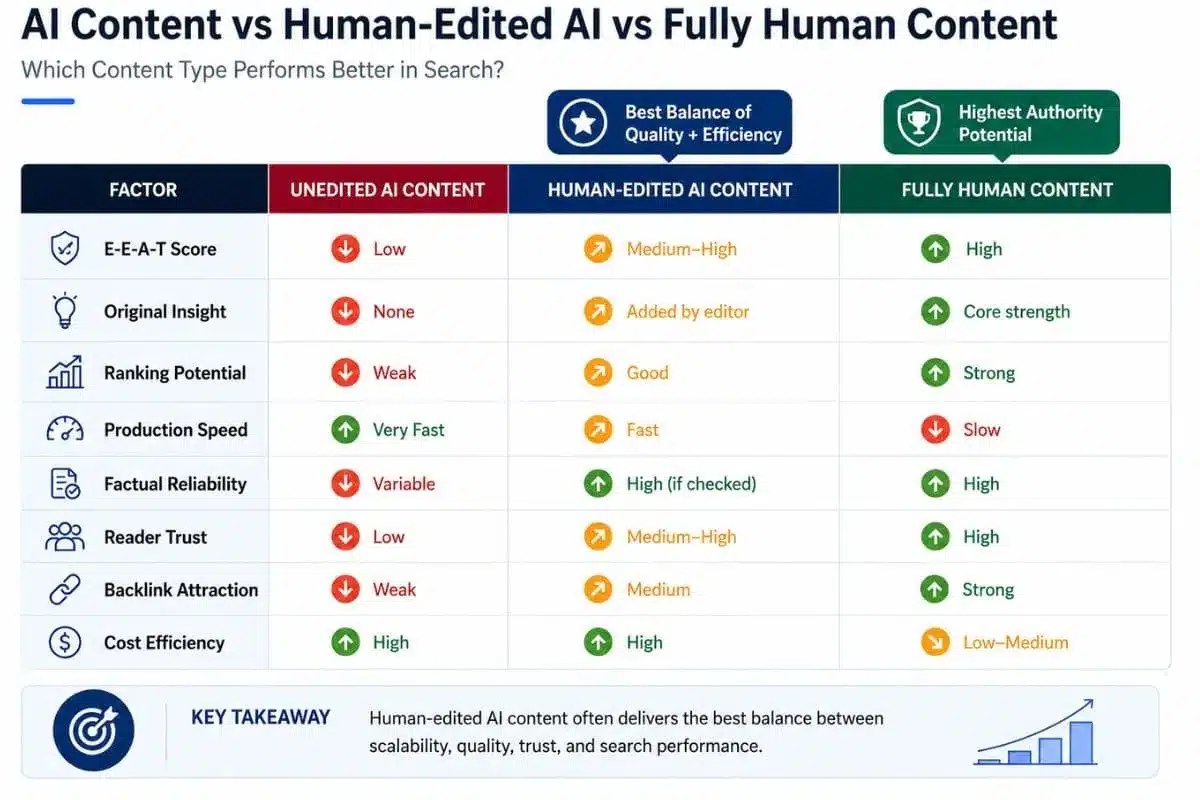
Comparison of AI-generated, human-edited AI and fully human content across quality, originality, reliability, trust and production efficiency.
Six Reasons AI Content Often Fails in Search
1. It Targets Keywords but Misses Search Intent
AI often targets keywords but misses the real question behind them. Google prioritizes content that fully satisfies what users are actually looking for. A keyword tells you what somebody searched for. It does not always tell you exactly what that person wants.
For Example let’s consider a search such as:
“best digital marketing course”
The user might want:
- Course comparisons
- Fees
- Duration
- Placement information
- Online vs offline options
- Curriculum details
- Certifications
- Career opportunities
Simply repeating the keyword throughout an article does not satisfy these needs. Good content identifies the underlying intent and answers the questions a user is likely trying to solve.
2. It often Lacks Supporting Evidence
Credibility is rarely built upon general statements! Data, examples, and citing credible sources make content far more persuasive.
For example:
Weak:
“Email marketing delivers a strong ROI.”
Better: Use a current statistic from a reliable original study and link directly to the source. While mentioning the publication date and relevant methodology where necessary.
Do not replace vague statements with precise-looking statistics unless you have verified the original source.
Useful supporting evidence can include:
- Primary research
- Official documentation
- Industry studies
- Internal data
- Experiments
- Surveys
- Screenshots
- Case studies
- Expert commentary
Evidence improves both usefulness and trust.
3. It often Follows Predictable Patterns
Most AI-driven content closely follows well-known sentence patterns, making it repetitive and rather boring. The problem occurs when every article presents the same ideas, examples, wording patterns, and conclusions.
Introduction → Definition → Benefits → Tips → FAQs → Conclusion
Structure should follow what helps the reader understand the subject rather than a fixed AI-generated template.
4. It May Include Unverified Claims
Claims of research or expert opinion without citations can be debased to trust and credibility.
5. It Prioritises Coverage Over Insight
AI might have the breadth to cover a topic, but good content is about depth, context and meaningful analysis, often not more words.
Useful depth comes from answering questions such as:
- Why does this happen?
- When does this advice not apply?
- What mistakes do beginners make?
- What happens during actual implementation?
- What would an experienced professional do differently?
- What evidence supports the recommendation?
A shorter article with original insight can be more valuable than a long article that simply repeats existing information.
6. It Adds Little Original Perspective or Information Gain
This is one of the biggest weaknesses of generic AI content. If your article contains essentially the same information available across dozens of existing pages, it gives users little reason to choose it.
Original value can come from:
- Firsthand experience
- Original research
- Internal data
- Real campaign results
- Case studies
- Experiments
- Expert commentary
- Screenshots
- Unique comparisons
- Updated information
- A clearer explanation of a difficult concept
- Lessons from failed attempts
You don’t need to disagree with everyone else simply to appear original. You need to contribute something genuinely useful.
What Google Has Actually Said About AI Content
Let’s be clear, because this gets misrepresented constantly.
Google does not penalise content written by AI Models. Their stated target is content that’s “unhelpful, low-quality, or created primarily to game search results” — however it was produced.
But Google also says its systems are built to reward:
- First-hand experience
- Depth beyond the obvious
- Content made for people, not algorithms
- Authors and sites with a reliability track record
Unedited AI output fails all four. That’s the real problem — not the tool, but what the tool produces when nobody edits it.
The Helpful Content Update. Now baked into Google’s core ranking systems — was built specifically to filter out mass-produced, low-differentiation content. AI publishing at scale is exactly what that update had in mind.
You may also be interested in: 👉 What Are Search Engines and How Do They Work?
How to Fix AI Content: A Practical Human-Editing Framework
Step 1: Understand Search Intent Before Editing
Search your target keyword in an incognito window. Look at what the top 5 results are actually doing — comparing, explaining, guiding?
If your AI draft is structured differently, restructure first. Editing a mis-aimed article is wasted effort.
Step 2: Verify Every Important Claim
“Email marketing provides a strong return on investment.” → “$36 returned for every dollar invested in email marketing according to the Litmus Report of 2024.”
Where you have internal data about your products, surveys, etc., use it; nobody else has it.
Step 3: Add Genuine Human Expertise
This is the step that actually moves rankings. Have someone who knows the subject add what AI can’t — real opinions, missed nuances, common mistakes, hard-won context. Even 300–400 words of genuine expert input changes the quality signal of an entire article.
The expert should look for:
- Missing nuances
- Incorrect assumptions
- Common beginner mistakes
- Real-world exceptions
- Practical examples
- Implementation difficulties
- Industry-specific considerations
Step 4: Strengthen E-E-A-T Naturally
- A named author
- Relevant author credentials
- A meaningful author bio
- Accurate publication and update dates
- Primary-source references
- Original screenshots
- Expert commentary
- Transparent methodology
- Clear business/contact information where appropriate
- Editorial or review information for sensitive topics
Don’t add these elements simply because they appear on an SEO checklist. Add them because they help readers understand why they should trust the content.
Step 5: Structure it for how people actually read
AI produces uniform structures. Real readers scan, jump, and skim. Help them with:
- Table of contents on longer pieces
- Callout boxes for key findings
- FAQs pulled from People Also Ask — not AI-generated guesses
Step 6: Ask One Question Before Publishing
Does someone with zero context leaving this article have a clear, correct understanding of what to do?
If it makes you ask if the content adds enough value, then it probably doesn’t. According to Google’s own standard, content must offer “substantial value over other pages found in search results.” This is a tough criterion to meet. However, meeting it always brings the desired result.
Tools That Help (Without Replacing Human Judgment)
Several tools can support the human editing process without substituting for it:
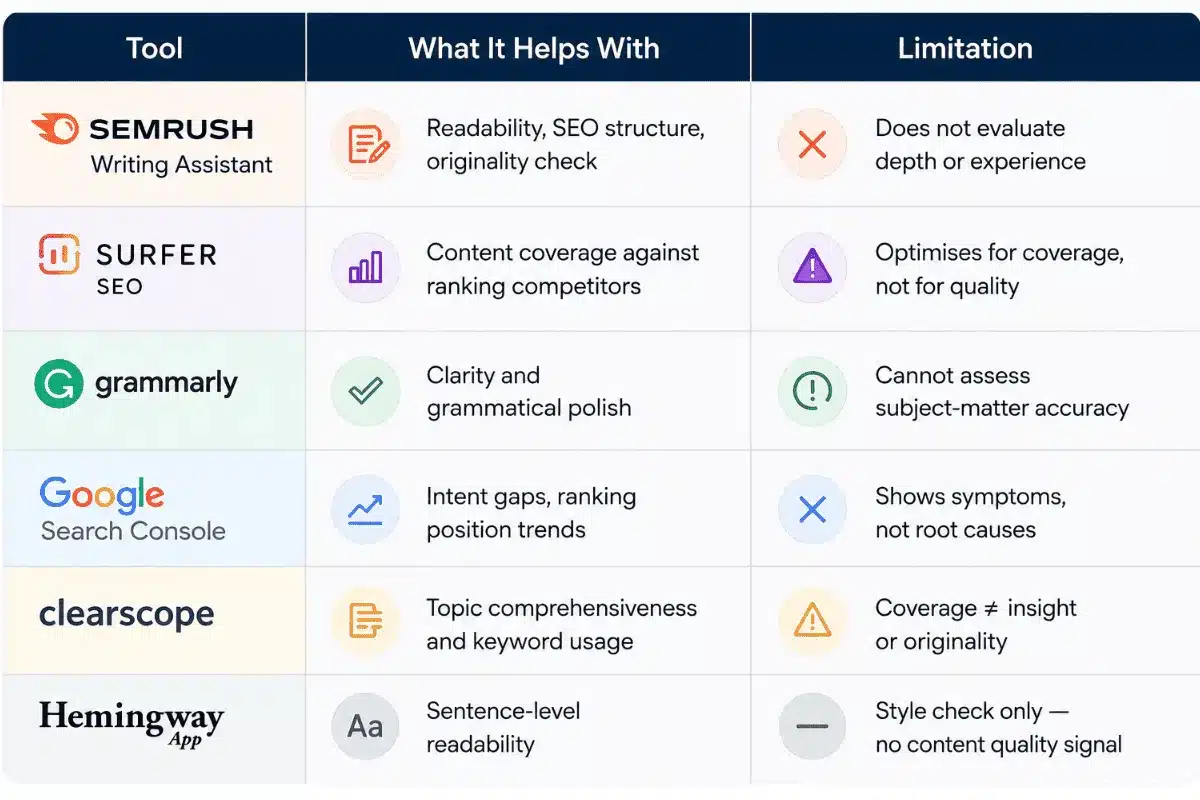
Use these tools as finishing checks, not as a replacement for expert review. Even a content piece running 100% across all these tools will fail if there is little to no insight/knowledge presented. If it lacks true value for the reader.
Frequently Asked Questions: AI Content Ranking Factors
No, Google does not penalize content simply because it was created using AI. Since 2023, Google’s official policy has stated that content is evaluated on quality, helpfulness, and search intent — not on the method used to produce it. What actually gets penalized is low-quality, thin, and mass-produced content created at scale purely to manipulate rankings. If AI is used responsibly and content is edited for accuracy and value, there’s no inherent risk of penalty.
Of course. According to a 2025 Ahrefs study of 600,000 pages, 86.5% of pages at the top had AI help in any form and the correlation coefficient between AI percent of content and rank position was only 0.011, which is pretty much nothing. So, whether your content was AI-generated doesn’t have any effect whatsoever on its ranking. What really does matter is how deep, accurate and relevant to search intent it is.
In order to be able to make sure that the content generated by AI can truly help people, you should always edit it and do some research in order to fact-check the content. Include your own knowledge, examples, data, etc., which only you are capable of coming up with. Remember to write for the reader, and not for the search engines.
The fact that the content is generated using AI does not necessarily reduce its E-E-A-T (Experience, Expertise, Authoritativeness, Trustworthiness) value. But content that fails to have any authentic human expertise or experience or sources will fall short on these criteria. Therefore, it is crucial for content to have author expertise, credible sources, and unique insight even when being created by using AI.
Yes, AI-written content can show up in both the Google AI Overviews and the AI Mode. This is because these are built using Gemini technology and provide summaries of the most relevant and accurate information available online. Irrespective of whether it has been written by humans or AI. However, the inclusion of AI-written content depends on its quality, coherence, and relevance to search intent.
Conclusion
7 Signs Your AI Content Won’t Rank
- There is no named author or verifiable credentials on the article.
- All claims are generic, with no specific data, dates, or trusted sources.
- It covers the topic generally without going into great detail.
- There are no case studies or examples or firsthand insights used in your writing.
- The structure looks similar to competing articles.
- There is no use of any original research, internal data, or expert commentary.
- The content adds no unique perspective or value.
While AI can greatly enhance productivity and effectiveness. The use of such technology cannot substitute real-life experiences, analytical thinking, or fresh insights. The best writing is created when the efficiency of technology and expertise of people merge, creating something that will be insightful, pertinent, well-researched, and actually useful for the reader. Such articles will easily gain credibility and top search results.

Mohit Vij is the Founder & Digital Marketing Trainer at iConnect Digital Marketing Training Hub & Agency (iConnectDM), based in Ghaziabad. With over 9+ years of experience in SEO, Google Ads, Meta Ads, Social Media Marketing, Search Intent, Content Marketing, and Lead Generation.
Over the past years, He has trained hundreds of students, job seekers, working professionals in building successful careers in digital marketing while helping businesses improve their search rankings, website traffic, brand visibility, and lead generation. His insights are based on hands-on industry experience, continuous learning, and proven digital marketing strategies that deliver measurable results.