

Google algorithms are the filter mechanism that understands, sorts, and ranks the internet for you to receive useful results. At first, in 1998, Google was only a simple system that was counting links and nothing more. Nowadays, however, due to such updates as Panda and BERT. It has turned into a very smart AI-driven search engine. However, despite all the advancements in technology, the goal of this search engine is still the same. It tries to find useful information without exposing any tricks and spam. In today’s Google Search, there are several ranking mechanisms, not one algorithm anymore.
What Are Google Algorithms?
Whenever you type anything into Google and hit enter, there are many things going on behind the scenes in a few seconds. Google searches through billions of pages. After that it filters out those that really answer your query and then displays them to you from the best ones. The Google algorithm carries out this entire operation. Also, Google uses multiple ranking systems and signals to determine which results are likely to be most useful and relevant.
You can describe a Google algorithm as a long checklist with a score system attached to it. It considers things like — web page content, loading speed, its reliability, and the number of credible websites linking to it. Taking all this into account, Google assigns the highest ranking to the page. However, Google does not rely on one formula to do this. It carries out many algorithms simultaneously and merges the output instantly.
If you run websites, create articles on the web, or just wonder why some links come before others, search algorithms are responsible for that. Let us figure out how this whole process works, beginning from the very start.
How Google Algorithms Actually Work
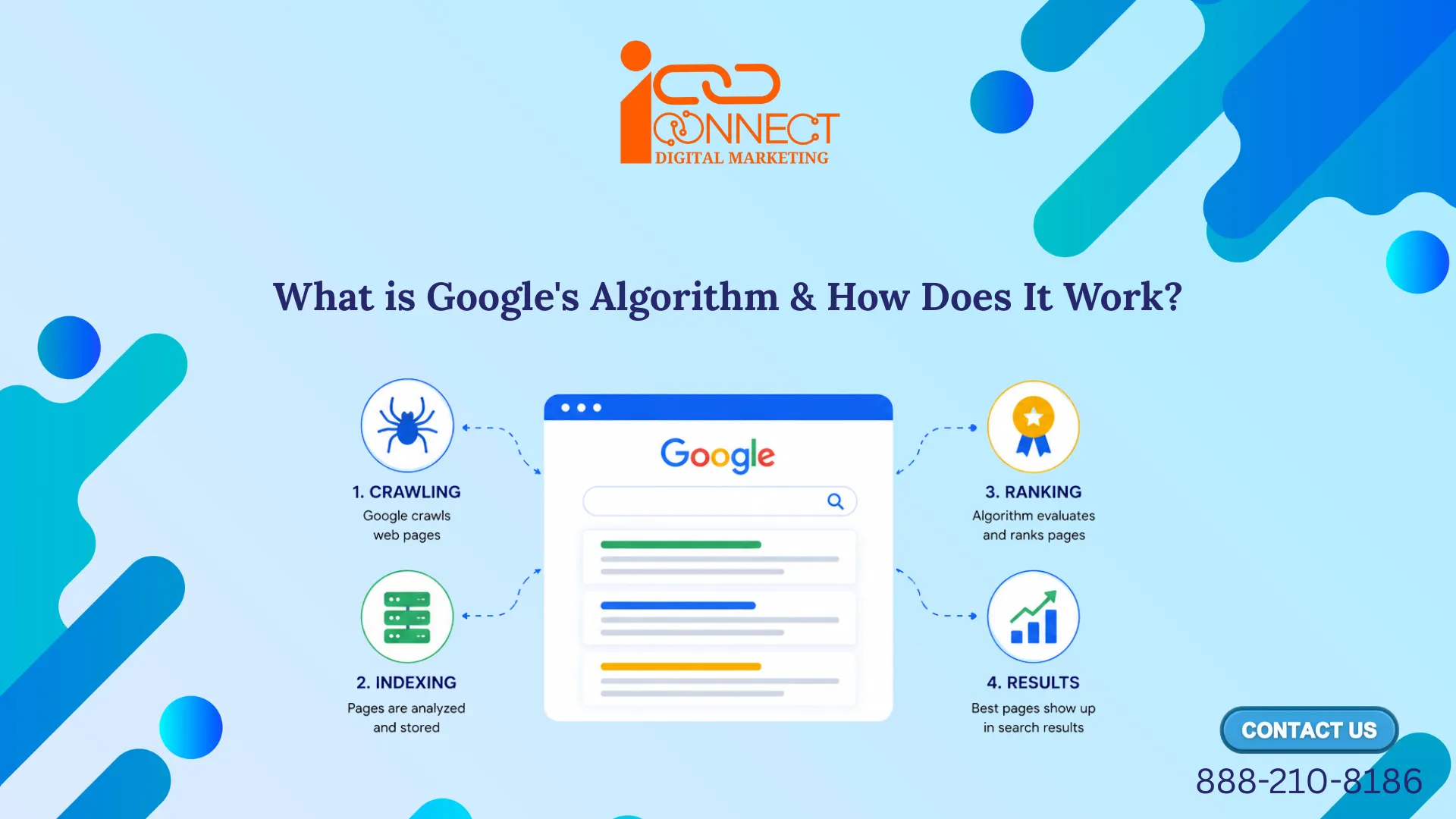
Before a web page can normally appear in Google Search, Firstly, Google must be able to find and index it. This process takes place through three easy steps:
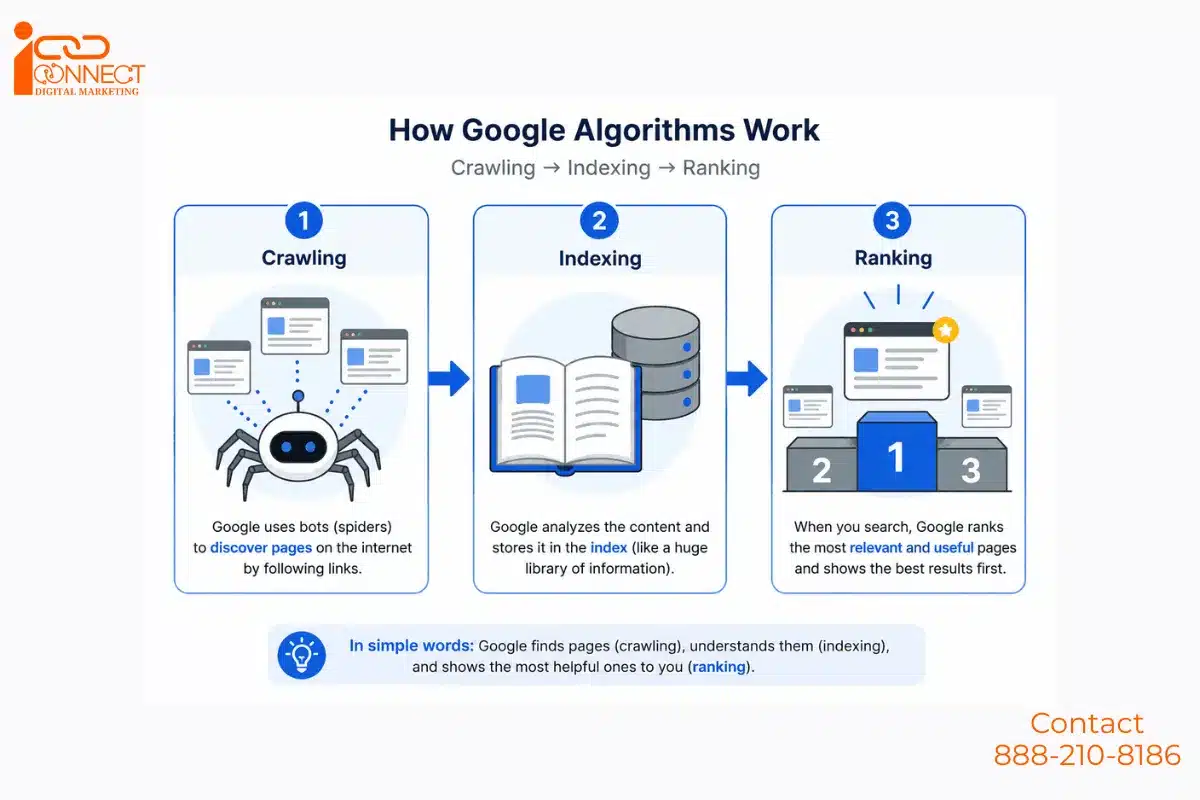
- Step 1: Crawling: Google makes use of special software, often referred to as bots or spiders. This is used to search for information throughout the web. The bots travel from one page to another through the use of links, and this is done through the process of crawling.
- Step 2: Indexing: As soon as the bot crawls into the site, it takes into consideration everything within it, the text, pictures, and even video contents. Google stores all this information in a huge database called the search index. Which allows for the immediate acquisition of the data by Google through any search request. This process is called Indexing.
- Step 3: Ranking: Last, but not least, when you perform a search query, Google will not search all over the internet again. It will only check the index, retrieve pages that contain the information, and rank them according to the quality and relevance of information. Algorithms call this last process ranking.
You may also be interested in: 👉 What Are Search Engines and How Do They Work?
Major Google Algorithms and How Each One Came About
Now comes the interesting part. Over the years, Google has built and released several major algorithms. Each one came out to fix a real problem people were facing while searching.
- PageRank (1998)
This is where much of Google’s early ranking innovation began. Larry Page and Sergey Brin were still students at Stanford University which is located in the United States, when they built PageRank as part of a research project. Their idea was simple. A link from one page to another works like a small vote of trust. Pages with more quality votes climbed higher. This concept laid the base for Google itself.
- Florida Update (2003)
As Google gained popularity, more and more website owners started using keyword tricks to boost rankings. Google wanted to control this practice. The company launched the Florida update, and it just worsened the situation. This is because it came just prior to the Christmas shopping season. Many site owners got caught off guard when their rankings fell dramatically overnight. Many people in the SEO industry considered this the first major wake-up call.
- Panda (2011)
By this time, the internet was full of thin, copied content made just to earn ad money. Users were getting frustrated with poor quality results. A Google engineer named Navneet Panda led the fix, and the update, named after him, pushed low-value sites down and gave genuine content a fair chance again. Panda was named after Google engineer Navneet Panda and later became part of Google’s core ranking systems.
- Penguin (2012)
Backlink manipulations such as spammy links continued influencing rankings despite the changes in the Panda algorithm. In order to avoid these manipulations, Google applied the Penguin algorithm, which penalized only the particular web pages that used such manipulations. By 2016, Google introduced this change to its core algorithm.
- Hummingbird (2013)
Before that time, the search results for local searches were entirely separate from normal web search results. This algorithm allowed Google to integrate local search listings into normal search results via web ranking factors.
- Pigeon (2014)
Until the release of this algorithm, there was no correlation between local search results and web search results. Nevertheless, Pigeon has rectified this problem, allowing Google to incorporate local search results into the web search results and rank them using the very same metrics traditional web pages use.
- Mobilegeddon (2015) or Mobile-Friendly Update
Since more searches were being conducted via smartphones than computers, Google made it a priority to have mobile-friendly sites ranked higher in its ranking system. Therefore, non-mobile friendly sites were immediately kicked out of the search engine results page.
- RankBrain (2015)
Google was getting millions of searches it had never seen before. Old rule-based systems struggled with these odd or vague queries. So Google has to bring RankBrain, its first real machine learning system. It learned from patterns instead of fixed rules. RankBrain marked an important stage in the increasing use of machine learning within Google Search.
- Fred (2017)
Around this time, a lot of websites leaned heavily on ads and thin affiliate content. The community nicknamed this crackdown Fred. Since Google never officially confirmed a name, but it clearly hit sites that cared more about revenue than readers.
- BERT (2019)
In spite of the progress made after the release of Hummingbird, Google was unable to comprehend the significance of certain words in long sentences. Using the information from natural language processing, BERT allowed Google to understand the sentence by reading all the words within that sentence relative to each other.
- Core Updates (2018 onward)
In contrast to past updates, which concentrated on solving a certain problem, Google adopted a different strategy and introduced core updates multiple times in a year. Core updates are not aimed at addressing any certain problems, as they just reassess everything and reward those sites that possess actual expertise, experience, authority, and trustworthiness (E-E-A-T).
- Helpful Content Update (2022 and Beyond)
In 2022, Google introduced its helpful content system with an increased focus on content created primarily to help people rather than content produced mainly to attract search-engine traffic. This one came directly from user frustration. Too many creators wrote articles just to rank, not to help. Google responded by rewarding content written for actual people first, and search engines second.
For website owners, this means “helpful content” should not be treated as a separate SEO box to tick. A page should genuinely satisfy its intended audience, provide original value where possible, answer the main search needs clearly and avoid being created primarily to manipulate search visibility.
What This Means for You
- Overlooking changes in the algorithms will have you losing traffic very quickly.
- Writing high-quality and relevant information protects you from any future updates.
- Google ranks those websites higher in searches now which load quickly and work well on mobile.
Frequently Asked Questions: What Are Google Algorithms?
Google core updates are comprehensive changes made to Google’s search ranking algorithms. The purpose of such an update is to improve the overall quality and relevancy of the search results without concentrating on a particular site or on any single SEO technique. The loss of ranking following the launch of a core update does not automatically indicate a penalty.
Google first discovers web pages through crawling, processes eligible pages for its index, and then uses automated ranking systems when someone searches. These systems evaluate potentially relevant results using signals related to meaning, relevance, quality, usability, context and other factors before presenting search results.
Google makes many changes to Search over time, ranging from small adjustments to broad core updates. Not every change is publicly announced. Google generally announces major updates when the information is particularly useful for website owners, publishers and search professionals.
E-E-A-T should not be treated as one direct ranking factor or a single score assigned to every website. Experience, Expertise, Authoritativeness and Trustworthiness are concepts used in Google’s Search Quality Rater Guidelines to describe characteristics associated with content quality, particularly where trust and accuracy matter.
Yes. Search traffic can increase or decrease after ranking-system changes because Google may reassess which pages best satisfy particular queries. However, a traffic decline does not automatically indicate a penalty. Search demand, competitors, changing intent, technical issues and content changes can also affect organic traffic.
A website can regain search visibility, but there is no guaranteed recovery formula. The useful approach is to identify which pages and queries lost visibility. Check technical and indexing issues. Compare the content with current search intent. Correct inaccurate or outdated information and make substantial improvements where they genuinely benefit users.
Conclusion
Google algorithms have come a long way. A lot of changes have occurred since the creation of the simple link-counting formula of PageRank back in 1998 to today’s machine-learning powered system. Despite all the algorithm updates, Google still values quality, relevancy, and authority but does not tolerate any cheating or manipulations. For students, marketers, and website owners, the knowledge about this algorithm evolution history will help to create long-lasting content. In case of further Google algorithm improvements with artificial intelligence, it is the most reliable approach to keep writing for people first, and the rankings will be a consequence.

Mohit Vij is the Founder & Digital Marketing Trainer at iConnect Digital Marketing Training Hub & Agency (iConnectDM), based in Ghaziabad. With over 9+ years of experience in SEO, Google Ads, Meta Ads, Social Media Marketing, Search Intent, Content Marketing, and Lead Generation.
Over the past years, He has trained hundreds of students, job seekers, working professionals in building successful careers in digital marketing while helping businesses improve their search rankings, website traffic, brand visibility, and lead generation. His insights are based on hands-on industry experience, continuous learning, and proven digital marketing strategies that deliver measurable results.