

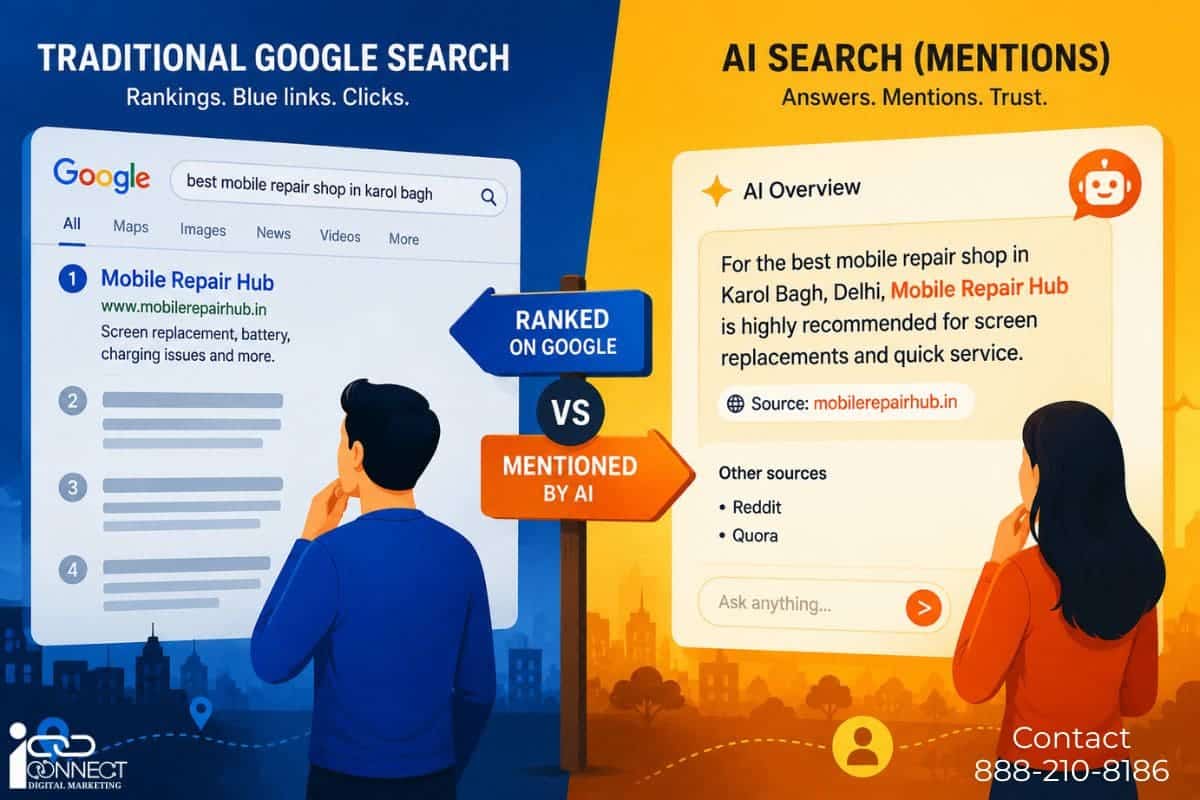
Imagine a situation — you are running a small mobile repair shop in the crowded Gaffar Market in Karol Bagh, Delhi. If your store is located right at the main entrance near the metro station, every shopper looking for a cheap screen replacement sees your glowing banner first. This prime physical placement is exactly like ranking high on traditional Google Search.
Alternatively, if your shop is located deep inside the narrow lanes of Nehru Place or Palika Bazaar, but you have a loyal agent at the entrance gate who answers everyone’s questions by saying, “Go straight, the third shop has the best phone cases,” that agent is acting like a traditional search engine crawler — guiding the foot traffic directly to your doorstep. This is exactly like being mentioned by Artificial Intelligence (AI) tools like ChatGPT, Google AI Overviews, or Perplexity.
The internet is changing very fast today. According to search industry updates from Search Engine Land, recent Google Core Updates have permanently changed how people find information online. Traditional click traffic to standard website links has dropped significantly. Because of this, business owners must stop writing just for computer bots. Instead, they need to earn trusted mentions from AI models.
Understanding the clear line between traditional Google search rankings and AI mentions is vital. It is a fundamental requirement to survive online and beat big competitors.
You may also be interested in: 👉How Does Google Decide Website Rankings?
What ranking on Google actually means today
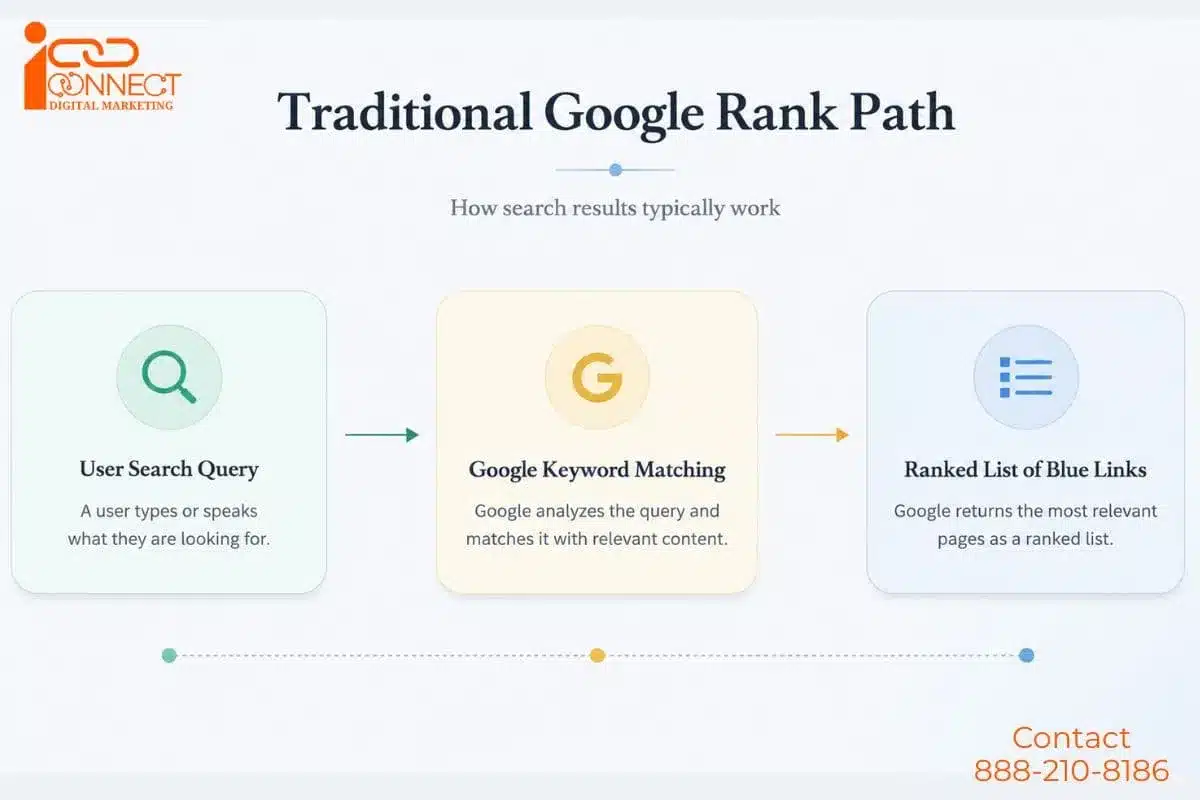
Ranking on Google means your website link appears at the very top of the screen when someone types a question into a search box. For many years, this process was purely mechanical.
Mechanical library systems
Google operates like an enormous public library. Its automated computer programs browse billions of web pages. It organizes them into giant digital files. When you type a word, Google uses complex mathematical formulas to sort through these files. It checks website speed, words, and authority to show you a list of blue links.
Historical search loopholes
In the past, clever web builders could easily trick this system. A business owner could hire someone to write thousands of empty words. They would repeat the same keyword over and over again. By buying cheap links from random websites, that low-quality page could jump to the number one spot.
However, Google’s latest updates have stopped these shortcuts completely. The system now focuses entirely on a strict quality rule called E-E-A-T (Experience, Expertise, Authoritativeness, and Trustworthiness).
You may also be interested in: 👉What Is Google E-E-A-T? A Complete SEO Guide
True meaning of an AI mention
Being mentioned by AI means a smart AI model actively picks your business, data, or product to write a direct answer for a user.
Synthesis engines at work
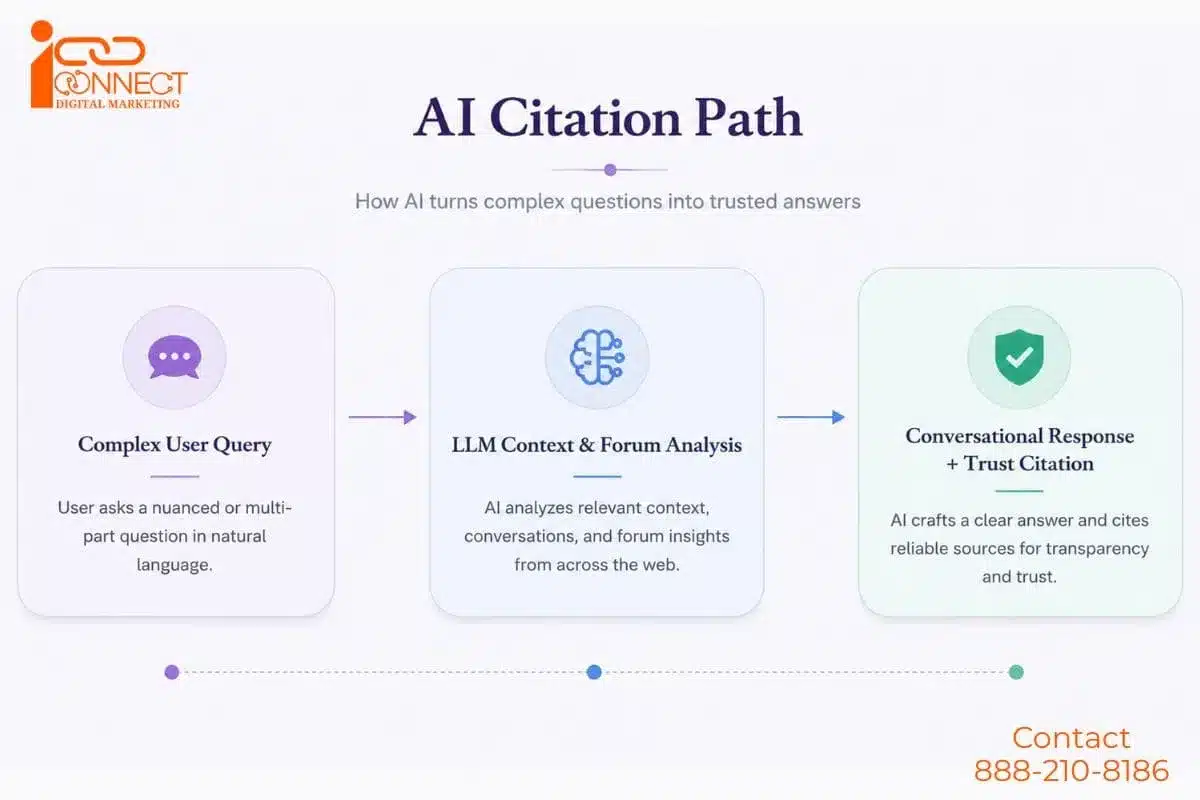
AI tools do not just give you a list of website files to click. Instead, platforms like ChatGPT or Perplexity read thousands of internet pages all at once. They understand the true meaning behind a user’s question. Then, they write a completely fresh, single response.
If your website has a clear fix for a problem, the AI pulls your exact words into its response. It then places a small clickable badge next to your brand name.
Position independence in AI discovery
A big surprise about AI search is its position independence. Data compiled by search researchers from Wellows shows that you do not need to be a massive website to get noticed by AI. In fact, studies show that 47% of citations in Google AI Overviews come from web pages ranking below position 5 in standard search results.
Consequently, even if a massive company dominates the top spot on Google, a smaller website can completely bypass them. If your content is clear, you can become the primary source cited by the AI overview.
Direct comparison of search features
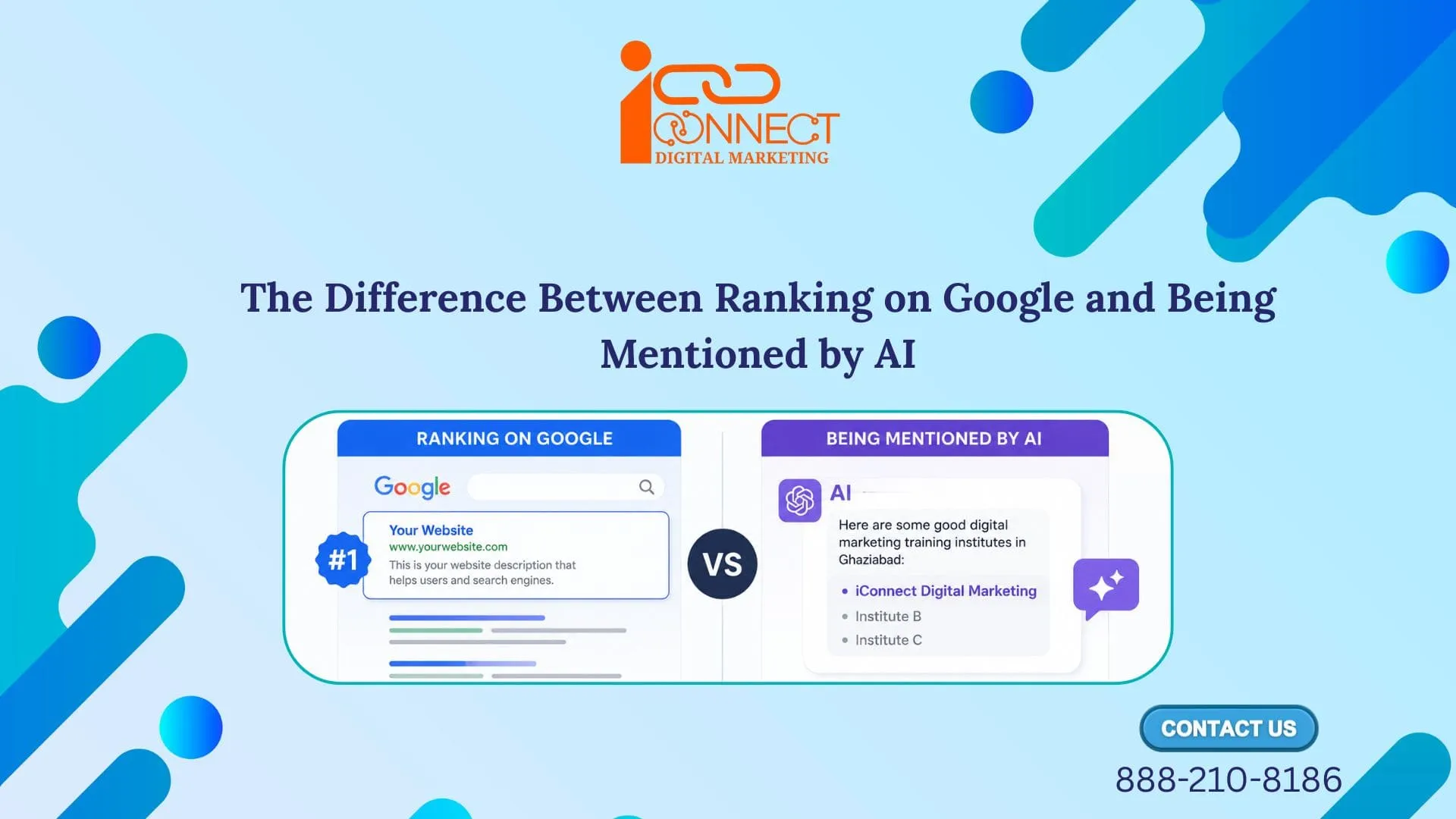
To clearly see how these two systems diverge, let us look at their core mechanics side by side.
| Feature | Ranking on Google | Mentioned by AI |
| Format | List of links (10 blue links) and snippets. | Conversational summary or direct answer. |
| User Intent | User clicks through multiple sources to find the answer. | User gets a single, synthesized response. |
| Traffic Path | Click-through to your website. | Often no click-through; the user gets the answer instantly. |
| Visibility Metric | SEO rankings, organic click-through rate (CTR). | Brand mentions, citations, and inclusion in training data. |
Why Keywords Fail where context wins
The functional differences between these two states come down to how content is analyzed, presented, and rewarded.
- User Interaction: Google gives you a list of links to click. AI provides a finished answer directly on your screen.
- System Evaluation: Google historically matched exact words. AI reads text like a human judge, looking for honesty and real usefulness.
- Core Rewards: A Google rank brings direct traffic to your site. An AI mention builds instant trust and gives you highly targeted customers.
In addition, a thorough study conducted in regard to AI search behavior on Search Engine Land found out that AI searches often bypass corporate sites. Rather, they simply get their information from discussion forums like — Reddit and Quora. Why is this so? The simple answer to this question is that AI gives higher importance to real-life conversations than to overly complex language used in business environments.
How Google updates enforce real human experience
Google has already managed to integrate the E-E-A-T concept into its system in order to close the gap between traditional ranking and AI.
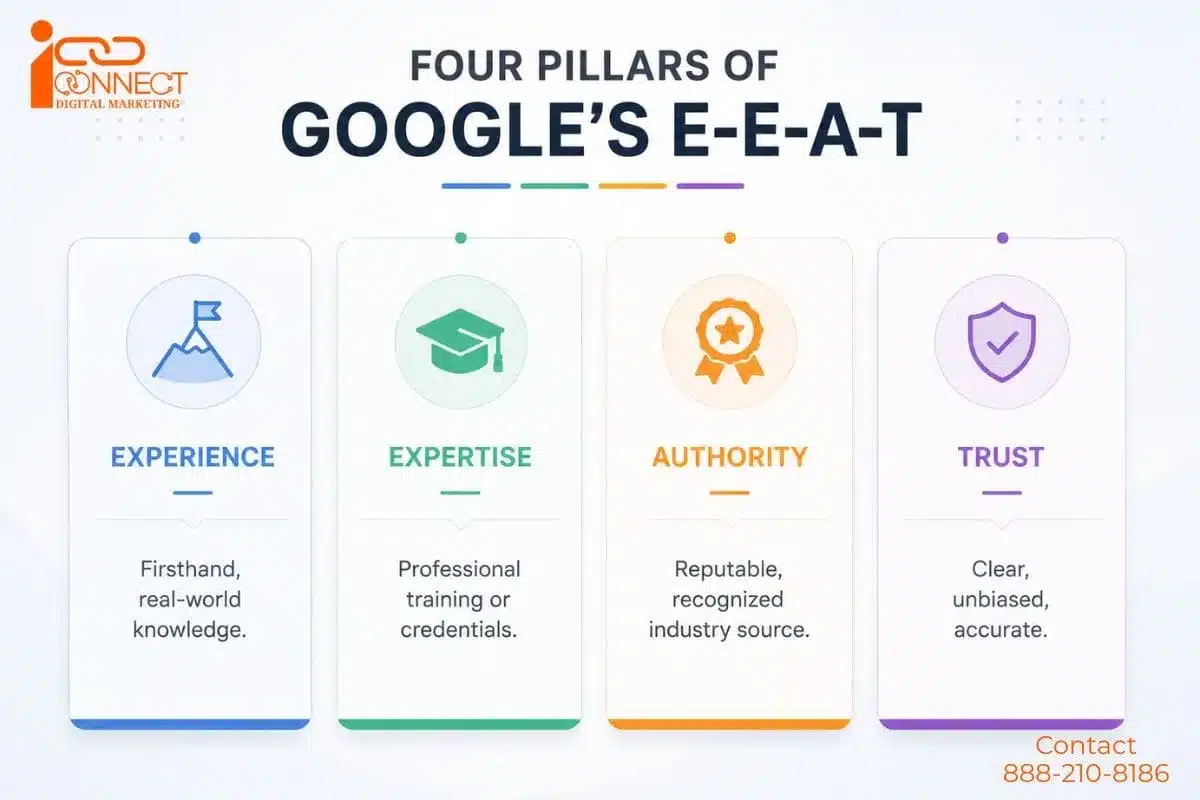
You should understand these essential quality signals:
- Firsthand Experience: Did you actually test the product yourself? Or are you just rewriting someone else’s thoughts?
- Real Expertise: Do you have the background, degrees, or professional training to support what you’re saying?
- Industry Authority: Is your platform widely known and respected as a go-to voice in your specific niche?
- Pure Trust: Is your information accurate, transparent, safe, and completely honest for the reader?
Battle against empty text
Google’s updates specifically target thin, robotic articles made just to win rankings. If an article reads like an encyclopedia summary, Google drops its rank. The system now actively looks for signs of physical presence, unique data, real photographs, and human stories. Therefore, if your website lacks these signals of true human experience, it will lose its Google rank. It will also fail to appear in AI search summaries.
Problems that happen when optimizing the wrong way
Let us look at a real-world failure to see how these systems interact.
Mistakes of over-optimization
A local agricultural supplier wanted to sell an organic pest control spray. They published an 8,000-word blog post filled with repeated keywords like “best pest spray” and “buy low cost pesticide online.” They bought hundreds of cheap links to boost their score.
Consequences of recent updates
When Google rolled out its recent core updates, this page collapsed completely. The article was empty of real-life substance. It did not contain original field test data, expert farmer interviews, or clear safety warnings. It was just a copied version of other internet articles.
Furthermore, a study highlighted by Search Engine Land proved that Google AI Overviews actively punish self-serving corporate lists. While the AI might look at a brand’s page for reference, it filters them out of actual recommendations if honest community trust signals are missing. The company spent significant money on old tactics, yet they became completely invisible.
In addition, a thorough study conducted in regard to AI search behavior on Search Engine Land found out that AI searches often skip corporate sites and take their answers straight from discussion forums such as Reddit and Quora. Why does it do so? Simply because the AI values genuine human conversations more than corporate jargon. The company spent significant money on old tactics, yet they became completely invisible.
Real case studies proving the search shift
To understand exactly how this works in practice, we can analyze the data from landmark digital marketing case studies.
Case study 1: Princeton University experiment
A massive joint academic study by Princeton, Georgia Tech, and IIT Delhi mapped out exactly how to increase AI search visibility. Researchers modified web content to see what AI models prefer.
- The Strategy: They embedded hard statistics, clear facts, and data tables directly into simple text.
- The AI engines read the pages but completely left out the self-praising brand from the final shortlist. The Result: Content optimized with clear, fact-backed data tables saw an incredible 40% increase in AI citations over standard SEO text.
Case study 2: Lily Ray AI recommendation study
SEO researcher Lily Ray conducted a live analysis published on Search Engine Land investigating how Google AI Overviews treat corporate brands that boast about themselves.
- The Strategy: She analyzed corporate blogs that published self-serving lists titled “Why We Are the Best Provider” to see if AI tools would recommend them.
- The Result: Instead, they recommended independent competitors who had strong community mentions on public forums. This proved that self-promotion without honest proof fails in AI search.
Fixing your website for both systems
The solution to this modern challenge is a unified content strategy—often called Generative Engine Optimization (GEO)—that provides concrete proof to Google while serving concise factual summaries to AI platforms.
Using clear answer capsules
Data confirms that web pages structuring their insights into highly direct, upfront summaries get cited 67% more often by AI engines.
Industry experts call these Answer Capsules. Write a highly accurate, direct answer under 40 words right at the start of a section. Do not include promotional talk or external links inside this specific block. This makes it incredibly easy for an AI model to extract your text and cite your website as the primary source.
Highlighting authentic case studies and real data
Every piece of content you produce must feature a real-world anchor. Include real field testing data, specific local problem logs, and direct quotes from real buyers. This fulfills Google’s strict E-E-A-T criteria while feeding AI models the high-quality data they look for.
Simplifying technical website frameworks
AI models rely heavily on backend organization to understand your website. Ensure you use structured data tags on your website (also known as Schema Markup) that will clearly convey to search engines who you are, what products you offer, and who the author of your content is. Keep your URL addresses short, descriptive, and clean.
Summary of findings
In conclusion, traditional Google ranking requires tactical keyword density and link authority to secure traffic via classic lists of links, whereas AI overview demands structural entity authority, clean information tables, and real community trust to win automated conversational endorsements.

Mohit Vij is the Founder & Digital Marketing Trainer at iConnect Digital Marketing Training Hub & Agency (iConnectDM), based in Ghaziabad. With over 9+ years of experience in SEO, Google Ads, Meta Ads, Social Media Marketing, Search Intent, Content Marketing, and Lead Generation.
Over the past years, He has trained hundreds of students, job seekers, working professionals in building successful careers in digital marketing while helping businesses improve their search rankings, website traffic, brand visibility, and lead generation. His insights are based on hands-on industry experience, continuous learning, and proven digital marketing strategies that deliver measurable results.