

People believe that Google Ads and PPC provide an instant solution for increasing website traffic. The process of running a campaign requires more than just investing money into the operation. The process requires you to select appropriate keywords while determining your target audience and verifying that actual results come from your website visitors.
Final-year students learning digital marketing often understand PPC concepts in theory but struggle to apply them in practical situations. Knowing terms and having the experience in PPC (Pay Per Click) through small projects allows you to acquire Job-Ready skills. Some like CPC, CTR, bidding strategy, or conversion tracking is useful, but employers and internship recruiters usually expect candidates to understand how campaigns are planned and improved in real business scenarios.
This guide covers Google Ads PPC Project Ideas for Final Year Students who can practice using real or simulated business examples. The focus is on learning how paid advertising decisions influence traffic, clicks, leads, and conversions.
You May Also be Interested in |👉 What is Digital Marketing and How Does It Work?
What Do We Understand by PPC and Google Ads?
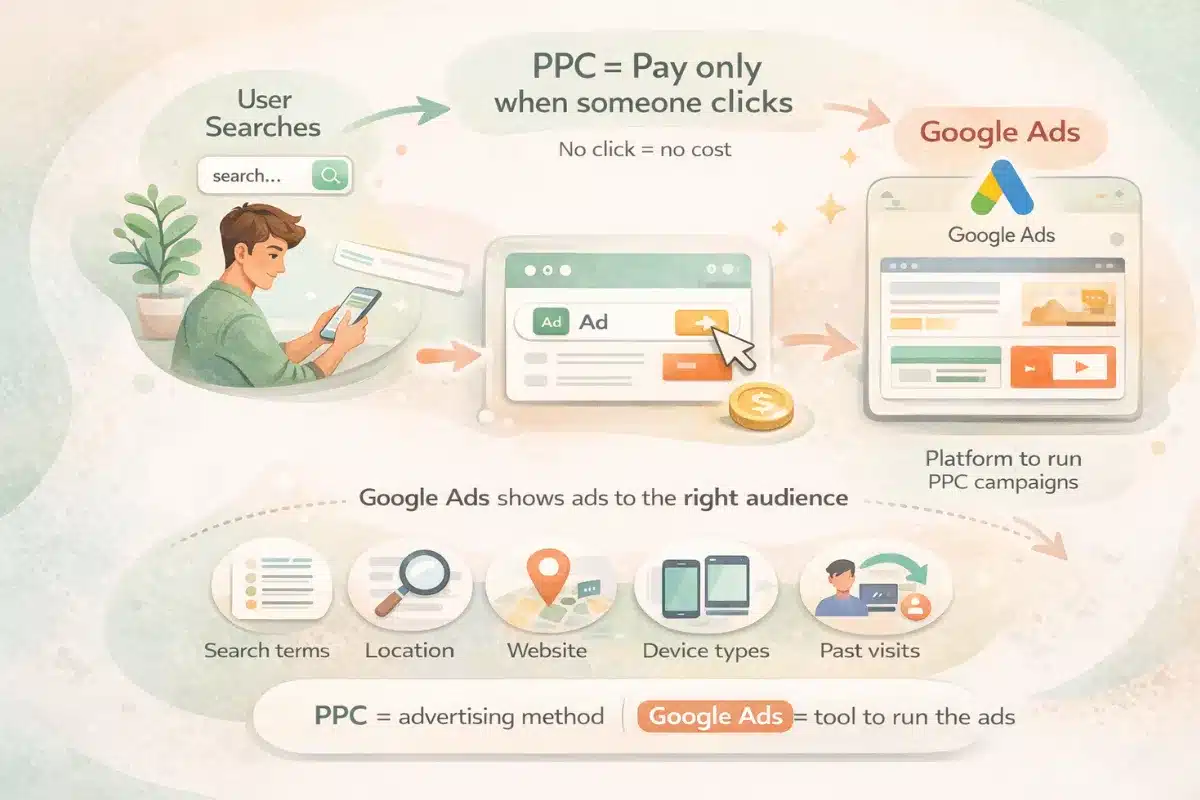
PPC (also called as Pay Per Click) is a digital advertising model (form of online advertising). In PPC, where advertisers pay only when someone clicks on an ad. This means that business pays only when a person clicks on the ad and visits the website or landing page instead of paying for the ad display. The instant advertising service from PPC enables businesses to show their ads on search engines and various websites.
Google Ads is one of the most widely used PPC advertising platforms. It allows businesses to display:
- Ads in Google search results
- Banner ads on websites
- Video ads on YouTube
- Ads again to people who have already visited their website
- Local service campaigns
The most significant advantage of Google Ads comes from its ability to target specific audiences. The advertising platform enables businesses to select their desired audience through four different criteria which include search terms, geographic location, device type, and previous websites visited by users.
For example, a local coaching digital marketing institute in Ghaziabad may want its ads to appear only for students searching terms like “IELTS coaching near me” or “digital marketing course in Ghaziabad.” This targeting helps businesses avoid spending money on unrelated audiences.
We can say that:
- PPC is the advertising model, i.e. pay for clicks
- Google Ads is the platform that is used to launch and run those ads
Hence, it is better for students to understand both as it helps them learn how paid marketing actually drives real traffic, leads, and sales.
You May Also be Interested in |👉 What Is Google AI Mode and How Does It Work?
Why Studying PPC Projects Matters for Students
Practical PPC Projects help students understand how digital advertising works beyond classroom theory.
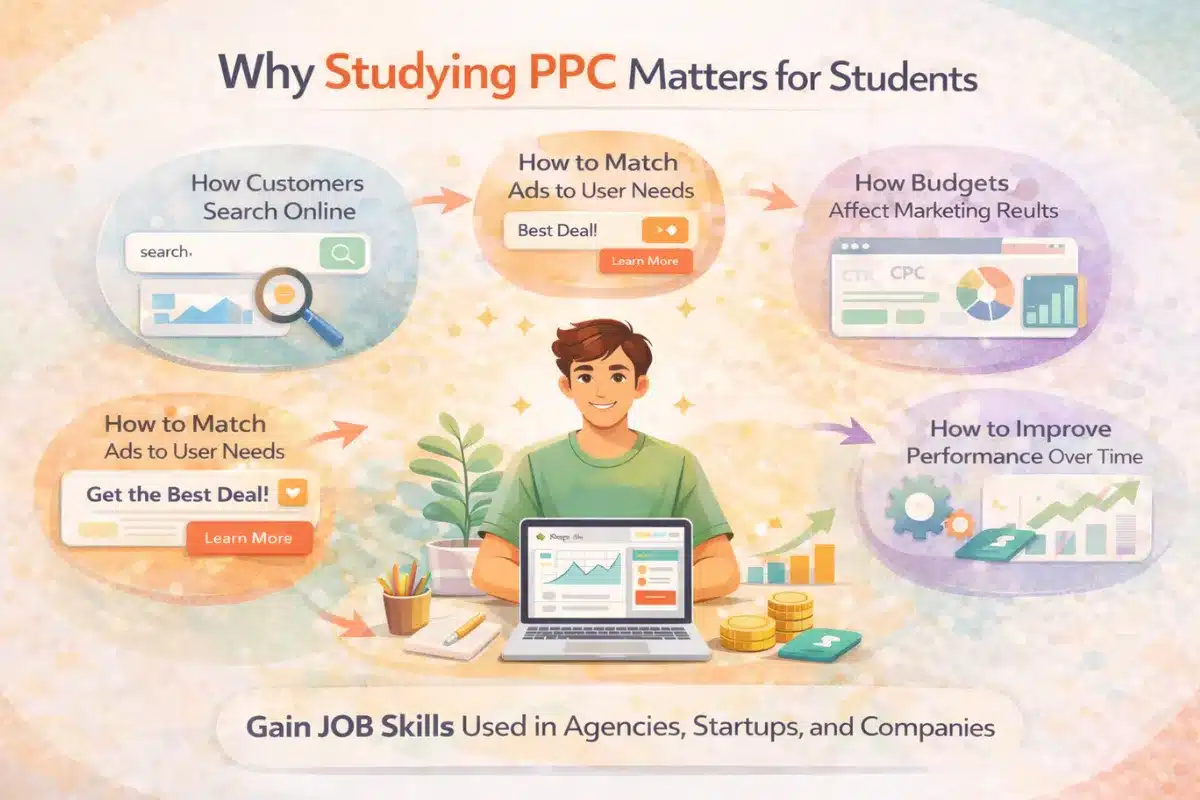
Working on PPC projects helps students to learn about:
- How Customers/Users search online
- How Keyword intent affects campaign performance
- How landing pages affect conversions
- How campaign data is analyzed
- How to match ads to user needs
- How to measure campaign success
- How to improve performance with optimization
These are real practical job skills used in digital marketing agencies, startups, ecommerce businesses, SaaS companies, local service providers, performance marketing teams, and companies of all sizes. Even small practice projects can help students explain campaign logic more confidently during interviews and internships.
The Student PPC Learning Path
To make things easier, these projects follow a progressive learning structure:
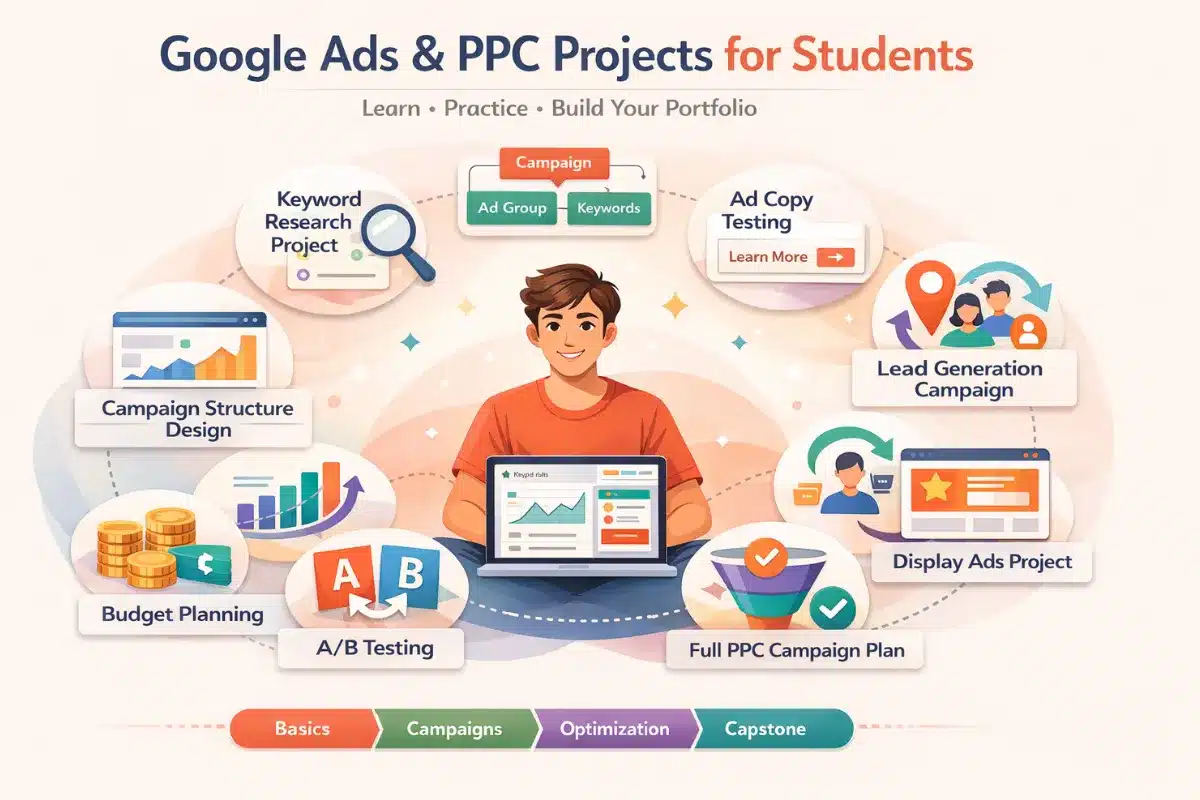
Level 1 – Basics: Keyword research, ad writing, campaign structure
Level 2 – Conversion Campaigns: Leads, local targeting, display ads
Level 3 – Optimization Skills: Remarketing, testing, performance analysis
Level 4 – Capstone: Full PPC strategy project
Common Tools Used in Google Ads PPC Project Ideas for Final Year Students
- Students working on PPC (Pay Per Click) Projects commonly use:
- Google Ads
- Google Keyword Planner
- Google Analytics
- Google Tag Manager
- Google Sheets
- Canva
- Looker Studio (Formerly called Google Data Studio, Looker Studio is a free reporting and dashboard tool from Google.)
- Google Ads Keyword Forecasting tools
Learning how these tools connect with each other helps students understand how advertising performance is measured in real campaigns.
Top Google Ads & PPC Project Ideas for Final Year Students
1. Keyword Research Blueprint for a Real Business
Objective
Learn how to identify search terms customers actually use.
What you should do
You can pick a real local business such as — Gym, Salon, Bakery, Coaching Center, Dental Clinic, etc. and then create a keyword research document for that business.
Many beginner PPC campaigns fail because keywords are too broad. For example, targeting “gym” may attract irrelevant clicks, while “women fitness classes in Noida” usually reflects clearer search intent.
This project helps students understand why keyword specificity matters.
Implementation steps
- Write down the services offered by the particular business.
- Use Google Keyword Planner to find related search queries.
- Organize Keywords and create groups.
- Service Keywords
- Location Keywords
- Long-tail queries
- Create a spreadsheet including:
- Keyword
- monthly searches
- competition level
- suggested bid
- Select Primary Keywords or Top 10 Keywords you would really use. Highlight the most relevant keywords for campaign targeting.
Tools
Google Keyword Planner, Google Sheets
Skills gained
Keyword research, intent understanding, campaign preparation
Final tangible outcome
A structured keyword research spreadsheet ready for campaign use.
2. Google Ads Campaign Structure Design
Objective
The goal in this project is to know how campaigns, ad groups, and keywords are organized.
What you should do
Create or Design a complete campaign structure for one service business.
Implementation steps
- Select a business (e.g., “Home Cleaning Service”).
- Create:
- 1 campaign (Search campaign)
- 2–3 ad groups (for instance, Deep Cleaning, Office Cleaning, Move-out Cleaning)
- You can assign 5–8 keywords per ad group.
- Write the structure in a document or diagram.
- DefineTargeting :
- Target location
- Daily budget
- Campaign goal
- Language
Tools
Google Ads interface (demo), PowerPoint / Canva / Sheets
Skills gained
Campaign organization, keyword grouping
Final tangible outcome
A visual campaign structure chart.
3. PPC Ad Copy Creation & Comparison
Objective
Learn how different messaging influences clicks.
What you should do
Write multiple ad copies for the same business and compare them.
Implementation steps
- Write 3 ad variations:
- one price-focused
- one benefit-focused
- one urgency-focused
- Each ad should include:
- headline
- description
- call to action
- Put them in a comparison table.
- Explain which you think will perform best and why.
Tools
Google Ads preview, Docs or Sheets
Skills gained
Copywriting, positioning, CTA clarity
Final tangible outcome
A PPC ad copy comparison sheet.
4. Local Lead Generation Campaign Plan
Objective
Understand how PPC campaigns generate enquiries.
What you should do
Plan a Google Ads lead campaign for a local service.
Implementation steps
- Select a service (e.g., dentist or coaching center).
- Define:
- location radius
- audience type
- Create:
- keyword list (10–15 keywords)
- 2 search ads
- Design a simple landing page wireframe including:
- headline
- form fields
- CTA button
- Explain how leads would be tracked.
Tools
Google Ads, Canva, Google Forms
Skills gained
Lead targeting, landing page planning
Final tangible outcome
A complete lead campaign mini-proposal.
5. Display Ad Campaign with Banner Designs
Objective
Learn how visual ads help build awareness.
What you should do
Create a display campaign for an event or product.
Implementation steps
- Choose a product/event.
- Define target audience interests.
- Create 2 banner designs in Canva:
- square banner
- rectangle banner
- Write a short campaign goal.
- List websites or placements where ads may appear.
Tools
Canva, Google Display Network concepts
Skills gained
Visual messaging, audience targeting
Final tangible outcome
Two actual banner creatives + campaign explanation.
6. Remarketing Campaign Strategy Blueprint
Objective
Learn how businesses bring back visitors who didn’t convert the first time.
What you should do
Create a remarketing plan for people who visited a website but didn’t take action.
Implementation steps
- Choose a business or product website.
- Define the audience segment, such as:
- visited homepage only
- viewed product page
- added to cart but didn’t purchase
- Write two remarketing ads:
- reminder-style ad
- offer/discount-style ad
- Decide:
- how many days ads should run
- how often users should see them
- Create a simple flow diagram showing:
Website Visit → Audience List → Remarketing Ads → Conversion.
Tools
Google Ads remarketing concepts, Canva or PowerPoint
Audience segmentation, retention marketing, ad sequencing
Skills gained
Final tangible outcome
A remarketing workflow diagram + ad samples.
7. PPC Budget Allocation & Bid Strategy Exercise
Objective
Understand how campaign performance depends on smart budget planning.
What you should do
Work with a fixed monthly budget and decide how to distribute it.
Implementation steps
- You have to assume a monthly budget (like for example: ₹3000 or ₹25,000).
- Divide it between:
- Search campaign
- Display campaign
- Remarketing campaign
- Then decide daily budgets for each.
- You have to select a bidding strategy for each campaign:
- Manual CPC
- Maximize clicks
- Maximize the conversions
- Develop a spreadsheet depicting:
- campaign type
- budget
- bid strategy
- reason for decision
Tools
Google Sheets, Google Ads documentation
Skills gained
Budget planning, cost control thinking, campaign prioritization
Final tangible outcome
A budget allocation spreadsheet with explanation notes.
8. PPC Performance Analysis & Optimization Report
Objective
The goal is to learn how to read campaign results and improve them.
What you should do
You will analyze a sample PPC report and suggest improvements.
Implementation steps
- Use a sample report (from online tutorials or simulated data).
- Record key metrics:
- CTR
- CPC
- conversions
- cost per conversion
- Identify:
- best performing keyword
- worst performing keyword
- strongest ad
- weakest ad
- Suggest 3 improvements, like:
- pausing weak keywords
- improving ad headline
- adjusting bids
- Write a one-page optimization report.
Tools
Google Ads sample reports, Excel/Sheets
Skills gained
Data interpretation, campaign evaluation, optimization thinking
Final tangible outcome
A written PPC performance analysis report.
9. A/B Testing Plan for Ads or Landing Pages
Objective
In this project, you will understand how structured testing improves results.
What you should do
Create a test that compares two ad headlines or landing page versions.
Implementation steps
- Choose what to test:
- two headlines
- two CTA buttons
- two landing page layouts
- Write a clear hypothesis, for example:
“Including price in the headline will increase CTR.” - Define:
- success metric (CTR or conversions)
- testing duration
- audience size
- Design both versions visually or in text.
- Prepare a testing plan document explaining:
- what is being tested
- expected outcome
- how winner will be chosen
Tools
Google Ads experiments concept, Canva, Docs
Skills gained
Testing mindset, conversion optimization, analytical thinking
Final tangible outcome
A complete A/B testing plan with sample creatives.
10. Full PPC Campaign Strategy (Capstone Project)
Objective
Combine everything into one professional, portfolio-ready PPC project.
What you should do
Choose a real or imaginary business and build a full Google Ads strategy.
Implementation steps
Step 1 — Business overview
Write:
- business type
- target customers
- marketing goal
Step 2 — Keyword research
Create a list of 20–30 keywords grouped by ad group.
Step 3 — Campaign structure
Define:
- campaign type(s)
- ad groups
- targeting settings
Step 4 — Ad creatives
Write:
- 3 search ads
- 1 display banner concept
Step 5 — Budget plan
Define:
- monthly budget
- daily budget split
- bidding strategy
Step 6 — Landing page outline
Sketch:
- headline
- benefits
- form/CTA
Step 7 — Tracking & reporting
Explain:
- how conversions will be tracked
- what metrics will be monitored
Put everything into a single presentation or PDF proposal.
Tools
Google Ads, Keyword Planner, Canva, Sheets, Docs
Skills gained
End-to-end PPC planning, campaign strategy, reporting skills
Final tangible outcome
A complete PPC campaign proposal ready for portfolio or interview.
Typical Google Ads Performance Benchmarks
Students can use these industry-based averages as rough reference points:
- Search campaign CTR: about 3–7%
- Conversion rate: around 2–6%, depending on industry
- Display campaign CTR: usually below 1%
- CPC: varies widely based on competition and keyword intent
These figures come from industry studies like — LOCALiQ (WordStream) Google Ads benchmark reports, Google Ads training resources, and marketing research from HubSpot. They serve as performance indicators that enable you to assess whether campaign results operate within typical performance boundaries.
Common Mistakes Students Make in PPC Projects
- Selecting very broad keywords instead of focused ones
- Forgetting to add negative keywords
- Writing unclear or generic ad headlines
- Ignoring landing page quality
- Not planning budgets realistically
- Launching campaigns but not reviewing performance
Avoiding these mistakes instantly makes your work look more professional.
Student Google Ads & PPC Project Ideas Checklist
Before submitting your project, confirm:
- Campaign objective clearly defined
- Keywords researched and grouped logically
- Target audience/location selected
- Ads written and reviewed
- Budget and bid strategy planned
- Conversion tracking or metrics included
- Final report or presentation prepared
Frequently Asked Questions About PPC or Google Ads Projects for Students
The best PPC project for beginners is a local lead generation project. You will create a simple website for selling products or providing services like home cleaning, Digital Marketing Classes, or laptop repair, then run ads using Google Ads or Meta Ads Manager. Students can do planning of this using Google’s Keyword Planner inside a free practice account. This helps beginners learn keyword research, ad creation, audience targeting, budgeting, and conversion tracking. Keyword research and campaign structure projects are usually the best starting point because they help students understand how Google Ads campaigns are organized.
No. Students can learn campaign planning, keyword research, ad writing, and optimization using demo accounts, simulations, and practice datasets. However, running live campaigns with a small budget helps students understand real performance metrics such as clicks, conversions, and CPC. However, even an amount of ₹300–₹500 is enough for basic hands-on experience and practical learning.
The most important PPC skills for digital marketing jobs are Keyword Research, ad copywriting, audience targeting, landing page planning, conversion tracking, campaign optimization and many more.
Yes. Practical projects help students explain how they approach campaign planning, optimization, and marketing decisions in realistic business situations.
Negative keywords prevent ads from appearing for unrelated searches. This helps improve targeting quality and reduces wasted ad spend.
Conclusion
Learning PPC becomes much easier when students work on practical projects instead of relying only on theory. Ultimately, the most efficient method to learn PPC requires practical experience. So, you should select a project which you will complete by applying your gathered knowledge.
Your notes and your created ads will serve as your reference material. And the actual work you did will mean more than the theory, thus making it easier to talk about your skills in an interview or internship.
These projects, though small in scope yet effective, will give you confidence and help you understand the concepts in a much better way. This is what will help final-year students get closer to actual opportunities in digital marketing.
The purpose of these projects is not to achieve perfect advertising results immediately. The real value comes from understanding how advertising decisions influence clicks, lead quality, conversions, and campaign performance over time.

Mohit Vij is the Founder & Digital Marketing Trainer at iConnect Digital Marketing Training Hub & Agency (iConnectDM), based in Ghaziabad. With over 9+ years of experience in SEO, Google Ads, Meta Ads, Social Media Marketing, Search Intent, Content Marketing, and Lead Generation.
Over the past years, He has trained hundreds of students, job seekers, working professionals in building successful careers in digital marketing while helping businesses improve their search rankings, website traffic, brand visibility, and lead generation. His insights are based on hands-on industry experience, continuous learning, and proven digital marketing strategies that deliver measurable results.