

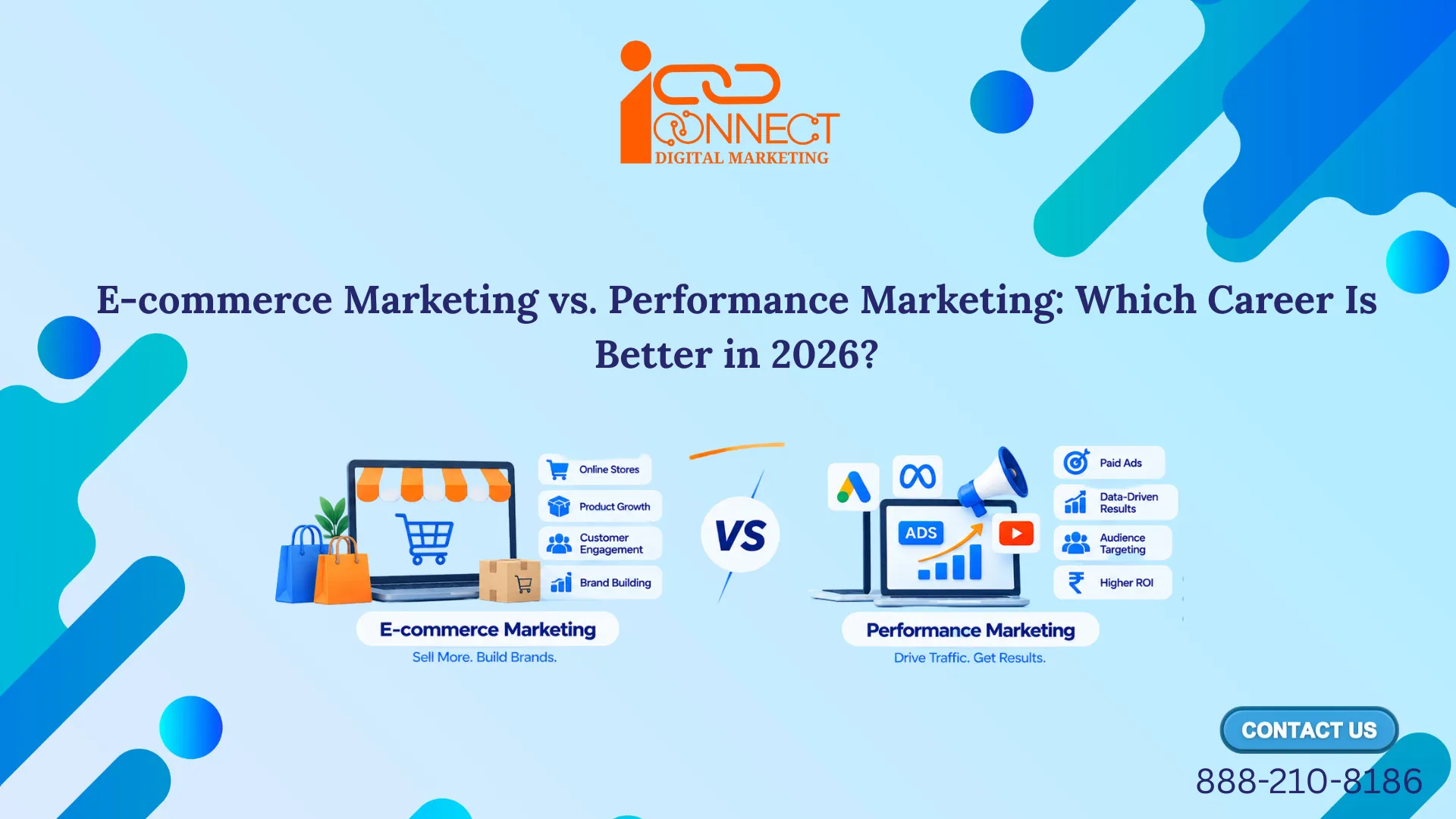
Performance Marketing and E-commerce Marketing are two solid career paths within digital marketing. Although, both focus on full business growth. They are different in their responsibilities, required skills, and career opportunities for everyone.
Performance Marketing is a type of digital marketing in which we make sales and acquire customers for our businesses with the primary focus on generating measurable results through paid advertising campaigns. In other words, performance marketing involves how much money is spent on ads with calculating the ratio between the investment that is made in online advertisements and the amount of success that we get from it, such as the number of clicks, purchases, or inquiries received from an ad on social media platforms such as Instagram or Google.
E-commerce Marketing on the other hand, is the process of promoting products through online platforms to increase sales. It covers a broader range of activities involved in attracting online shoppers, improving their purchasing experience, and encouraging repeat purchases. This includes everything from publishing advertisements of goods or items such as clothing, shoes, electronics, baby products, furniture etc. on popular platforms like Amazon or Flipkart. We can also sell our products through our e-commerce website to social media and getting customers interested in buying products.
Through online marketing, the company gains many more customers. Here, marketers manage everything required to do product SEO, paid advertising, email marketing, conversion rate optimization, marketplace promotions, and customer retention for repeat purchases.
However, I would recommend Performance Marketing for those who are inclined towards learning paid ads, want fast career progression, and want good starting pay. On the other hand, if you like to gain proficiency in the entire retail business from end to end, then go with the option for learning E-commerce Marketing.
So, which career should you choose in 2026?
If you want to work and enjoy with numbers, running ads, analyzing results, and testing various strategies, then Performance Marketing could be a great career option for you.
On the other hand, if you are looking to open your own business in future or interested working with an ecommerce company who is selling products online, understanding customer needs, promoting products, and driving business growth, then E-commerce Marketing might be the right choice for you.
Both fields offer excellent career opportunities. You simply need to decide which field you would prefer to work in based on your interests, skills, and career goals.
What Is Performance Marketing?
Performance Marketing is an data-driven approach for ad setup where you only spend money when you see real results. That means you won’t have to throw big money upfront at billboard or TV ads, since every expense here ties directly to a specific outcome. In this you will generate qualified leads for your business, increasing online sales, acquiring new customers, or encouraging app installations through your digital ad campaign.
Unlike traditional advertising, where campaign effectiveness can be difficult to measure directly, performance marketing provides detailed data about campaign reach, clicks, conversions, and advertising costs. Such as a click on that ad, a lead form submission, an app install, or an actual sale—rather than paying just to display the ad.
Also, this area of expertise allows you to get into a variety of industries since it equips you with skills on how to market your products and sell them quickly. This is why the skills you acquire here are very technical, meaning that you will be able to move from one sector to another.
Example of Performance Marketing: Nykaa
- Nykaa: Nykaa, a major Indian beauty and lifestyle retailer. They used the Google Performance Max Strategy along with Value-based Bidding, which enabled Nykaa to get a 50% increase in customer acquisition while keeping their CPA targets intact [Nykaa: AI-driven advertising in India].
What do we mean by E-Commerce Marketing?
It is all about overseeing the entire online shopping experience right from start to finish. Some of the elements include — product SEO, abandoned cart emails, influencer marketing, website design, and sales promotions. As compared to performance marketing that relies entirely on paid acquisition. E-commerce Marketing is all about the full process, i.e., the complete frontend and backend process.
Furthermore, through this path you get the chance to master the field of online shopping, brands, marketplaces, customer retention, and the lifecycle of products. You will be trained on everything about starting up and managing your stores, including how to deal with stock and dealing with customers, which makes E-commerce Marketing the ideal path for such skills.
Example of E-Commerce Marketing: Myntra
Myntra, one of India’s major fashion e-commerce platforms. Myntra combined tactics involving — Google search, streaming video, and live inventory to reach shoppers from passive browsing to active checkout. Data released by Google reveals that syncing ad triggers directly with digital storefront architecture expanded Myntra’s ultimate return by 37% in late 2022. Therefore, one may be able to say that E-commerce Marketing goes beyond the initial acquisition cost; rather, it basically combines discovery, experience, and closure.
You may also be interested in: 👉Content Marketing vs SEO vs Performance Marketing: Which Career Is Better in 2026?
Where do E-commerce Marketers Work?
E-commerce marketers come in to picture wherever products or services are purchased online. In specific terms, they cover five primary business functions:
- B2C or Online Retail: Business-to-consumer (B2C) e-commerce involves selling products directly to individual customers through online stores or their websites. Here, marketers focus on product discovery, promotional campaigns, website conversions, and customer retention.
- D2C or Direct-to-Consumer: Direct-to-consumer (D2C) brands sell products directly to customers through their own websites or other brand-controlled channels emphasizing retention of customers.
- Online Marketplaces: Marketplaces such as Amazon, Flipkart, Myntra, Meesho connect buyers with multiple sellers by increasing the number of product categories and promotional campaigns.
- Omnichannel Retail: This is an interesting setup, where you combine your online and offline shopping experiences deals with campaigns directly with physical, brick-and-mortar stores.
- B2B E-commerce: Business-to-business (B2B) e-commerce involves online transactions between companies. Here, you deal with large-scale online sales and long, complex buying processes between different companies.
E-commerce Marketing gives you specific insights into dealing with products, stores and their management and increasing the customer lifetime value. Whereas, the skills that you acquire during performance marketing tend to be platform-oriented as such, thus allowing easy application in different industries like software and finance.
How Does Performance Marketing Differ from E-Commerce Marketing?
In performance marketing, we focus on ad results, whereas in e-commerce marketing, we focus on the overall growth of the online store and products. Performance marketing can also be a part of e-commerce marketing. So let’s see some of the major differences between these two:
| Aspect | Performance Marketing | E-commerce Marketing |
| Primary focus | Paid ads and quick sales. Drives cold traffic and tracks profit margins on ad spend. | The whole online store. Manages complete storefront journey from landing pages to checkout. |
| Core skills | Include – Media buying, tracking data, testing ads, and analyzing daily web numbers. | Include – Writing email sequences, sorting product catalogs, pricing, and managing stock levels. |
| Success metric | Cost per sale (CPA) and your total return on ad spend (ROAS). | Total store revenue (GMV) and how often past buyers return. |
| Industry reach | Very wide. Transfers easily across software (SaaS), finance (Fintech), education, apps, and retail. | Retail specific. Stays focused on direct-to-consumer (D2C) brands, online marketplaces, and retail shops. |
| Tools used | Google Ads, Meta Ads Manager, GA4, and mobile tracking apps. | Shopify, Klaviyo (emails), Amazon Seller Central, and site tracking tools. |
| Funnel stage | Top of the funnel. Focuses purely on finding fresh buyers and getting them to click and convert. | Full funnel. Focuses heavily on customer service, email updates, and bringing old buyers back. |
| Time horizon | Short-term and fast. Changes budgets and turns ads on or off daily based on performance. | Long-term and planned. Follows seasonal holiday sales, product launches, and monthly calendars. |
| Budget type | Variable ad budgets. Manages fluctuating ad spend directly inside ad networks. | Fixed business costs. Pays for software apps, email platforms, tool subscriptions, and shipping impacts. |
| Data reliance | Ad platform pixels. Tracks pixel data and tracking links to see which ad worked best. | Direct customer data. Relies on direct store sales history, email lists, and customer feedback. |
| Main risks | Ad platform changes. There can be sudden algorithm updates, rising ad costs, and audience getting tired of ads. | Store supply problems. Running out of stock, shipping delays, and losing money to huge discount wars. |
“Performance marketing gets customers through the door. E-commerce Marketing determines what happens after they arrive.”
— Mohit Vij, Founder, iConnect Digital Marketing
Skills That Compound in Each Career
Performance Marketing
- Google Ads
- Meta Ads
- Analytics
- Tracking
- Attribution
- Experimentation
- Creative testing
- Budget management
- ROAS/CPA/CAC
- Incrementality
On the other hand, E-commerce Marketing
- Product Merchandising
- Product and catalogue management
- Customer Relationship Management (CRM)
- Email and WhatsApp Marketing
- Conversion Rate Optimization (CRO)
- Pricing and Promotions
- Marketplace management
- Customer experience (ORM)
- Inventory coordination
- LTV/repeat purchase
Salary Comparison Between Performance Marketing and E-Commerce Marketing, By Career Level
Here is a tier-by-tier comparison for your information:
Entry (Executive): Performance Marketing pays about 96% more
- Performance Marketing Executive – ₹5,00,000 average, which is based on 127 salaries.
- E-commerce Executive – Glassdoor lists ₹21,250, with average base pay of ₹20K a month, based on 142 salaries. Glassdoor’s headline calls this a yearly figure, but the base-pay line and the recent submissions are all monthly. I have considered it as monthly and after converting, it gives about ₹2.55 LPA.
Mid (Manager): Performance Marketing pays about 38% more.
- Performance Marketing Manager – ₹12,45,000 average, based on 352 salaries.
- E-commerce Manager – ₹9,00,000 average, based on 266 salaries as of June 2026.
Top (Head): E-commerce Marketing comes out about 41% higher (though data sample is very less)
- Head of Performance Marketing — ₹16,25,000 average, which is based on 13 salaries, while the top 10% earning up to ₹40.3 lakh.
- Head of E-commerce – ₹22,97,945 average, it is based on only 3 salaries as of July 2026.
Verdict: Performance marketing provides a clear salary edge at the entry and management levels because companies pay more for direct ad budget ownership and technical platform skills. However, at the very top tier, e-commerce heads take the edge with higher average pay due to their strategic ownership of the store’s complete profit and loss (P&L) operations.
How Do You Grow in Performance Marketing vs E-commerce Marketing?
Both professions have well-defined ways to reach the top, but at varying paces.
Performance marketers begin their careers running minor ad campaigns. Post that, they make progression into managing larger budgets and implementing whole growth strategies. This is the career ladder they follow:
- Executive
- Specialist
- Manager
- Senior Manager
- Head of Growth
- VP of Marketing / CMO
Next, e-commerce marketers first get into the business of product listings. Gradually, they take up the responsibility of entire product lines, website operations, and eventually store management. The career path is as follows:
- Executive
- Specialist
- Category or Brand Manager
- Senior Manager
- Head of E-commerce
- CXO or Chief Experience Officer / Chief Operating Officer
What will I actually do every day — Performance Marketing vs. E-Commerce Marketing?
| A typical day | Performance Marketing | E-commerce Marketing |
| Morning | Check spend, CPA, ROAS, conversion data | Check sales, orders, inventory and store performance |
| Main work | Campaign optimization and testing | Product, promotions, merchandising and retention |
| Meetings | Creative, analytics, sales/growth | Product, operations, merchandising, CRM |
| Decisions | Where should ₹10 lakh ad budget go? | Which products, offers and customer segments should we prioritise? |
| Pressure | Ad performance and acquisition efficiency | Revenue, inventory, conversion and customer experience |
| Main outcome | Efficient customer acquisition | Overall online-store growth |
How AI Is Changing Both Careers in 2026
AI is minimizing the value of repetitive execution in both careers. Consequently, the higher-value skills are moving toward — strategy, experimentation, data interpretation, customer understanding and business decision-making.
| AI impact | Performance Marketing | E-commerce Marketing |
| Automation | Campaign setup, bidding, reporting | Product descriptions, merchandising, CRM workflows |
| Data | Attribution, forecasting, anomaly detection | LTV, segmentation, demand forecasting |
| Creative | Ad copy, images, variations | Product content, email, offers |
| Human advantage | Strategy, experimentation, measurement | Customer understanding, merchandising, commercial judgement |
| New skill | AI-assisted media buying + measurement | AI-assisted CRM + merchandising |
What Skills Should One Gain First if a Fresher?
As a fresher, try to gain the below-mentioned skills if you wish to succeed in the early stages of your career:
- For Performance Marketing: You need to become an expert in Google Ads, Meta Ads, and GA4 tracking. You also need to have knowledge about ad optimization and some basics of metrics like — CPA, CAC, and ROAS. Also, try to perform minimum one ad campaign or build one mock case study.
- For E-commerce Marketing: You need to be skilled in online store platforms, product catalog management, and basics of SEO. You also need to understand some basics of email tools (CRM), marketplaces, and how to promote stores to ensure repeat purchases from buyers. Creating a dummy shop or doing practical e-shop project will make a big plus in your portfolio.
Can You Switch Between Performance and E-commerce Marketing?
Yes, it is possible to shift between the two fields. The reason is that both — Performance and E-commerce Marketing — depend on data, customer acquisition, and digital sales. If you want to transition into Performance Marketing, then learn about Google Ads, Meta Ads, tracking pixels, and ROAS. On the other hand, if you want to make a move to E-commerce side then gain hands-on experience with product pricing, inventory, CRMs, and marketplaces. Ultimately, it all comes down to your practical experience of handling tools and data – not your position – when it comes to making this transition.
You may also be interested in: 👉 Digital Marketing or Performance Marketing: Which One Student Actually Choose in 2026?
Conclusion: Which Career Path Should You Choose — Performance Marketing or E-Commerce Marketing?
In reality, both of these paths provide a good job security in 2026. But according to me, your choice should depend entirely on your personal strengths and career goals.
If you like data, numbers, and quick campaigns, go for Performance Marketing!
- Your working style: You are good at managing ad budgeting, analyzing numbers, conducting campaigns testing, and performing quick edits.
- Career Reality: Costs of advertising are increasing all around the world. Firms are willing to pay extra for those people who can guarantee profit margins and efficient spending of each rupee.
- Future opportunities: With AI taking care of standard advertising campaigns, your future is in high-level strategies, advanced tracking, and smart decision-making.
- Potential Reward: Quick campaigns and high starting salaries with highly technical skill development which can be used in various industries.
Select E-commerce Marketing for running an End-to-End Business:
- Style: You like overseeing physical products, studying consumer psychology, creating the user experience on websites, and nurturing customer loyalty.
- Reality: Internet retailing is booming. Companies require specialists who know how to manage their online store in its totality, not just do advertising.
- Future: The direct relationship with the customer is under your control. Your career cannot be harmed by changes in ad platforms’ algorithms.
- Reward: Although your starting pay may be slower, you get insight into how an entire business functions. That makes you ready for a top management position like COO.
If you are not sure which path actually fits how you think and work — Ask iConnect Digital Marketing and understand the differences and choose a learning path based on the skills you want to build.

Mohit Vij is the Founder & Digital Marketing Trainer at iConnect Digital Marketing Training Hub & Agency (iConnectDM), based in Ghaziabad. With over 9+ years of experience in SEO, Google Ads, Meta Ads, Social Media Marketing, Search Intent, Content Marketing, and Lead Generation.
Over the past years, He has trained hundreds of students, job seekers, working professionals in building successful careers in digital marketing while helping businesses improve their search rankings, website traffic, brand visibility, and lead generation. His insights are based on hands-on industry experience, continuous learning, and proven digital marketing strategies that deliver measurable results.