

Answer at a Glance: Digital Marketing or Performance Marketing
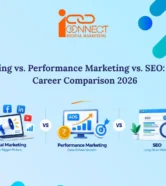
Performance Marketing is not a competitor to Digital Marketing. It’s the paid, trackable part of it and generally considered a results-driven specialization. Digital Marketing is the whole system, including SEO, Content Marketing, Social Media Marketing, E-mail, Websites, and paid ads in combination, and other digital channels. Performance Marketing is just one part of that system. It comprises the paid campaigns where every rupee is tracked to a click, a lead, customer acquisitions, or a sale. It commonly includes paid search, paid social, affiliate marketing, display advertising, and other measurable acquisition channels.
- Digital Marketing = Complete system (organic + paid), covers the wider scope.
- Performance Marketing = Only the paid, trackable part inside it. Focuses more closely on what the marketing spend actually produces.
TL;DR
- Performance Marketing is one paid branch inside the bigger digital marketing field, not a separate industry.
- The gap is small at the Executive level. Performance marketing goes ahead as you move to higher roles.
- Digital Marketing as a career keeps growing directly with India’s digital economy.
- Smartest move in 2026: For beginners, our approach at iConnectDM is to learn digital marketing fundamentals first and then build deeper expertise in performance marketing or another specialisation.
India’s Digital Marketing Opportunity, at a Glance
| ₹2.01 lakh crore | 68.10% | ~20% |
| India’s total ad spend, 2026 | Share of that spend going to digital | Digital economy’s projected share of India’s GDP by 2026 |
Sources: WPP Media TYNY Report, 2026; India’s Digital Economy overview citing government digital-economy targets
The important distinction here is that ₹2.01 lakh crore and 68.1% are projections for India’s advertising market in 2026. The approximately 20% digital-economy figure refers to the longer-term projection for around 2030, rather than 2026.
Comparison: Digital Marketing vs Performance Marketing
| Area | Digital Marketing | Performance Marketing |
| Main focus | Build visibility, traffic, engagement and customers across digital channels | Drive measurable actions such as leads, sales or conversions |
| Typical channels | SEO, content, social media, email, paid ads, analytics | Google Ads, Meta Ads, affiliate, display and other paid acquisition channels |
| Main goal | Grow the brand and customer base across the digital journey | Get measurable results from marketing spend |
| What you work on | Content, SEO, social, email, websites, campaigns and analytics | Campaign setup, audience targeting, bidding, creatives, landing pages and conversion tracking |
| Key metrics | Traffic, rankings, engagement, leads, conversions and revenue | CPA/CPL, conversion rate, ROAS, revenue and conversion volume |
| Time horizon | Often a mix of short- and long-term growth | Usually more focused on measurable, near-term campaign results |
| Budget focus | Can include both organic and paid activities | Strong focus on paid media and efficient use of ad spend |
| Skills needed | Broader mix of marketing, content, SEO, social and analytics skills | Stronger focus on paid media, analytics, testing, tracking and optimisation |
| Best suited for | Someone who wants a broader marketing skill set | Someone who enjoys numbers, testing and performance-driven work |
Is Performance Marketing Better Than Digital Marketing?
No, because it can’t run without digital marketing supporting it. That is, when you call performance marketing “better”, you mix up a tool with the system that tool belongs to. The question isn’t which one is better of the two. But, it’s “better for what?” Performance marketing is good for quick results, while digital marketing is for long-term growth, like 3 years or 5 years from now.
Key Takeaway: It depends on the timeline which one to choose. Performance marketing is better if you are looking for fast results and love working with numbers. Whereas, digital marketing is suited if you like storytelling and building something that grows with time.
What’s the Difference Between Digital Marketing and Performance Marketing?
Digital marketing is the whole system. It covers SEO, content, email, organic social, and paid ads, which is basically every channel a brand touches online. Performance marketing is the part of that framework. It only covers the paid campaigns you can measure in real time: cost per click, cost per lead, return on ad spend.
As stated earlier, India’s total ad spend will cross ₹2.01 lakh crore in 2026, and digital already owns 68.1% of it. A part of that money funds SEO, content, and brand work that compounds over months or years. The rest of it funds performance campaigns you can switch off tomorrow if the numbers stop working or there is a shift in plans. Both live under “digital marketing”. Only one of them is “performance marketing”.
In 2 years running iConnectDM, we have seen this happen I explain the relationship to students this way:
“Digital marketing is the vehicle. Performance marketing is the accelerator. You still need the vehicle before the accelerator does anything.” — Mohit Vij, Founder, iConnectDM
The analogy is deliberately simple, but the underlying point matters: performance marketing works best when it is supported by strong positioning, relevant messaging, useful landing pages, reliable tracking, and a clear understanding of the target customer.
Can We Say Performance Marketing Is Part of Digital Marketing or a Separate Field?
Though important in the context of digital marketing, it’s officially a sub-field and nothing more. Every job listing and certification body treats performance marketing as one specialisation alongside SEO, content, and social media, rather than an industry on its own.
Let’s see where it fits inside the bigger picture:
- SEO — builds free, long-term traffic
- Content marketing — creates the message ads later amplify
- Social media — builds community and organic reach
- Performance marketing — runs the paid, trackable campaigns
- Email and automation — nurtures leads from both sides
A performance marketer who never touches SEO or content still needs an audience to target and a message that converts. That work comes from the broader digital marketing skill set. In 2 years running iConnectDM, we have seen this happen the same way almost every time: the strongest paid campaigns come from people who understood their audience before they opened an ad account.
This is an observation from our practical experience rather than a guarantee that the same outcome will occur in every campaign.
Which Pays More in India: Performance Marketing or Digital Marketing?
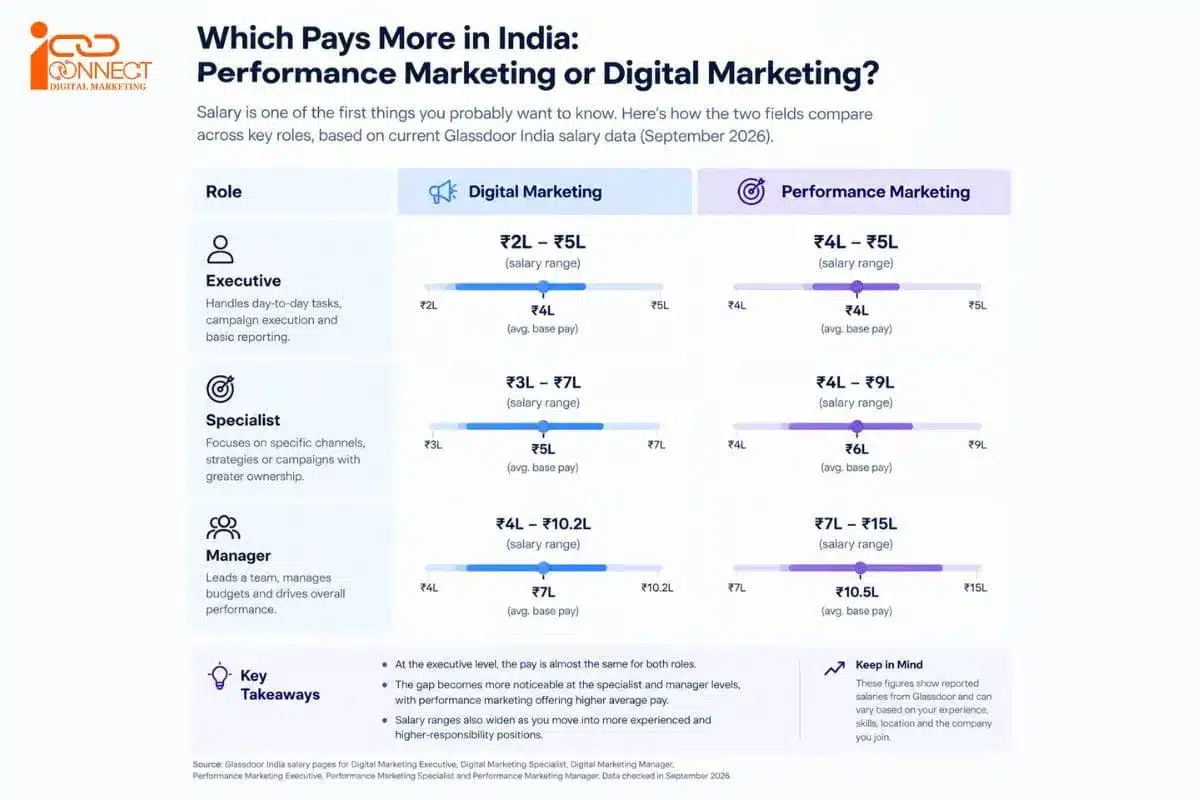
If you are comparing digital marketing with performance marketing, salary criteria is one of the foremost things you may check for. Looking at the chart below, we can say that the gap is not very much at the executive level. However, it becomes more noticeable as you progress into specialist or manager roles.
| Role | Digital Marketing | Performance Marketing |
| Executive | ₹2L–₹5L • ₹4L avg. base | ₹4L–₹5L • ₹4L avg. base |
| Specialist | ₹3L–₹7L • ₹5L avg. base | ₹4L–₹9L • ₹6L avg. base |
| Manager | ₹4L–₹10.2L • ₹7L avg. base | ₹7L–₹15L • ₹10.5L avg. base |
Source: Glassdoor India salary pages for Digital Marketing and Performance Marketing roles, checked in September 2026.
- For the Executive role: They are both similar in terms of average salary.
- As you advance further: Performance marketing is starting to take the lead, since it is showing higher averages at the Specialist and Manager positions.
- With more experience: Larger salaries are possible with increased responsibility.
- Factors that could be responsible for the discrepancy: Handling advertising budget, campaign effectiveness, ROAS and tangible results.
- Takeaway: It is important to remember that performance marketing does not necessarily guarantee increased earnings straight away at the start of your career. The difference will widen with time and specialisation.
Is Digital Marketing a Good Career Option in 2026?
India had more than 1.09 billion internet subscribers as of March 2026, while the digital economy contributes around 12–14% of GDP. And is projected to reach 20% over the next decade.
This will result in larger digital markets for companies and, therefore, increased demand for talent that is able to bring customers, run campaigns, generate content, and generate results from the digital market.
However, in 2026, being successful in a digital marketing career cannot be limited to one channel only. The development of skills related to digital marketing, together with one of the following areas: performance marketing, SEO, content creation, analytics, or artificial intelligence, offers a better perspective.
So yes, digital marketing remains a solid career option in 2026 — but staying adaptable will matter just as much as the job title.
Source: MeitY Annual Report 2025–26 and PIB — Digital India 2026 factsheet
Is Digital Marketing Still Profitable or Not in 2026?
Yes, for businesses that don’t depend much on paid ads alone. Digital ad spend keeps outgrowing the overall ad market, which is exactly why more businesses lean into it every year. But profit doesn’t come from ad spend by itself. It rather comes from organic and paid working combined together. A business running only ads sees its cost per lead climb every time competition rises. A business with SEO and content working behind the scenes of those ads sees that cost per lead flatten out over time. This is because free traffic quietly does part of the job.
Should You Learn Digital Marketing or Performance Marketing First?
Start with the core basics first. Spend four to six weeks just learning simple SEO, content writing, and how to research your audience. Once you actually understand who you are targeting and why, you can then jump into paid channels like Google Ads, Meta Ads, and setting up conversion tracking.
This is similar to driving without any knowledge of traffic laws. We are sure that you will drive quickly; however, you will ultimately waste your ad budget on that audience who are not the right for your business.
Running campaigns without understanding the audience is similar to learning how to accelerate a car without learning how to navigate. You may learn the controls quickly, but that does not necessarily mean you know where you should be going.
Does Performance Marketing Have a Future?
Yes, but the job is changing shape fast. Automation has already taken over the manual part of the work.
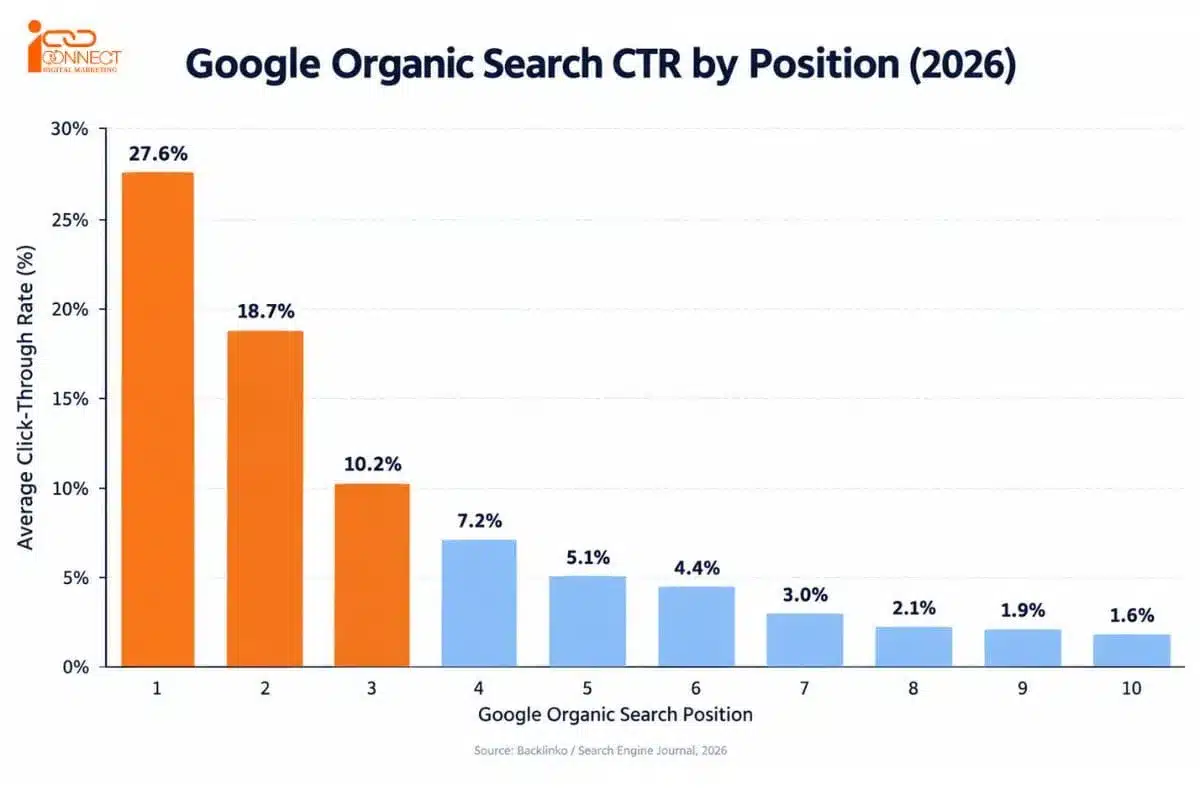
Source: Backlinko / Search Engine Journal.
Position 1 still earns roughly 15x the clicks of position 10 — organic visibility isn’t optional even in an automated, paid-heavy market.
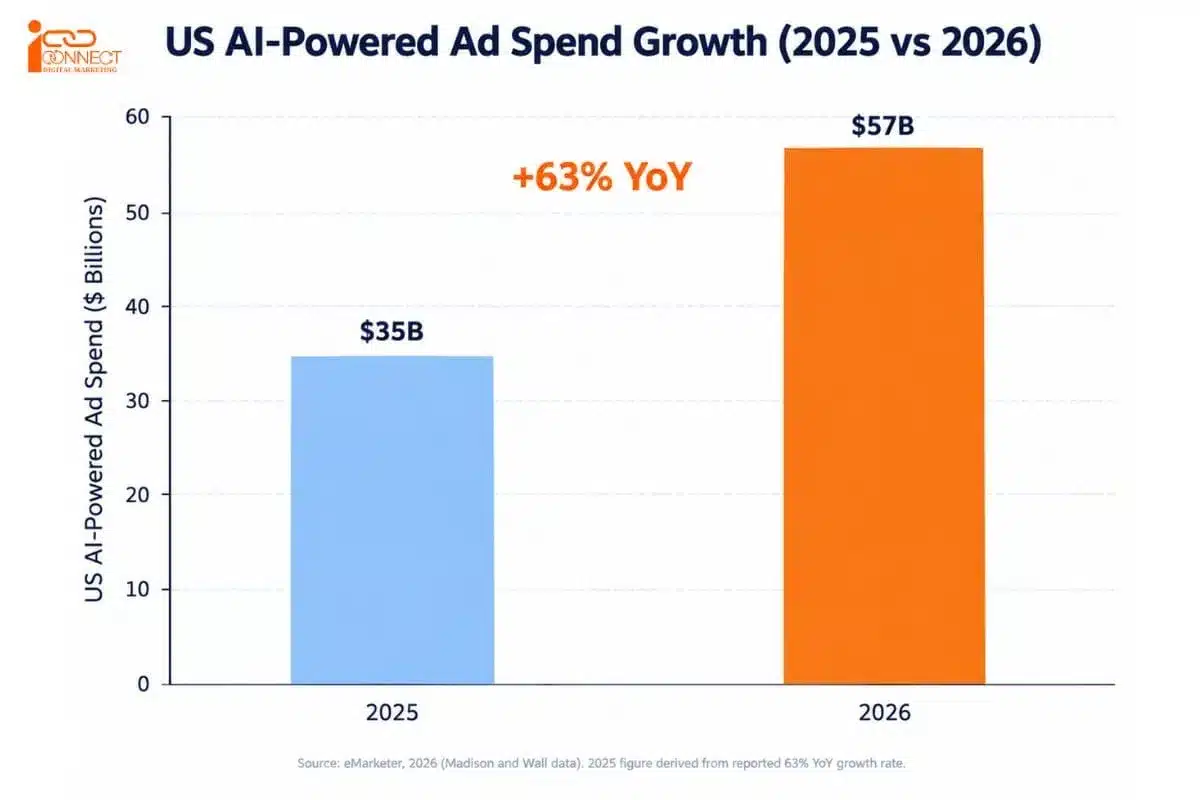
US AI-powered advertising spend is projected to reach approximately $57 billion in 2026, representing 63% year-over-year growth. The 2025 figure of about $35 billion is derived from the reported growth rate. Source: eMarketer, citing Madison and Wall.
| Metric | Figure | Source |
| Advertisers giving Performance Max >50% of budget | 51% | Optmyzr, 24,702 campaigns, June 2025 |
| US AI-powered ad spend, 2026 | $57 billion (63% YoY jump) | eMarketer, 2026 |
This is the automation eating the manual side of performance marketing — the $57B AI-powered category barely existed three years ago.
Now machines can adapt their bidding in real time. However, they cannot determine which message is worth testing, provide clean first-party data to the system, or provide reasoning about the campaign’s performance despite looking good on the dashboard. Though performance marketing has a future, but it belongs to people who manage strategy and data, not people who only manage bids.
Mistakes People Make Choosing Between the Two
- Mistake 1: Treating performance marketing as the shortcut. Ad platforms show results in days, so it feels like the fast track that skips the slow groundwork. Fix: spend two to three weeks on audience research before touching a live ad budget. At iConnectDM, we therefore encourage beginners to spend meaningful time on audience and market research before managing significant live advertising budgets.
- Mistake 2: Businesses pausing or completely stopping all organic work to fund ads. The moment ad costs rise or an account gets restricted, the lead pipeline collapses overnight. Fix: So, you can keep a small, consistent SEO and content budget running alongside ads, always.
So, Which One Should You Prefer — Performance Marketing or Digital Marketing?
In place of asking which one is better, one should ask which one you should learn first. For almost everyone — freshers, career switchers, small business owners — the answer is digital marketing fundamentals first, performance marketing second.
- Performance marketing is a paid, trackable branch inside digital marketing, not a rival to it.
- At the Executive level, reported average pay is roughly the same.
- The gap becomes more noticeable at Specialist and Manager levels, where performance marketing shows higher reported averages.
- Digital marketing’s growth is tied to India’s growing digital economy, and it isn’t slowing down.
- Automation is changing performance marketing, not ending it.
If you are not sure which path actually fits how you think and work — Ask iConnectDM and understand the differences and choose a learning path based on the skills you want to build.

Mohit Vij is the Founder & Digital Marketing Trainer at iConnect Digital Marketing Training Hub & Agency (iConnectDM), based in Ghaziabad. With over 9+ years of experience in SEO, Google Ads, Meta Ads, Social Media Marketing, Search Intent, Content Marketing, and Lead Generation.
Over the past years, He has trained hundreds of students, job seekers, working professionals in building successful careers in digital marketing while helping businesses improve their search rankings, website traffic, brand visibility, and lead generation. His insights are based on hands-on industry experience, continuous learning, and proven digital marketing strategies that deliver measurable results.