

While comparing Content Marketing, SEO, and Performance Marketing, one cannot state which one is a better career choice for you. In 2026, Performance Marketing usually gives you faster feedback because you can see campaign data soon after launching ads. However, on the other side, Content Marketing and SEO takes some time and they will teach you many things about business operations. So if you are about to learn about these two, your decision should therefore not depend only on salary or which field is currently popular. In fact, you should choose the kind of work you can see yourself learning and improving at every day.
In this guide, I’ll explain what each career involves, how they differ, their growth potential, and what I would recommend learning as a beginner based on my own experience working in digital marketing.
Content Marketing vs SEO vs Performance Marketing: What’s the Difference?
Let’s take an example of a shop in a busy market.
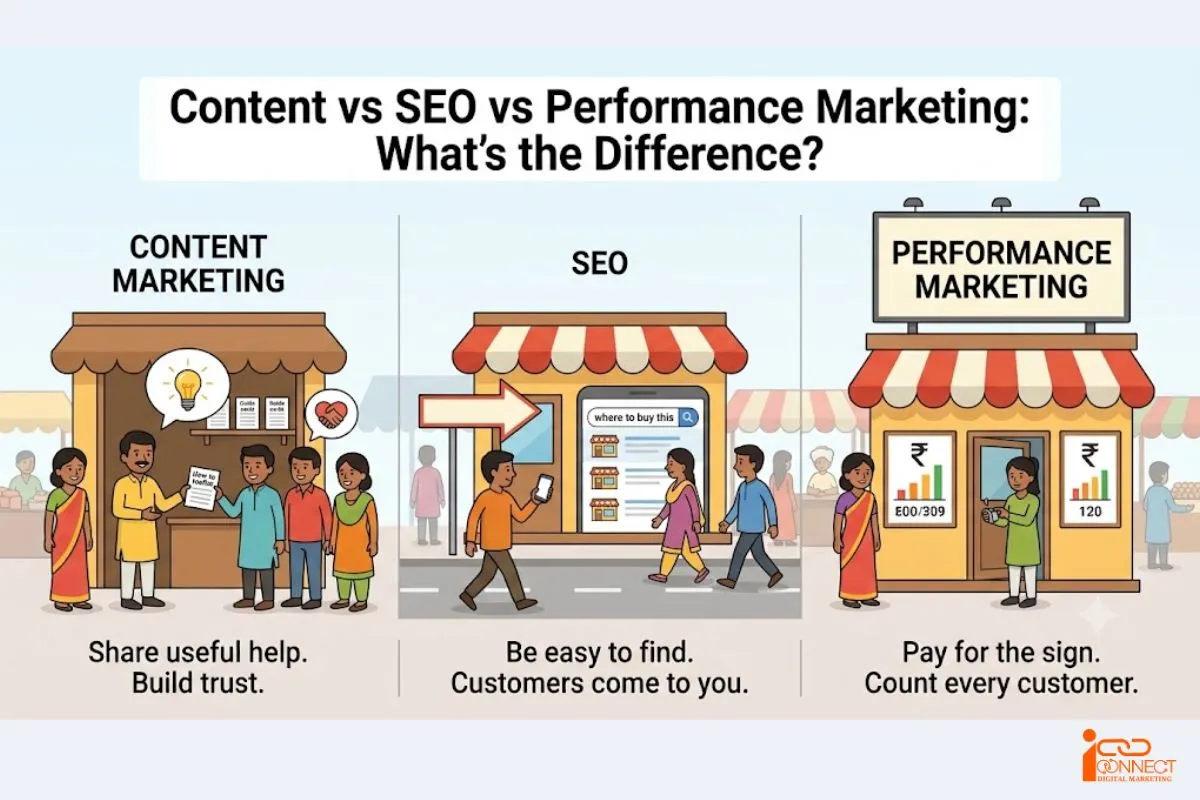
Content Marketing builds trust with useful information, SEO helps customers find you organically, and Performance Marketing uses paid promotion to generate measurable results.
- Content Marketing is where the marketer is giving useful information to customers on their products/services. You will explain all the things to them and in return, they will trust you.
- SEO is placing your shop on the main road. That way, when someone searches “where to buy this”, your website shows up.
- Performance Marketing is paying for a signboard and counting every customer who walks in because of it.
| Career | Main work | Key skills | Feedback speed |
| Content Marketing | Create useful content | Writing, research, planning | Slower |
| SEO | Help people find your website | Search, website checks, analysis | Slower |
| Performance Marketing | Run and improve paid ads | Ads, numbers, testing | Faster |
A content marketer needs to understand how people search. An SEO professional needs useful content. A performance marketer needs good messaging, landing pages, audience understanding, and conversion-focused content.
In fact, the three jobs overlap a lot. That is why many people move between them.
What Does a Content Marketer Do?
Actually, it’s much more than writing blogs. You research what people want to know. Then you plan topics. You write, or you edit other writers. Also, you work with designers. After that, you publish and share the content. Then you check what worked and what did not.
Over time, your tasks will change. You will do less writing and do more planning. Eventually, your work will connect content to business objectives.
How you can start: By developing skills in writing and research. Thereafter, gain the knowledge about SEO fundamentals and analytics. Lastly, create a small portfolio. Content strategy and three well-researched articles should be sufficient.
As a digital marketing professional and trainer, I know from experience that writing a good article is only the first step. Previously, I thought that increasing the number of words would contribute to making the content rank. But once I discovered how readers read my content by searching and analyzing my stats, everything changed for me. Now, I regularly guide my content team — providing precise instructions to improve introductions, capture exact search intent, and refine structure and readability. Ultimately, my main goal is answering the reader’s real question clearly so that every single section stays useful.
Website: https://www.iconnectdm.com/
What Does an SEO Professional Do?
SEO means helping your website show up on Google when people search. Because of this, many beginners think it’s only keywords. But it isn’t. For example, you also check website speed. You fix technical errors. In addition, you improve page structure and read data in Google Search Console.
Also, SEO is not “free traffic”. You don’t pay Google per click, true. But you pay with time, study and patience. Besides, search keeps changing, so you keep learning.
How you can start: Firstly, understand search intent. This means knowing why someone typed a search query. Secondly, you should understand on-page SEO and technical basics. Finally, practice all this knowledge on a live website, even yours.
What Does a Performance Marketer Do?
You are involved in executing and monitoring paid ads on Google, Meta (Facebook and Instagram) and other platforms. Also, you set up campaigns, pick audiences, test ad designs and watch the numbers daily.
See below the main metrics:
- CPL (cost per lead): what you pay for one enquiry.
- CPA (cost per acquisition): what you pay for one sale.
- ROAS (return on ad spend): how much money comes back for every ₹1 spent on ads.
For example, you run ads for an online product. You track purchases and test two ad designs. Then you see one works better, so you shift more budget to it. That’s performance marketing. Because ads give data fast, feedback is quick. That is why this suits people who like numbers and testing.
In one campaign for an e-commerce client, I handled an approx. ₹10,000 daily budget for ads. I experimented with different creatives and checked leads and costs every now and then. Initially, my CPL/CPA was ₹1,000-₹1,200. But I realized that the landing page was affecting the conversion rate too. So I focused on both campaign and landing page and reduced the cost to ₹600-₹700. Later on, I used the campaign data to decide the next changes.
Content Marketing vs SEO vs Performance Marketing: Which Career Pays More in India?
To be honest, salary data can’t give a perfect ranking. Job titles differ, and sample sizes are small. However, treat these numbers as a guide.
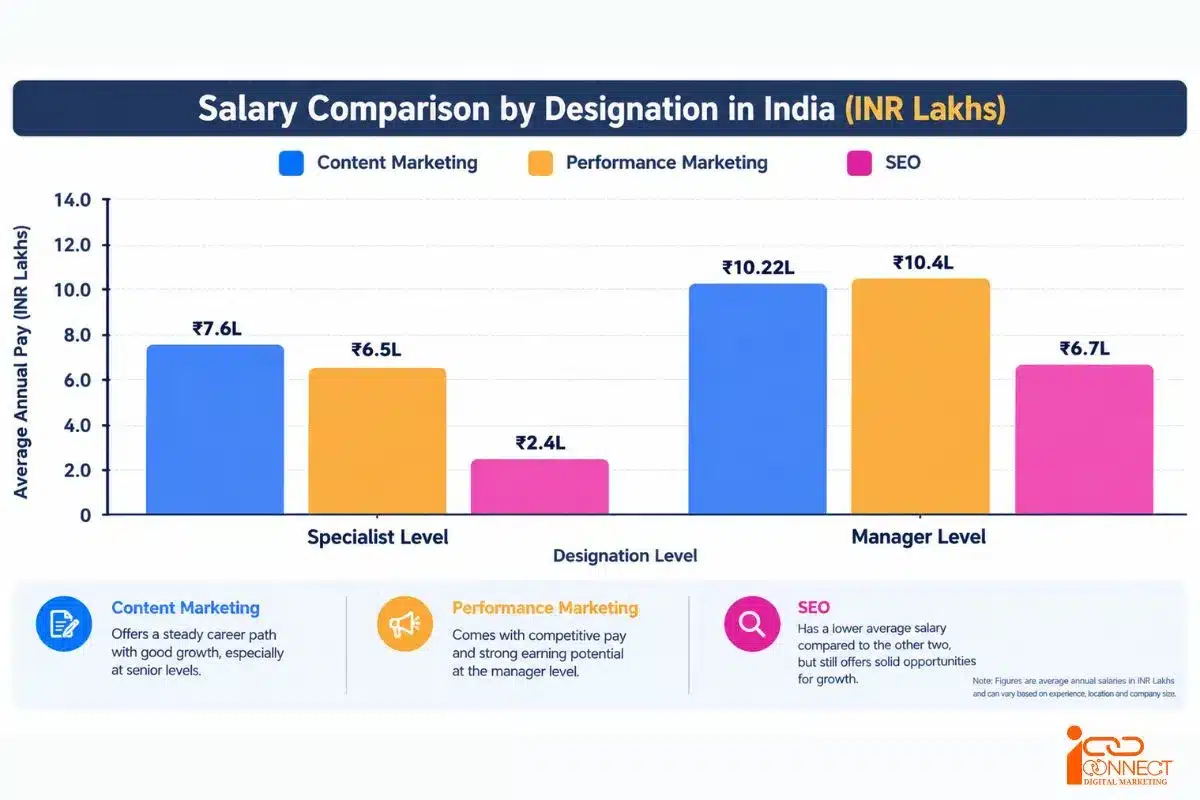
Specialist level (Glassdoor India):
| Role | Average yearly base pay | Typical range |
| Content Marketing Specialist | ₹7 lakh | ₹3–10.1 lakh |
| Performance Marketing Specialist | ₹6 lakh | ₹4–9 lakh |
| SEO Specialist | about ₹2.4 lakh (₹20,000/month) | ₹15,000–30,000/month |
Manager level (Glassdoor India):
| Role | Average yearly base pay | Typical range |
| Performance Marketing Manager | ₹11 lakh | ₹7–15 lakh |
| Content Marketing Manager | ₹10.8 lakh | ₹8–16 lakh |
| SEO Manager | ₹7 lakh | ₹5–10 lakh |
You may find other salary websites indicating higher or different salaries for SEOs, and that’s fine, so these figures are only a guide. The sources do not agree. Therefore, your actual salary depends on your city, employer, and skills.
Overall, there is considerable overlap in salary ranges. On Glassdoor, performance and content have higher averages than SEO among managers. However, skills matter more than the position title.
At senior levels especially, professionals who can connect their specialist skill to revenue, customer acquisition, strategy, or measurable business outcomes can become more valuable than someone who simply holds a particular job title.
Content Marketing vs SEO vs Performance Marketing: Which Career Has Better Growth?
All three can take you to senior roles.
- Content: Writer → Specialist → Manager → Head
- SEO: Executive → Manager → Head
- Performance: Executive → Manager → Growth Lead
However, titles differ from one company to another. For example, a content person can move into product marketing. Likewise, an SEO person can move into organic growth. Likewise, a performance marketer can move into growth or paid media leadership. In other words, your skills determine your path, not your title.
Content Marketing vs SEO vs Performance Marketing: How is AI Changing These Careers?
AI is changing all three career paths. However, it is not removing the requirement for skill.
- Content: AI can help with research and first drafts. So your value now comes from original ideas, real experience, careful editing and understanding people.
- SEO: Google says its AI features still depend on its core search systems and that SEO basics still matter. Also, several studies have demonstrated that AI-powered summaries lead to fewer clicks on regular search results, especially those which are purely informational. In such a case, it becomes even more necessary for companies to develop content that not only gives information but also answers particular queries related to purchases.
- Performance Marketing: Ad platforms are becoming more automatic. Because of this, pressing buttons is worth less. Instead, creative testing, offer planning and measurement are worth more.
Simply, AI reduces repeated work. But it raises the value of people who make good decisions.
Content Marketing vs SEO vs Performance Marketing: What Should a Fresher Learn First?
First, you need to choose a path. Because trying to learn all of them is very confusing for beginners. Instead, select one, then master it. After completion, then learn the fundamentals of the other two paths.
- Content Marketing: On the content side of marketing, start with writing and research. Learn content planning since good topics are based on reader questions. Then, learn basic SEO and analytics to see what people are reading.
- SEO: Start with search intent and keyword research. Second, learn on-page SEO and technical SEO, including page speed. Finally, learn Google Search Console to track your progress.
- Performance Marketing: Start with learning how Google Ads and Meta Ads work. Second, learn tracking to determine which ad made the conversion. Third, learn creative testing and the main metrics: CPL, CPA and ROAS.
Whichever way you choose, create at least one tangible project. You may write three helpful articles, fix five issues on a small website, or conduct a small advertising campaign with a small budget. In that case, a small portfolio will demonstrate your skills to potential employers.
From my own experience, all three methods share one common lesson: to look beyond the surface and go deeper. For content, the most valuable ideas come from knowing the real queries and searches people perform and not just finding keywords to create content around them. Ranking your page is only half of SEO. The other half is checking whether the page provides the answer to the query and attracts the right traffic. As for campaign management, it is not always the ad that causes problems. It can be the target audience, landing page or even the conversion process itself. So learn to look beyond the ad manager numbers.
Can You Switch Between These Careers?
Yes, because there is an overlap of skills.
For instance, content writers can transition to SEO because of the requirement of search intent in both these disciplines, while SEO people can switch to content planning as well. Additionally, content and SEO professionals can gain knowledge of paid advertising and tracking to enter performance marketing.
Therefore, the option that you choose at the start will not define your entire career progression.
Conclusion: Which Career is the Right Choice For You?
If you are deciding between Content Marketing, SEO, and Performance Marketing, think about the type of work you naturally enjoy.
- Choose Content Marketing if you enjoy writing, research, communication, storytelling, explaining concepts, and understanding what audiences care about.
- Choose SEO if you enjoy working on websites, looking for people who are searching things on google (search behaviour), analysis, problem-solving, investigation, and working towards longer-term results.
- Choose Performance Marketing if you enjoy numbers, dashboards, experimentation, advertising, frequent optimisation, and relatively fast feedback.
Above all, an outstanding career does not necessarily involve choosing the one that offers you the biggest compensation. On the contrary, the best career involves continuously developing yourself, accumulating skills, and showing real results.

Mohit Vij is the Founder & Digital Marketing Trainer at iConnect Digital Marketing Training Hub & Agency (iConnectDM), based in Ghaziabad. With over 9+ years of experience in SEO, Google Ads, Meta Ads, Social Media Marketing, Search Intent, Content Marketing, and Lead Generation.
Over the past years, He has trained hundreds of students, job seekers, working professionals in building successful careers in digital marketing while helping businesses improve their search rankings, website traffic, brand visibility, and lead generation. His insights are based on hands-on industry experience, continuous learning, and proven digital marketing strategies that deliver measurable results.