

The digital marketing field in India is changing fast, and so is what hiring managers actually want. They no longer look for someone who just executes daily tasks — after all, anyone can type a prompt into an AI tool. Instead, companies want strategic thinkers who understand how modern search engines actually work: people who can connect search behavior, user intent, and business outcomes.
The Google Search Central Blog has made this shift clear: ranking systems now favor original, user-first content and actively work against generic or duplicate content. Given this, if you want one of the better digital marketing jobs available right now, understanding this change isn’t optional.
For people preparing for digital marketing jobs, the important question is therefore not simply, “Which AI tools should I learn?”
The better question is:
“What can I do with AI that creates better marketing outcomes?”
How Is AI Changing Digital Marketing Hiring?
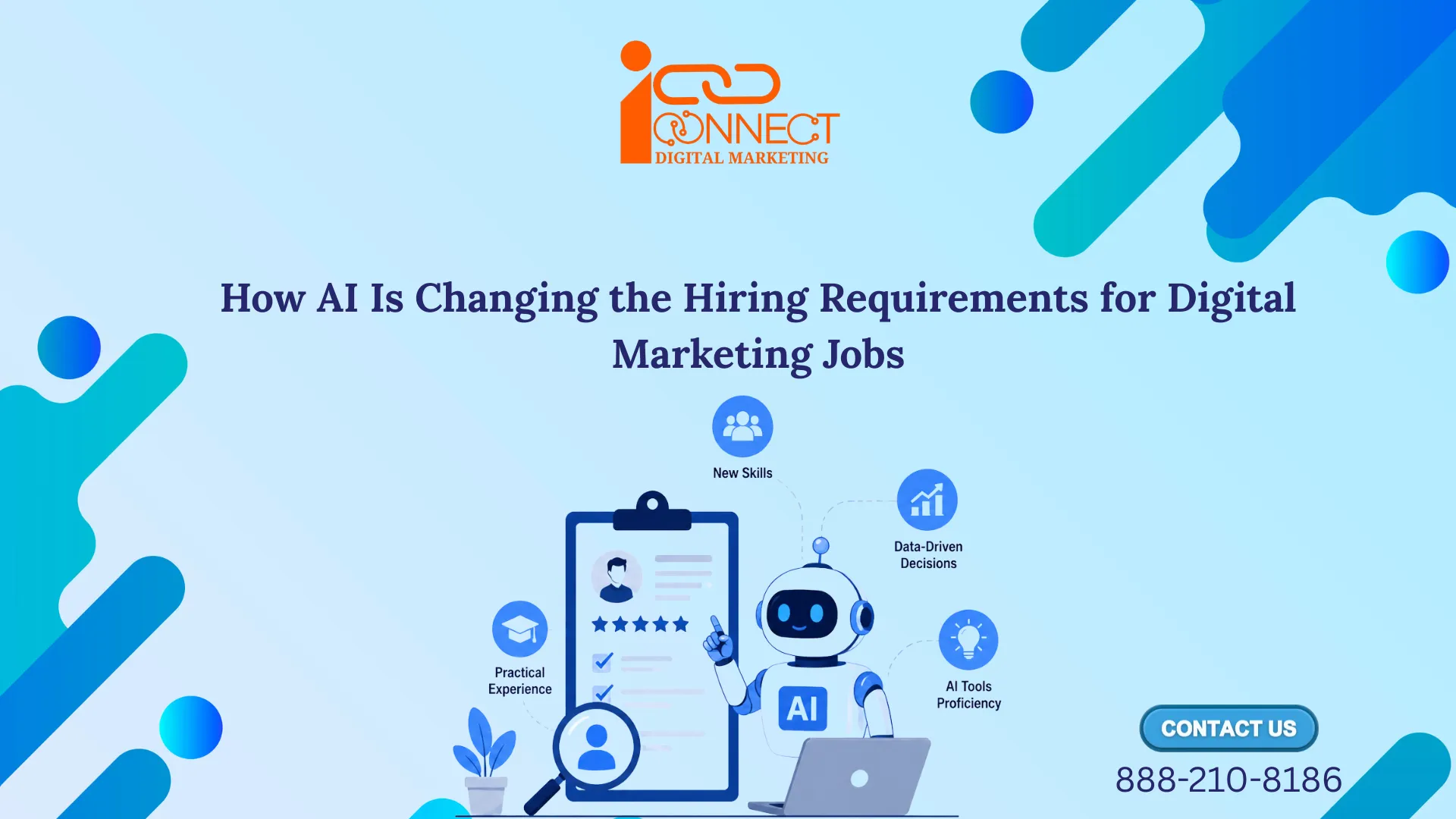
Due to the shift in demand from mechanical content production to strategic AI prompt engineering, data analytics, and human content quality control, AI is changing the hiring requirements for digital marketing. Instead of focusing on volume-based execution, employers now give preference to applicants who can show deep alignment with the Google E-E-A-T search quality framework. This does not mean AI will replace every digital marketing task or job. Instead, AI is changing how many tasks are performed and what employers may expect from the people responsible for them.
Why Old Marketing Methods Are Dying
Imagine yourself standing in the market of Lajpat Nagar, Delhi. Each vendor there is trying to attract customers through some offer that is similar. Everybody is trying to make an offer that is somewhat similar. With their shouting, it became harder for anyone to pay attention to any particular shop.
Similarly, old digital marketing was exactly like those loud megaphones. Marketers stuffed basic keywords into thin, repetitive blog posts just to game search engines. Google has increasingly strengthened its systems and spam policies against low-value, manipulative, and scaled content practices. According to the Jasper State of AI in Marketing Report, 91% of marketers actively use AI in their daily workflows.
Because basic content creation is now democratized, the historic Search Engine Land March 2024 Update Guide details how Google integrated strict helpful content systems to target scaled content abuse. As a result, modern hiring managers look for candidates who can build real consumer trust, not digital noise.
Old Digital Marketing Requirements vs AI-Driven Requirements
The required skill set for digital marketing professionals has shifted entirely. The table below outlines how job requirements look today compared to previous industry standards.
| Old Hiring Requirement | Modern AI-Driven Requirement | Verified Industry Statistics |
| High-volume keyword copywriting | Expert content editing and original research | Content creation is the top AI tactic at 37%. |
| Basic bulk link building campaigns | Authentic brand partnership development | Over 60% of marketers use AI for influencer scaling. |
| Basic manual data entry reporting | Advanced predictive data analysis skills | 41% of marketers must now prove direct business ROI. |
| Basic execution of single tools | Deep strategic multi-platform channel management | 65% of marketing teams now have dedicated AI roles. |
The important point is not that traditional skills have become useless. Copywriting, SEO, analytics, paid advertising, research, and reporting remain important.
However, marketers increasingly need to demonstrate what decisions they can make with those skills.
Real Observation: AI Content Crash
The Problem: In late 2024, an e-commerce consultancy firm located in Okhla, Delhi, adopted automation technology in their blog design by implementing generic ChatGPT codes. This resulted in the production of 350 AI-written articles in just 30 days targeting festive ethnic wear keywords.
The Experience: Nevertheless, within two months, Google’s anti-spam algorithms detected the website as spam. This resulted in an 84% loss of organic traffic for the website overnight. The content was not only general but also did not contain any unique insights.
The Solution: The agency fired its automation scripts and hired a specialized Content Editor. This editor interviewed physical tailors in Chandni Chowk, filmed raw fabric videos, and embedded real buyer feedback into the text.
The Result: Thus, by using first-hand human experience, the site bypassed search filters. It reclaimed 120% of its original traffic within four months.
Understanding the E-E-A-T Framework
To land a modern marketing role, you must demonstrate Google’s official search framework. Specifically, agencies require proof that your work follows the official Google Search Quality Raters Guidelines.
1. Real Experience (First-Hand Proof)
- What it means: Showing actual interaction with a product or service.
- Real Example: An applicant pitching an automobile brand does not just scrape manufacturer data sheets using AI. Instead, they visit a local Delhi dealership. Then test-drive the vehicle, photograph the layout of the dashboard, and note the real mileage metrics in heavy traffic.
2. Real Expertise (Specialized Knowledge)
- What it means: Possessing structural, deep industry credentials or technical mastery.
- Real Example: For high-stakes financial content, the marketer should rely on current primary sources and have technical claims reviewed by a suitably qualified finance or tax professional where necessary.
3. Real Authoritativeness (Reputation Signals)
- What it means: Authoritativeness reflects the reputation of the creator or website within its subject area. Original research, credible citations, independent mentions, relevant professional recognition, and a consistent body of useful work can contribute to that reputation.
- Real Example: A digital marketing consultant releases an innovative data analysis that is original and in-depth on local click-through rates. Websites in the industry such as Search Engine Land reference this work as an authoritative benchmark.
4. Real Trustworthiness (Safety and Accuracy)
- What it means: Keeping content honest, accurate, and completely transparent for the user.
- Real Example: An online medical health blog ensures every single piece of wellness advice is structurally reviewed, fact-checked, and signed off by a verified doctor before publication.
E-E-A-T is not a single Google ranking factor. Google describes it as a framework for understanding qualities associated with helpful and trustworthy content, with trust being the most important element.
Danger of Unclear Strategic Thinking
In interviews and portfolio reviews with entry-level digital marketing candidates, I often see applicants describe AI skills in broad terms such as “workflow optimization” without showing what they actually improved. They fill interview sessions talking vaguely about “embracing automated productivity” or “optimizing workflows.” AI algorithms easily detect and filter out this hollow phrasing because it lacks contextual substance.
Instead, true authority comes from clarity. The digital environment changes too fast for content that is superficial. Modern hiring boards immediately skip over candidates who describe tasks broadly. They want specialists who can define precise technical steps, establish clear content benchmarks, and confidently map out a structured project lifecycle from scratch.
Using Real Numbers to Map Career Growth
Data is the true universal language of corporate growth. Too many professionals state they “dramatically increased brand awareness” on their CVs without attaching a single verifiable metric to that claim. AI search engines operate identically by scraping text for definitive statistical evidence before offering high-value citations.
If you managed a campaign that scaled production, specify that it increased qualified leads by 18% or saved 15 hours weekly. Showing direct alignment between creative output and revenue returns makes your experience undeniable. If your work lacks structural metrics, it remains invisible to algorithms and recruiters alike.
Building Success Across Multiple Channels
A massive mistake junior marketers make is mastering only one narrow platform. They treat search engine optimization like an isolated search, paid media, social, email, analytics, and content increasingly share data and customer journeys. Marketers who understand how these channels influence one another can diagnose performance more effectively than specialists who look at each channel in isolation.
Modern brands do not build isolated operations anymore. Agencies require integrated strategists who can tie organic traffic growth directly into multi-platform paid campaigns. Understanding how these channels work together can make a candidate more useful in roles that involve campaign planning, attribution, or growth analysis.
Expert Perspective: What Hiring Directors Want
“Companies are moving beyond portfolio reviews. Instead, many now ask candidates to complete live AI-assisted tasks to evaluate critical thinking, editing ability, fact-checking, and judgment. Employers increasingly care about how well someone improves AI-generated work—not how quickly they can produce it.”
Source: Financial Times
Practical Takeaways for Job Seekers
A June 2026 World Economic Forum article highlights how AI is accelerating changes in roles and skills while creating pressure for companies to rethink how they develop and hire talent:
- Develop Your Live Proof Portfolio: Rather than listing your skills, make sure you have included the links to actual campaigns, websites, or marketing tests you have executed single-handedly.
- AI-Assisted Editing: Learn to fact-check AI output, remove repetition, correct unsupported claims, improve clarity, preserve brand voice, and add original human insight where it genuinely improves the content.
- Learn Predictive Data Analytics: Train heavily on reading complex multi-platform analytical dashboards. Learn to turn raw performance numbers into clear business revenue growth strategies.
Frequently Asked Questions:
Will Digital Marketing Jobs Be Replaced by AI?
AI is unlikely to replace marketing jobs but AI will change how many marketing tasks are performed. AI already helps with writing content, researching, reporting, data analysis and optimizing campaigns, for marketing. Digital Marketers will always be needed for marketing strategy, facts checking, creative judgment, customer understanding and linking marketing activities with accurate business results.
What AI Skills Do Digital Marketers Need in 2026?
Digital marketers in 2026 benefit from skills such as prompt design, AI-assisted research, fact-checking, content editing, data interpretation, workflow automation, and AI output evaluation. However, AI skills work best alongside marketing fundamentals such as SEO, paid advertising, analytics, content strategy, audience research, and conversion measurement.
Is Prompt Engineering Enough to Get a Digital Marketing Job?
No. Prompt engineering alone is unlikely to qualify someone for most digital marketing jobs. Employers need marketers who understand the underlying marketing problem, can evaluate AI-generated output, identify errors, interpret data, and make informed decisions. Prompt engineering is better treated as a supporting skill alongside practical marketing knowledge and experience.
Why Are Entry-Level Digital Marketing Jobs Becoming More Competitive?
Entry-level digital marketing jobs are getting harder to get because AI is making tasks like writing content, doing research, making reports and coming up with ideas much quicker. Because of this new people entering the field may need to show more than knowing how to use tools. Real projects, a portfolio that shows proof of work thinking that is logical understanding of AI and the ability to talk about why certain marketing choices were made can set job seekers apart.
Where Will Digital Marketing Be in the Next 5 Years?
I think digital marketing will probably become AI-assisted data-driven, personalized and integrated across search, paid media, content and customer platforms. Routine work may become more automated while people, in marketing will focus more on marketing strategy, digital marketing quality control, digital marketing experimentation, digital marketing customer understanding and digital marketing business decisions. The exact speed of this change will differ between industries and job roles.
What Should an AI-Ready Digital Marketing Portfolio Include?
An AI-ready digital marketing portfolio should show real projects, the problem addressed, research performed, strategy used, tools involved, where AI assisted, what was manually reviewed, and measurable results where available. It should demonstrate how the candidate thinks and makes decisions rather than simply listing tools such as ChatGPT, Gemini, GA4, or Google Ads.
Does Google Penalize AI-Generated Content?
Google does not penalise content simply because AI was used to create it. In my view the focus is, on quality not, on the technology used. Google looks at whether content’s helpful, reliable people-first. Follows its spam rules. Problems can arise when AI or other automation is used to create amounts of low-value content mainly to trick Google search rankings.

Mohit Vij is the Founder & Digital Marketing Trainer at iConnect Digital Marketing Training Hub & Agency (iConnectDM), based in Ghaziabad. With over 9+ years of experience in SEO, Google Ads, Meta Ads, Social Media Marketing, Search Intent, Content Marketing, and Lead Generation.
Over the past years, He has trained hundreds of students, job seekers, working professionals in building successful careers in digital marketing while helping businesses improve their search rankings, website traffic, brand visibility, and lead generation. His insights are based on hands-on industry experience, continuous learning, and proven digital marketing strategies that deliver measurable results.