


If you type “best CRM software for small businesses” today, Google may not just act like a search engine anymore. Instead of just showing you ten blue links like usual, Google’s AI kind of writes a long, paragraph answers right there, and it cites only one website, not ten. Which website gets cited? The one Google trusts most on that topic. That trust has a name: Topical Authority.
This is the game every digital marketer needs to learn right now.
Table of contents
- Why This Matters More Than Ever in 2026
- The Proof Google Kept Secret (Until It Leaked)
- The HubSpot Warning: What Happens When You Ignore This
- The Architecture: How to Actually Build Topical Authority
- One Indian Angle Nobody Talks About
- How to Know If It’s Working
- Sources & References:
- We Have Answered All Your Common Questions Here
What Exactly Is Topical Authority?
A simple way to understand this is to think of that Maths teacher who has mastered the whole subject and knows how everything connects together. Another knows everything about History. You wouldn’t ask the Maths teacher about the French Revolution — you’d go to the History teacher. Google and AI search engines think the same way about websites.
Topical authority means your website is recognised as the go-to expert on a specific subject. Not just one article about it — but dozens of deeply connected articles covering every angle of that subject.
So instead of writing one post about “email marketing,” an authoritative site covers email subject lines, email automation, A/B testing emails, email list building, email deliverability, email analytics — everything. That’s depth. That’s what AI engines reward.
Why This Matters More Than Ever in 2026
Here is a number worth saving: 60% of all Google searches now end without a single click to any website, according to a Bain & Company study cited widely by SEO analysts in 2025 (source: position.digital). The AI writes the answer. Users read it and leave.
So if you’re not the source AI cites, you’re invisible.
This shift happened because of Google’s AI Overviews, ChatGPT Search, and Perplexity. These tools don’t rank pages — they select trusted sources. And the criteria for “trusted” is topical depth.
Reference: Bain & Company research on AI-powered search behavior and zero-click searches.
The Proof Google Kept Secret (Until It Leaked)
In 2024, Google once accidentally made a massive internal document visible outside the company. SEO researchers called it the Google Content Warehouse API Leak. It confirmed something the SEO world had suspected for years but couldn’t prove.
Google internally measures two scores for every website (source: hobo-web.co.uk):
- siteFocusScore — how concentrated your entire site is around one core topic
- siteRadius — how far each individual page strays from your site’s main theme
Think of your website as a planet. The siteFocusScore measures how strong your gravity is. The siteRadius tells Google how far each piece of content orbits from your core. Write too many off-topic articles, and your gravity weakens. Google stops trusting you.
This isn’t theory anymore. It’s a confirmed algorithmic signal stored inside Google’s own quality-scoring system.
Reference: Research and analysis of the Google Content Warehouse API leak by multiple SEO industry publications and researchers.
The HubSpot Warning: What Happens When You Ignore This
HubSpot was once considered India and the world’s textbook example of great content marketing. While on top, it attracted 24 million monthly visitors. Then, between November 2024 and early 2025, it lost approximately 75% of its organic traffic (source: xpert.digital).
Reference: Independent SEO industry studies examining HubSpot’s organic traffic trends following Google’s core updates.
Why? Because HubSpot had spent years writing content about everything — cover letters, famous quotes, resignation letter templates — none of which had any real connection to its core product: CRM software. Google’s 2024 core updates punished this scattered approach harshly.
The lesson for every student and professional reading this: more content is not better. More relevant content is better.
The Architecture: How to Actually Build Topical Authority
Step 1: Choose One Topic Universe
Before writing a single article, decide your topic territory. Be specific. “Marketing” is too broad. “Email Marketing for D2C Brands in India” is focused. The tighter you make your niche, the quicker you start building authority.
One useful little exercise: write your main topic down right there in the centre of a page. Then branch out all the sub-topics, questions, and problems your audience has related to it. This is called a content map.
Step 2: Build Topic Clusters (Not Isolated Articles)
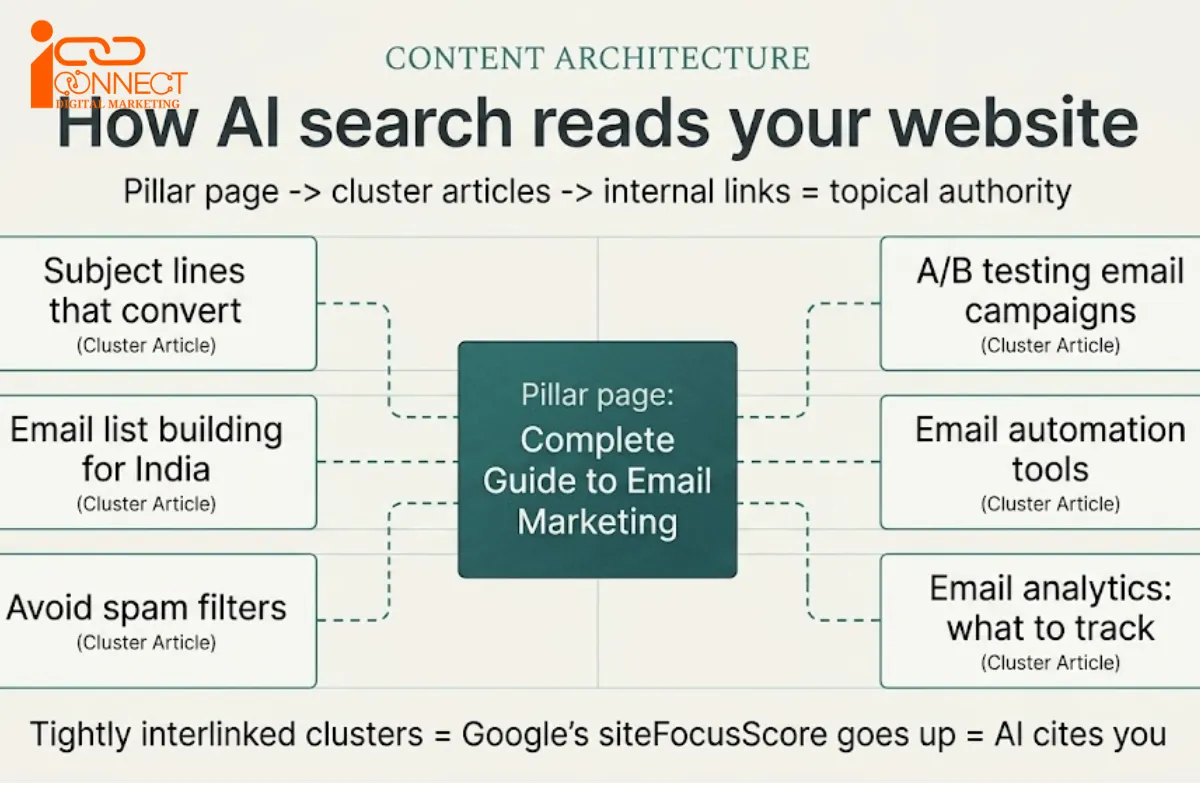
Rather than publishing unrelated blog posts one after another, modern SEO works better when your content gets grouped around one strong central theme — this is called a topic cluster.
A topic cluster consists of two parts.
- First, a Pillar Page — one long, thorough article that covers your main subject from all angles. Think of it as your home base. “The Complete Guide to Email Marketing for Indian Startups” is a good example.
- Then come the Cluster Articles — 8 to 15 shorter pieces, each going deep on one slice of that topic. Subject lines. Spam filters. Automation tools on a budget. One article, one problem, solved properly.
Every cluster article links back to the pillar. The pillar links back to each cluster. That web of connections is how AI search engines understand that your content belongs together, not like scattered thoughts, but like one site that really knows its subject. It’s more a connected thing than random bits.
Step 3: Map the Questions Your Audience Actually Asks
Go to Google and type your main topic. Scroll to “People Also Ask.” These questions are exactly what your cluster articles should answer. Tools like AnswerThePublic (free), Semrush, or even ChatGPT can generate a full list of related questions.
For Indian audiences specifically — think in regional contexts. When a student is looking into “SEO tools” they might also be curious about “free SEO tools for students in India” or “best SEO tools under ₹500/month.” In a lot of cases, those India-focused searches are kind of less crowded/competitive, and they can be faster to rank also.
Step 4: Interlink Everything Deliberately
Every new article you publish should link to at least 2–3 older articles on the same topic — and those older articles should link back to the new one. This creates a web of relevance that AI crawlers love.
Think of it as building roads inside a city. The greater the number of roads linking various locations, the more convenient the travel is. Websites with a clear internal linking structure makes it much easier for AI and search engines to understand and trust.
Step 5: Update, Don’t Just Publish
AI engines favour websites that stay current. A pillar page updated every 6 months signals active expertise. Publishing 20 articles and forgetting them does not. Set a content calendar that includes regular updates to your best-performing pages — not just new posts.
One Indian Angle Nobody Talks About
Most topical authority guides are written for Western markets with high domain authority and big content budgets. Here’s what works differently in India:
Vernacular and bilingual content is basically an untapped topical authority strategy. If you build authority in English and Hindi (or Tamil, Bengali, Telugu) all on the same topic cluster then you’re covering a lot of semantic ground that almost no competitor is really touching, like not even close. AI engines like Gemini — which Google uses — are now multilingually trained. A site that covers a topic in two languages signals deeper expertise than one that covers it in one.
Vernacular plus bilingual content is an untapped topical authority strategy. If you build clout in English and Hindi, (or maybe Tamil, Bengali, Telugu) around the same topic cluster , you’re basically covering semantic territory that almost no competitor is really trying to grab at all.
This is a real, currently underused edge for Indian digital marketers.
How to Know If It’s Working
Topical authority is not measured by a single metric. Watch these three signals:
- AI Overview appearances — Search your target keywords in Google. Are you showing up in the AI-generated summary at the top?
- Featured snippet wins — When you earn snippets consistently for a topic, your authority is growing.
- Organic traffic to cluster articles — If your cluster articles start ranking without active link-building, Google is recognising your topical signal.
Free tools like Google Search Console show you which queries trigger your pages. Track this month by month.
Sources & References:
- Bain & Company’s study on AI driven search behavior and zero click searches.
- Analysis of the Google Content Warehouse API breach by SEO researchers and industry websites.
- Studies analyzing HubSpot’s loss of organic traffic after Google core updates.
- Google Search Central documentation on helpful content and quality search guidelines.
- Work from respected SEO industry publications on topic authority, semantic SEO, and AI search presence.
We Have Answered All Your Common Questions Here
Search engines define topical authority as the degree to which a website is viewed as a knowledgeable, trustworthy resource on a specific topic. It is cultivated through the creation of thorough, linked content that demonstrates expertise on the topic being addressed, ultimately building credibility with search engines.
Why is topical authority important for AI search engines?
This is because AI search engines prioritize authoritative content. Sites that demonstrate expertise and consistency in publishing content on a particular subject matter are more likely to appear in the “AI Overviews”, “ChatGPT Search” and so on.
What is a topic cluster in SEO?
Topic cluster: This strategy involves having a pillar page about a main topic that is backed up by numerous other pages related to subtopics of that topic. All these pages will be interlinked together to enable the search engine to understand the association and to increase authority.
How many articles are needed to build topical authority?
There is no exact number, but most websites start to gain significant topical signals after a certain number of authoritative articles about the same topic have been published. The key is to create comprehensive content rather than a specific number of articles.
How long does it take to build topical authority?
There are many ways of building Topical Authority and as with all good things, it’s often a long-term game and could take several months. The more content you create, and keep internally linked, the more likely signals will be sent to the search engines over time.
The Practical Takeaway
Building topical authority is not a hack. It’s a commitment. Pick one niche. Build a content map. Write a pillar page. Write 10 cluster articles. Interlink them. Update them. Repeat. The sites AI engines cite in 2026 are the ones that started this process in 2024. The good news? If you start today, you’re still ahead of most.
The question is not whether AI is changing search. It already has. The question is: when does your website become the one AI trusts?
👉 Learn more about our Digital Marketing Training Program
👉 View our training center and student reviews on Google

Mohit Vij is the Founder & Digital Marketing Trainer at iConnect Digital Marketing Training Hub & Agency (iConnectDM), based in Ghaziabad. With over 9+ years of experience in SEO, Google Ads, Meta Ads, Social Media Marketing, Search Intent, Content Marketing, and Lead Generation.
Over the past years, He has trained hundreds of students, job seekers, working professionals in building successful careers in digital marketing while helping businesses improve their search rankings, website traffic, brand visibility, and lead generation. His insights are based on hands-on industry experience, continuous learning, and proven digital marketing strategies that deliver measurable results.