

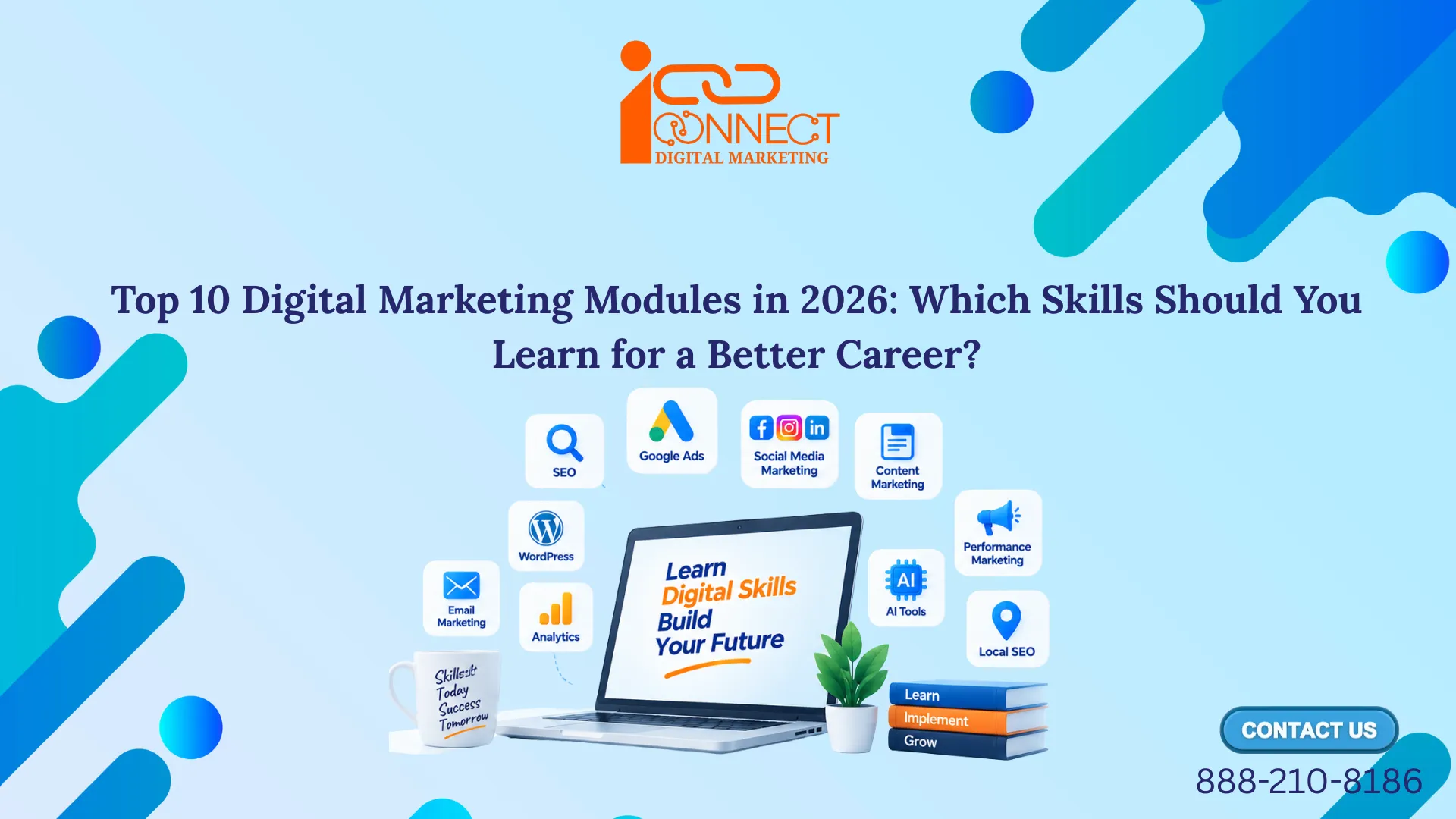
Search for a digital marketing course and you’ll run into the same problem every time. There are too many modules. SEO (Search Engine Optimization), Performance Marketing (Google Ads & Meta Ads), Social Media Marketing Optimization, Email Marketing, E-Commerce Marketing, Google Analytics, GA4,conversion tracking, prompt engineering, customer journey, search intent, Content Marketing & Content Writing, Canva for designing, Local SEO and usage of AI tools.
It’s not hard to find areas you need to learn in; It’s deciding which digital marketing skills are actually worth your time. So, basically If you’re a Student looking to learn digital marketing, Working Professional or a business owner looking to increase your business brand reputation or learn learn digital marketing in 2026, you need to first focus first on marketing fundamentals. SEO, content, paid advertising, and analytics. SEO now overlaps with AI search.
Then you need to build in-depth expertise in one area first and add skills that value such as CRO, automation, AI, or e-commerce based on the career path you want. Nowadays, Social media runs on video and creators more than static posts. So this isn’t a list of popular topics. It’s a list of the skills that hold real weight in the current marketing jobs.
We selected these modules based on the skills a marketer needs to plan, execute, measure, and improve digital campaigns rather than simply listing every topic found in a course syllabus. We also considered current changes in search, analytics, AI-assisted workflows, paid media, social content, and e-commerce.
You may also be interested in: 👉How AI Is Changing the Hiring Requirements for Digital Marketing Jobs
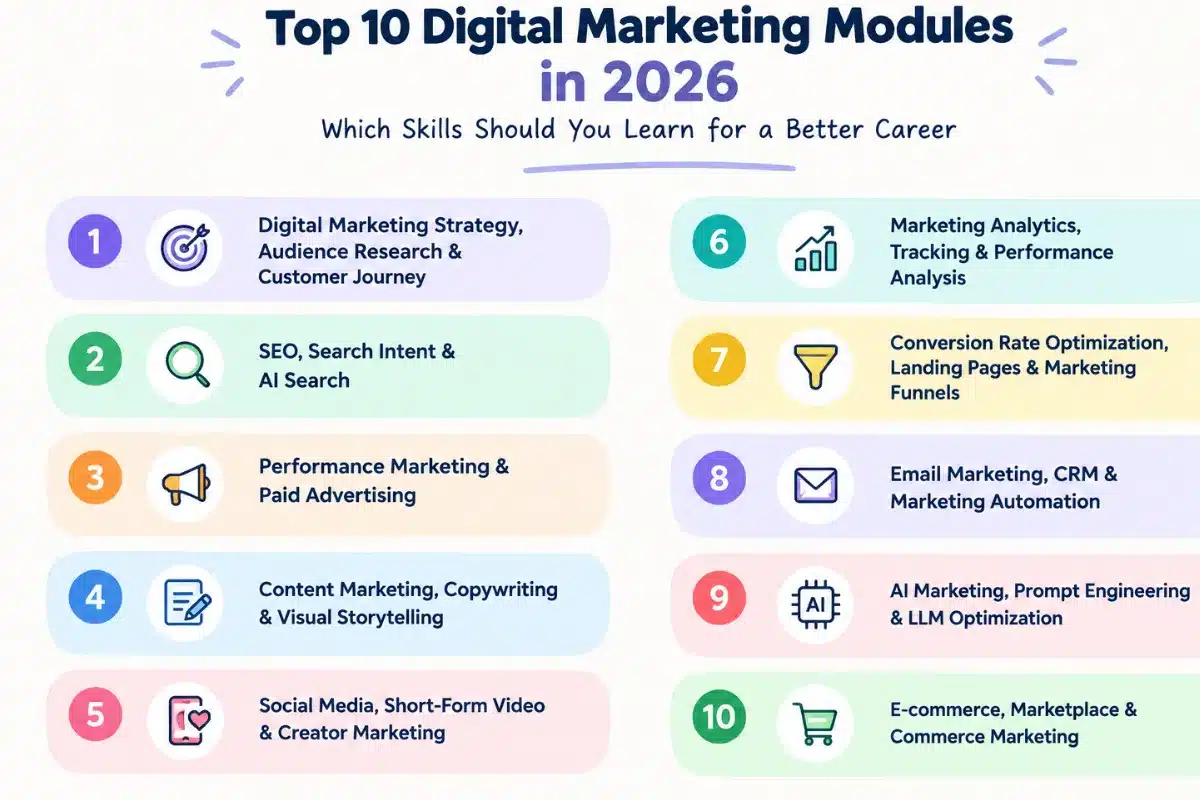
1. Digital marketing strategy, audience research, and customer journey
You can be a big expert at Google ads, Meta Ads, SEO, or Instagram but still have no idea about who you are actually marketing for and why you should do it. So, basically, this is where this module comes into the picture. It will guide you through audience research, customer personas, competitor research, intent research, and mapping the whole customer journey. Along with that, you will learn about positioning and choosing the right channels.
But look, before choosing any platform directly, you really need to understand your main goal and target audience properly. Once you get these two things right, then every other module from this list will become very easy to handle.
Where it’s used: brand strategy, marketing planning, campaign briefs, product positioning.
From our training experience: Students directly want to learn digital marketing and start directly with advanced SEO or advertising tools, but some basics like understanding the audience and campaign objective first makes those tools much easier to use correctly.
2. SEO, Search Intent, and AI Search
Nowadays, SEO is not only about ranking pages. The whole process of searching became very different: people can get their answers via AI directly, explore several different sources and even jump from one search engine result to another app and make a decision.
Nevertheless, the basic principles have not changed: Google should be able to crawl and understand your webpages; your content should also be relevant and useful. Thus, a good SEO module will provide all of the necessary information on keyword research, search intent, on-page SEO, technical SEO, internal linking, local SEO, E-E-A-T, and Search Console. Google’s 2026 documentation explicitly says its new generative-AI optimization guide addresses misconceptions around “AEO/GEO.”
A current SEO Course module should also explain how your content can appear across AI-assisted search experiences, including AI Overviews and AI Mode, while separating established SEO practices from industry terms such as AEO and GEO.
Where it’s used: Organic search, content, e-commerce, local marketing and AI search.
You may also be interested in: 👉What Is Search Intent in SEO and Why Does it Matter?
3. Performance Marketing and Paid Advertising
With paid advertising, getting a campaign live is only the starting point. The real challenge comes right after that. One audience might bring you cheap leads, while another group quietly finishes your entire budget. Sometimes, a campaign can also look completely fine on the outside while your actual sales and sign-ups remain very low.
As a result, it is necessary that this module includes other topics apart from Google and Meta Ads. In addition to the above, you’ll learn all there is to know about targeting, bidding, budgeting, retargeting, converting, and testing various creatives. You’ll also understand what CPC, CPA, conversion rates, and ROAS really tell you before making any changes to your active campaigns.
Where it’s used: Lead generation, e-commerce, paid acquisition, app marketing and growth teams.
4. Content marketing, copywriting, and visual storytelling
Creating content is easy. Creating content that the right audience wants to read, watch, save, or share is much harder. But it can be difficult to develop content that people will actually want to see, view, or share.
Good content marketing requires far more than good writing. You must understand your target market like the back of your hand and position every piece of content at the exact point of influence in their buying process.
Content format varies depending on goal:
- Search-focused articles: Useful, intention-based resources meant to provide answers.
- Landing Pages: Compelling, targeted copy meant to get leads.
- Ad Copy: Quick, punchy copy that grabs attention immediately.
- Visual Scripts: Sharp, compelling storyboards for short video.
Where it’s used: content strategy, brand storytelling, SEO content, campaign creative.
5. Social media, short-form video, and creator marketing
Audience behavior has entirely shifted nowadays. And this module shows that change directly. Short-form video, creator partnerships, community-led content, and UGC now play major roles in many social strategies, although the right format still depends on the platform, audience, and business goal.
This module is a combination of things like platform strategy, short-form videos, community management, social listening, creator partnerships, user-generated content (UGC), and social commerce. You will be learning all of this on platforms like — Instagram, YouTube, and LinkedIn. The exact platform mix should depend on where the target audience actually spends time.
Where it’s used: brand awareness, community building, influencer campaigns, product launches.
6. Marketing analytics, tracking, and performance analysis
Consider this: there is a failure in a campaign; the report gives an accurate depiction of what happened without providing the exact reason behind the failure. Believe me, this is where marketers stop and precisely where this module starts.
This is where you learn GA4, Google Tag Manager, Search Console, UTM tracking, conversion tracking, funneling, CAC, ROAS, attribution fundamentals, and dashboarding. It is because a marketer who can only read the reports is beneficial; however, one who understands the meaning of the numbers is invaluable, and this fact becomes evident in all promotional strategies.
Where it’s used: growth marketing, media planning, executive reporting, campaign optimization.
7. Conversion rate optimization, landing pages, and marketing funnels
More website traffic does not automatically produce more leads or sales. If the landing page fails to convert the right visitors, increasing traffic can simply increase acquisition costs. That single sentence clearly explains why this module deserves much more attention than it normally gets.
Therefore, this particular module will touch upon such elements as landing page structure, CTAs, forms, funnel stages, A/B testing, heat maps, and checkout optimization among others. The truth of the matter is that this is exactly the module which connects everything you do to your revenue.
Where it’s used: e-commerce, lead generation, SaaS growth, landing-page design.
8. Email marketing, CRM, and marketing automation
There is a great difference between email marketing and customer lifecycle marketing. After all, the entire module revolves around this very point. So, you will go through email marketing, segmentation, lead nurturing, CRM basics, behavioral triggers, customer journey mapping, lead scoring, customer retention, and automation. If executed well, this entire module falls in the area where marketing meets sales. Email marketing focuses on individual campaigns and messages, while lifecycle marketing looks at how communication changes as a prospect or customer moves through different stages of the relationship.
Where it’s used: retention marketing, lead nurturing, sales-marketing alignment, lifecycle campaigns.
9. AI marketing, prompt engineering, and LLM optimization
The use of AI is becoming commonplace. Being able to tell where its usage is appropriate and where it is not is the real skill here, and that’s what this module is all about.
LinkedIn’s 2026 Skills on the Rise list for marketing in India ranked prompt engineering first and also included Large Language Model (LLM) Optimisation among its fastest-growing marketing skills along with LLM optimization. Discuss prompt engineering, research using AI, content workflows, variations in advertisements, personalization using AI, workflow automation, AI agents, and AI search visibility, without skipping fact-checking and human review of the process.
Where it’s used: content production, campaign ideation, workflow automation, AI search visibility.
10. E-commerce, marketplace, and commerce marketing
The process of discovery and purchase is being combined to form one action. People find a product through a search result or social media feed and proceed to buy the product without ever going to a traditional website. This is why the module has been created.
Include topics related to product page optimization, e-commerce SEO, shopping campaigns, Merchant Center, marketplace listings and marketing, product feeds, product reviews, and repeat purchase strategy. The latest search documentation from Google includes the shopping and product visibility in AI-generated results.
Where it’s used: online retail, marketplace management, D2C brands, product marketing.
What should you learn first?
In case you’re a total beginner, start out with the following sequence: marketing basics, SEO, content writing, Website development, Performance Marketing, Google analytics, Canva and Local SEO. This way you go through a sensible process and every step helps you understand the next one better.
If you want a specialized career, pick one core area and two supporting skills. SEO + content + analytics will get you further than five unrelated modules learned at a surface level.
If you already work in marketing, don’t restart from zero. Add AI, analytics, and automation on top of your existing specialty. LinkedIn’s 2026 marketing skills data also shows growing attention to capabilities such as prompt engineering, performance analysis, data-driven decision-making, LLM optimisation, SEO, and market research.
Do you really need to learn all 10 modules?
Absolutely not; that would take too much time, and employers do not give any damn about tooling and certification; they need people capable of solving marketing issues.
- Less is more: Begin with a general overview and concentrate on 2 or 3 interconnected modules which best suit you.
- Synergy of skills: Essential skills work well with each other. SEO requires analytics; paid marketing requires conversion optimization; content requires search intent analysis; AI requires existing knowledge about good marketing.
- The path to success: Choose one direction, immerse yourself into its environment, and practice till you see tangible results.
Conclusion
Choose one skill that is most relevant to your area of interest, and then choose two other complementary skills. Start applying yourself from the moment you master the basic concepts. Work on a project, optimize your website, analyze data, or develop a content strategy for SEO. It will help you realize how much you have learned and what else you need to practice.
Master a few skills, connect them properly, and apply them to real marketing problems.

Mohit Vij is the Founder & Digital Marketing Trainer at iConnect Digital Marketing Training Hub & Agency (iConnectDM), based in Ghaziabad. With over 9+ years of experience in SEO, Google Ads, Meta Ads, Social Media Marketing, Search Intent, Content Marketing, and Lead Generation.
Over the past years, He has trained hundreds of students, job seekers, working professionals in building successful careers in digital marketing while helping businesses improve their search rankings, website traffic, brand visibility, and lead generation. His insights are based on hands-on industry experience, continuous learning, and proven digital marketing strategies that deliver measurable results.