

Choosing the right online Digital marketing course from a good Digital Marketing Training Institute becomes important because your learning experience directly impacts your career opportunities. Therefore, if you are looking to do an online Digital marketing course, it can be difficult for you as there are so many things that can differ between your course curriculums.
Every year, there are several students and professionals that are enrolling in various digital marketing training programs simply in pursuit of higher salaries. But unfortunately, most of them end up being extremely disappointed within a few weeks. It happens because they have enrolled in the wrong programs after being cheated by a false advertisement for best online courses. So it has now become very important to note that the disappointment is not due to a lack of opportunities in the field but rather due to the marketing of those programs.
So before enrolling, every student should compare courses using clear criteria. Instead of relying only on big advertisements, early bird discounts, google rankings, or placement claims with guaranteed internships.
Why Does Comparing Courses Actually Matter?
Just take a look at the scenario regarding digital marketing courses in India. The fee structures are completely inconsistent. You could choose an affordable package costing less than ₹5,000 or choose a costlier package, which might even go above ₹2,00,000. However, the bottom line is that expensive courses do not necessarily make for quality education. For example, I’ve seen a simple ₹15,000 course with a real teacher can be way better than a ₹1,20,000 program that only gives you old videos and no help. Because the price difference is so big, you cannot just guess or pick a course based on cost. You require a checklist to check what you are getting before you pay.
What Should You Check Before Paying for a Digital Marketing Course?
Before paying for a digital marketing course, compare at least these factors: Never be misled by any of those eye-catching advertisements. Just ask the following questions:
Check Who Will Actually Teach You
You want to learn from active industry practitioners who manage real ad budgets for clients, not academics reading off stale slides. Look up the profile of instructors on LinkedIn and many other platforms for trainers visibility. If an institute hides its trainers’ names, run the other way.
Do not assume that the person appearing in an advertisement or webinar will also teach your regular batch. You should also ask whether the same trainer will teach throughout the course or whether different modules will be handled by different instructors.
Compare the Syllabus, Not Just the Number of Modules
Some course providers advertise large numbers of modules mainly because the number looks impressive. However, 50 short modules do not automatically provide more value than 20 well-structured modules. Instead of going with the wordings of their mouth, always check what the syllabus modules, what is actually going to be covered in the course.
In addition, A 2026-focused digital marketing course syllabus should also explain how search and marketing are changing because of generative AI. For example, you should understand AI-assisted research, content workflows, Google AI Overviews, AI Mode, search intent and their types, topical authority, and how marketers can use generative AI responsibly.
Consequently, an old curriculum leaves huge gaps. Make sure the syllabus includes modern topics like AI search optimization.
Check How Much Practical Work You Will Do
Digital marketing cannot be learned effectively through theory alone. Before enrolling, every student should ask how many live client projects or practical training will be given during the course for exposure.
Let’s understand with some examples what a student can ask?
- Will I be able to perform keyword research?
- We will be doing or conducting SEO audits?
- Proper learning of Google tools like Google Search Console & Analytics?
- Configuration of GA4?
- We will be creating live Google Ads campaigns & Meta Ads Manager?
- Professional learning of landing pages?
- Will you work on live or simulated projects?
Compare Live, Recorded, and Hybrid Learning
Do not just pickup a course just because it says “live classes.” Because you can speak with a trainer face-to-face and ask questions and mostly importantly live training that can be beneficial. Although you can use recorded videos to learn theories. You cannot ask a video to help you. You can test out real campaigns, learn from your mistakes, and meet mentors who can actually suggest you for jobs during live classes.
Always Verify the In-House Internship Claims
A genuine internship can make a digital marketing course more useful because it gives you an opportunity to apply what you learned and applied on live practical projects. A useful internship should provide exposure to actual marketing work rather than simply repeating classroom assignments.
How iConnectDM Structures Internship Opportunities?
At iConnectDM, In-House internship Programme with 60 Days of Internship helps students choose digital marketing courses with job placement and internship.
Some programs include a separate in-house internship phase after classroom training. Internship opportunities may be paid or unpaid depending on the program, role, performance, and applicable terms. Students should review the specific course page and confirm current internship terms before enrollment.
This distinction matters because internship conditions can vary even within the same institute.
What happens after graduation?
Ask for a definite job placement scheme rather than a general promise. As large colleges operate on complicated “pay after placement” schemes, the smaller agency-style setups often provide immediate internships. For example, iConnectDM in Ghaziabad transitions students directly into their agency to handle live SEO and social media accounts. Always get these post-course terms in writing.
Calculate the Total Course Cost
Calculate the total amount that you may need to spend. This brings up the final reality check most students forget to ask.
Verify Placement Claims Carefully
The job placement guarantee or placement assistance provided by the institute, you should always cross check with other students also and placement support can be useful, but you should understand what the institute means by “placement.” Like if it is placement assistance, support, connections or guaranteed placement that is offered by the institute.
Treat phrases such as “100% placement,” “guaranteed job,” or “highest package” as claims that need explanation.
Students should always check for genuine reviews where possible. Like Google reviews, professional profiles, employee platforms, glassdoor, trustpilot, mouthshut facebook, instagram, youtube, and student feedback can provide additional context. However, reviews should not be your only decision factor because reviews can be incomplete, outdated, or influenced by individual experiences.
Take a Demo Class Before Enrolling
Before enrolling for a digital marketing course, you must make the most of the available free demo sessions that are offered by the institute. This is because watching a demo session will help you understand the teaching methodology of the trainer. The interaction level of the trainer, and whether it is more theory based or practical. Find out if the trainer is using the latest AI marketing tools, whether he is making use of case studies in his teaching, and whether he answers all the queries.
A demo class should help you evaluate the actual learning experience, not just introduce you to the course.
Read the Refund and Cancellation Terms
Before making a payment, check the institute’s refund and cancellation policies thoroughly. Do not only rely on what is verbally assured. Find out when you can request a refund, whether registration or admission fees are non-refundable, and whether the course fee is refundable.
Also review the rules for batch transfers, missed classes, course cancellation, recording access, and EMI payments. If internship or placement support is included, check whether any eligibility conditions apply. Ask for important terms in writing before making the final payment.
Does Hands-On Internship Experience Actually Make a Difference?
This portion is very crucial, as it gives you an alternative perspective of two courses whose prices are exactly the same. Attending physical classes or video classes will give you the fundamental concepts. However, in reality, having knowledge of concepts alone is often not sufficient enough for getting hired. In contrast, a course paired with genuine internship work, applied to actual campaigns or client accounts, gives you something to show, not just something to say.
That said, don’t assume every “internship” means the same thing or runs for the same length. iConnectDM’s own website, for example, explicitly describes its internship as a “paid and unpaid in-house digital marketing internship program,” with structures that vary across course pages, some pairing a 3- or 4-month course with a separate internship phase of roughly one to two months. This kind of detail matters, so before enrolling anywhere, ask specific questions: Will you work on real client accounts, and does the institute clearly state this rather than just implying it? Is the internship paid, unpaid, or a mix? How long does it actually run? Does it end with a certificate that names the real work you did? These details separate a genuine learning opportunity from a token add-on used purely for marketing.
Is a Certificate From a Paid Course Actually Worth It?
The truth is, not all certificates are the same. Because of this, it helps to put them into three basic buckets so you can see what is actually worth your time.
First, you have free certificates from big names like Google Digital Garage, HubSpot Academy, and Meta Blueprint. These actually have real value because every single employer knows these brands. So, even if you are paying for a totally different course somewhere else, you should still do these on the side. It makes your resume look way better and costs nothing.
Next up, you have paid practitioner certificates. These are from the well-known places you always see online, like Digital Vidya, IIDE, or NIIT. They cost a decent chunk of money, usually starting right around ₹65,000. The main focus here is on the day-to-day work you actually do at a job, like SEO, paid ads, tools, and tracking analytics. If you are just trying to get a regular digital marketing job, these names definitely carry weight.
But then, if you look at localized institutions, the pricing is a totally different story. These institutes provide you with special courses priced from ₹5,000 to ₹50,000. Therefore, I would like to emphasize that if you pay more attention to your finances rather than branding, then you should consider localized institutes, which will definitely impress you. Nevertheless, you should contact them and find out what the actual cost of the program is.
Lastly, there are university programs, like upGrad’s course with MICA. These are expensive and often go way past ₹1,25,000. But the benefit is you get a famous college name on your resume. Honestly, this only really matters if you are trying to get into high-level strategy or leadership roles, not if you are just starting out doing the actual day-to-day marketing work.
But which one will suit you best? Well, if you are a beginner trying to make a portfolio, the practical approach combined with an internship will work better for you. However, if you have gained experience and want to become a manager, the university approach will be better for you, though small institutes are now offering more flexibility for professionals as well in terms of program delivery so that they can balance their personal and office life.
How Do You Compare Course Fees Without Getting Misled?
This is exactly where most learners get tripped up. See, a low price tag often hides the fact that they don’t offer any job placement help, while an expensive course doesn’t automatically mean the teaching is actually good. So instead of just looking at the big number on the flyer, you have to break down the fee to see what you are really paying for.
You should just ask the Digital Marketing Training Institute straight up: How many live classes do I actually get. Do I have to pay extra for Google or Meta certificates, or is that already included in the price?
Does this fee cover the software tools or the actual ad budgets for our projects. What about the internship? is it paid, unpaid, or totally free. How many weeks does it go on for, and will you give me that in writing? Are there monthly EMI options. What is the real interest rate hiding in there?
When you actually take the time to analyze the charges in such detail, it becomes obvious that even two courses that have the same price become entirely different from each other.
What Salary Can You Realistically Expect After Completing a Course?
When you check various job sites, they generally state that the starting salary for digital marketing professionals in India starts from ₹3 lakhs per annum for freshers and goes far beyond ₹10 lakhs for those who have some experience. In addition, performance marketing and analytics positions pay the most handsome salary packages. But look, you shouldn’t treat any single number as a promise. The truth is, your actual salary depends a lot on your skills, your city, and the company that hires you—not just the course you took.
Because of this, you should ask any institute you talk to what specific jobs their recent students actually got. And don’t just look at the happy student reviews on the school’s own website either. Go check independent sites like Google reviews, Trustpilot, or AmbitionBox instead. Big claims like “100% placement” or guaranteed jobs are almost always just pure marketing talk from the school itself, unless they can show you real, third-party proof.
A Quick Comparison Checklist
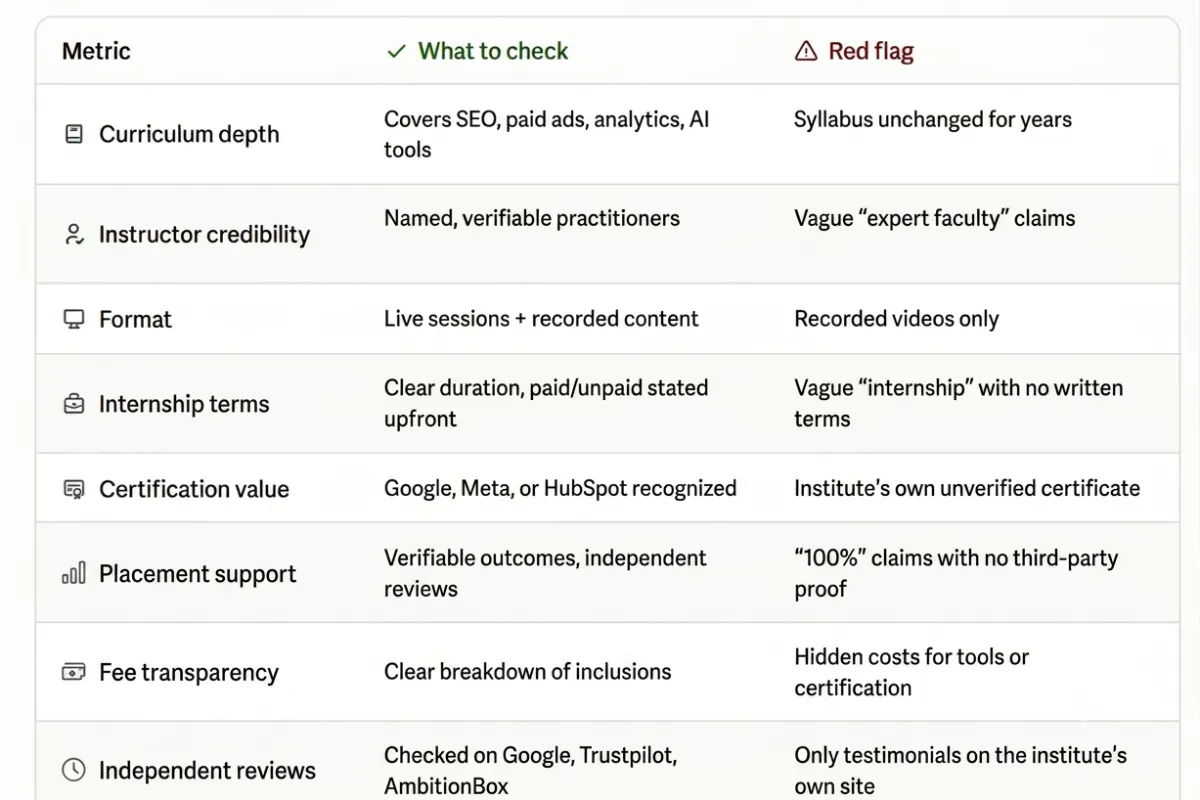
Compare digital marketing courses by curriculum, trainer credibility, internship terms, certification, fees, placement support and reviews.
How Long Should a Good Digital Marketing Course Take?
There is no single right answer, as course lengths depend entirely on what you want to learn for your career goals. A quick one-month brush-up works for specific skills, while massive university degrees take nine to twelve months.
Meanwhile, practical institutes such as iConnectDM provide courses that are about 3 & 4+2 months long, including an extra few months for internship placements. Since timelines differ between institutions, make sure you check how many months you’ll have to dedicate to the entire thing before you pay up.
Frequently Asked Questions: How to Compare Online Digital Marketing Courses
The best online course in digital marketing course will depend on your career objective, your existing skills, your budget and mode of learning. Make comparisons with regard to experience of trainers, updated curriculum, interaction, assignment and project work, internship period, certification, and job placement assistance. Beginners will be advised to consider training in SEO, Google Ads, Meta Ads, analysis, content writing, and social media. Rather than making the choice on the basis of reputation and cost alone, focus on what you will learn from the course.
An effective 2026 digital marketing course must offer both marketing fundamentals and up-to-date strategies/tools. While looking at it, consider the course syllabus having elements such as SEO, Google Ads, Meta Ads, GA4, Search Console, GTM, content marketing, social media, local SEO, conversion tracking, and projects. The curriculum needs to teach about generative AI, AI-assisted marketing workflows, AI Overviews, and AI Mode. But they should not overshadow the marketing basics. Instead of focusing on the number of modules, I’d advise getting into the one that involves actual implementation, teacher feedback and updated curriculum.
What’s a good digital marketing course with a certificate?
A high-quality digital marketing course with a certificate should include hands-on practical skills in addition to an industry relevant certificate of completion. Just having a certificate has little value. The course must provide you with practical work experiences too. So look for live client projects, internships, and practical assignments offered as part of the program. Certifications of relevant platforms may also come in handy, but employers will consider your experience, portfolio, and practical skills when choosing candidates.
You can find an online digital marketing course comparison for free by gathering data from the official websites of courses and preparing a simple comparison sheet. In the comparison turn your attention to course outline and syllabus, trainer’s experience, hours of a study, learning modes, availability of practical assignments, internships, certification, placement assistance and total costs of the course. Do not forget also to look at profiles of the trainers and read student feedback and reviews.
Absolutely. You can learn the fundamentals of digital marketing in three months, but to exactly gain all the practical experience, it normally requires between 4 and 6 months. So, you have a unique opportunity to study SEO, keyword research, content marketing and writing, Google Ads, Meta ads, social media, GA4, GMB, E-commerce Marketing, Email marketing, and Google Search Console. However, getting a diploma usually really allows you to get fundamental knowledge but not fully become a professional. Most probably, the development of your practical skills will continue through different activities such as projects, internships, freelance work, or creation of your own website.
A 6-month digital marketing course fee in India ranges between ₹30,000 to ₹60,000. It can be less also or higher. Because it depends upon the training institution and how the curriculum is set up, in different dimensions. It depends on- the in-depth training, meeting up with the trainers, medium of study, real-world assignments, certifications, internships, placement, etc. Even when two training providers set a similar fee for a 6-month digital marketing course, the overall learning experience can be radically different. Before comparing prices, check whether the quoted fee includes GST, tools, certification exams, advertising budgets, internship charges, and EMI or processing costs.
Finally, Choosing What Actually Fits You
In conclusion, there is no single digital marketing course that is the best fit for everyone. A fresher needs portfolio building. Whereas an experienced professional needs leadership skills to become a manager.
Also, big national brands are not automatically better than small, local agency-style institutes. So, instead of clicking flashy ads, ask for real placement numbers, look up the teachers, and read independent reviews.

Mohit Vij is the Founder & Digital Marketing Trainer at iConnect Digital Marketing Training Hub & Agency (iConnectDM), based in Ghaziabad. With over 9+ years of experience in SEO, Google Ads, Meta Ads, Social Media Marketing, Search Intent, Content Marketing, and Lead Generation.
Over the past years, He has trained hundreds of students, job seekers, working professionals in building successful careers in digital marketing while helping businesses improve their search rankings, website traffic, brand visibility, and lead generation. His insights are based on hands-on industry experience, continuous learning, and proven digital marketing strategies that deliver measurable results.