

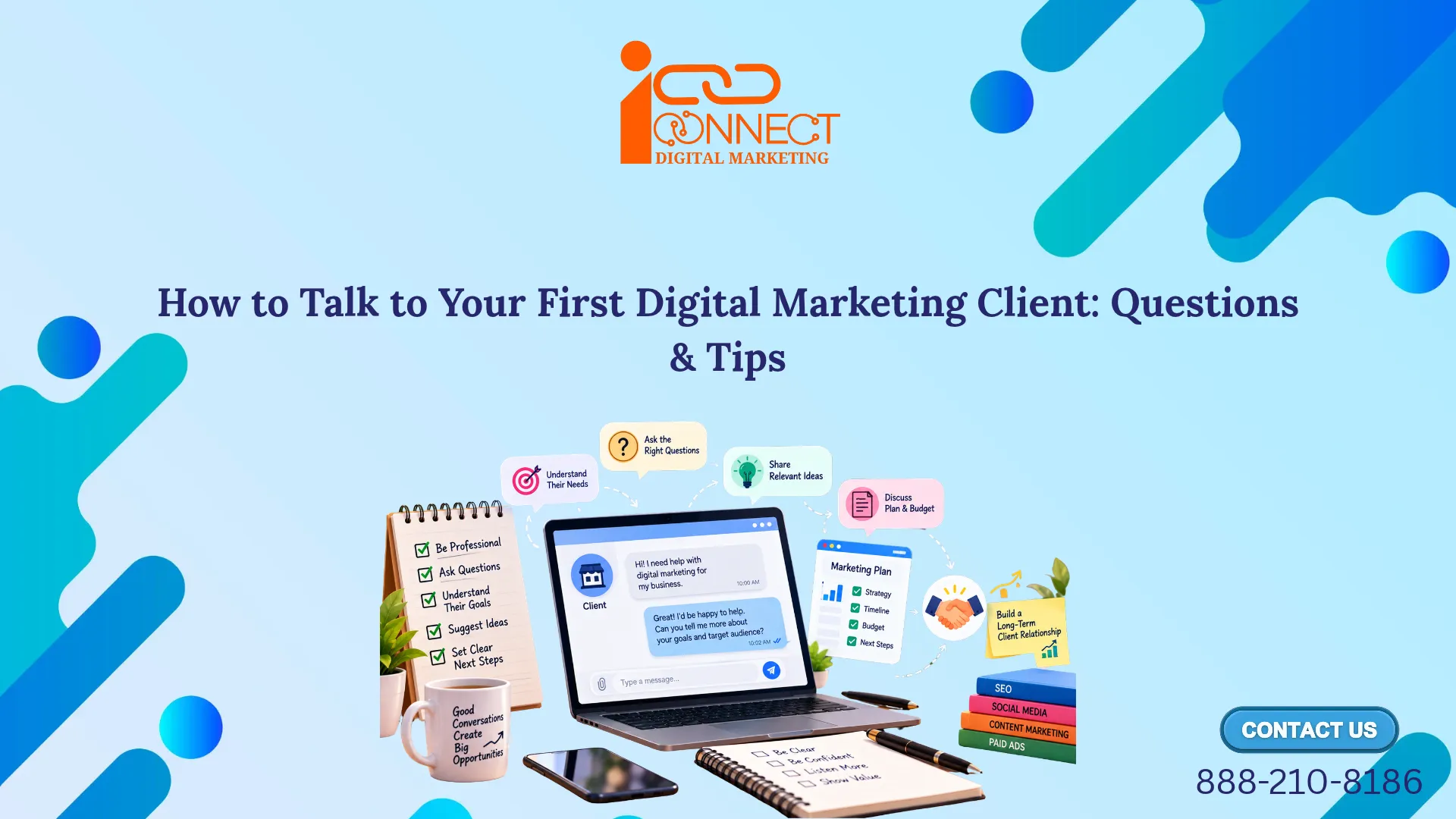
Finding your first ever digital marketing client is a first step of your freelancing career after completing digital marketing course. However, picking up that initial phone call can be quite a nervous moment especially when you are new into this field or as a beginner. To make them say ‘yes’, your early conversation should not focus entirely on selling your services directly. Rather than selling your services, your approach should be to first understand the client’s business.
Second, identify their marketing challenges and determine how you can genuinely help them in growing their business calls. Your focus completely should be on listening and resolving their business problems. When you show yourself as someone who will solve their problems, you automatically become much more valuable to them.
Table of contents
- Phase 1: Quick Pre-Call Research
- Phase 2: 4-Stage Call Plan
- 1. “What is your biggest business objective over the next six months?”
- 4. “What would a successful project look like to you?”
- 5. “Where do most of your customers or enquiries currently come from?”
- 6. “What budget have you allocated to marketing?”
- 7. “Who will approve the work and provide the information we need?”
- 8. “Is there a particular deadline or launch date we need to consider?”
- Phase 4: How to Handle Client Objections
- Phase 5: Send a Professional Follow-Up Email
- Phase 6: Three Important Rules for Your First Digital Marketing Client
- Start Learning Digital Marketing with Live Client Projects
This is a guide to help you learn the exact way of speaking to your first ever client with confidence.
Phase 1: Quick Pre-Call Research
You should avoid joining a client meeting without researching and understanding their business first. Therefore, one should spend approximately 20 minutes reviewing their business online presence. The purpose is not to find every possible mistake or promise instant results to the client. It is more to understand the business well enough to ask relevant questions and identify potential areas for improvement. As a result, you will look like an expert the second, the call starts. Let’s see some points to consider in this.
- Check Their Website and Tracking: First, go through with the client’s website. Review the main pages like Home Page, About Page, Contact Us, Service Pages, Contact forms, Product Pages, Privacy Policy, service descriptions, Terms & Conditions and More. Also check whether visitors who are coming onto the website through search engines like Google or from any other platform can easily understand what their business offers and how to contact it which is very important.
- Test their Website Speed: Run the website through Google PageSpeed Insights to review its performance. After all, slow websites lose customers quickly. You should pay attention to website loading performance, mobile responsiveness, layout stability, and whatever recommendations are provided by the tool which is being used.
- Look At Their Social Media Presence: Also, you need to check the client’s social media profiles to clearly understand how well the business communicates with its targeted audience. In addition, you also need to check when they have last posted images or videos. You should look for poorly created images or missing details in all those things. Incomplete profile information or outdated contact details.
Phase 2: 4-Stage Call Plan
To keep the conversation running smoothly, you should divide your meeting into four simple steps:
| Call Phase | Suggested Time | Your Main Goal |
| 1. Icebreaker | 3 – 5 Minutes | Say hello. First, build quick comfort, and then explain the schedule for the call. |
| 2. Diagnosis | 15 – 20 Minutes | Ask questions. Meanwhile, listen 80% of the time and let them explain their troubles. |
| 3. Pitch | 10 Minutes | Show them exactly how your marketing skills can solve their specific problems. |
| 4. Close | 5 Minutes | Agree on the next step. Finally, wrap up without forcing them to pay right away. |
Phase 3: Simple Questions to Ask Your First Digital Marketing Client
When entering into the discovery phase, think of yourself as someone diagnosing a business problem before recommending a solution. Just as a doctor needs to understand symptoms before suggesting treatment. For this purpose, consider using the following simple questions to figure out where they lack:
1. “What is your biggest business objective over the next six months?”
This will help you to understand whether the client is looking for more sales, qualified leads, website traffic, brand awareness, or another outcome from marketing.
Follow-up question: “How will you measure whether we have achieved that objective?”
2. “What marketing activities have you tried before, and what were the results?”
In this part, you will come to know on which platforms this business has done marketing before and what the client considers successful or unsuccessful.
Follow-up question: “Do you have any reports or previous campaign data that could help us understand those results?”
3. “Who is your ideal customer (Targeted Audience)?”
Understanding the target audience helps you evaluate which marketing channels and messages may be suitable.
Follow-up question: “What problems do your customers usually want your product or service to solve?”
4. “What would a successful project look like to you?”
This helps clarify the client’s expectations before you agree on the scope of work.
Follow-up question: “Would you primarily measure success through enquiries, sales, qualified leads, or another metric?”
5. “Where do most of your customers or enquiries currently come from?”
This helps you understand the client’s existing acquisition channels, such as referrals, organic search, social media, paid advertising, or direct enquiries.
6. “What budget have you allocated to marketing?”
This will help you understand the available budget which helps you propose a realistic scope of work. Where paid advertising is involved, clarify the advertising spend separately from your professional fees.
7. “Who will approve the work and provide the information we need?”
This helps establish responsibilities, decision-making authority, access requirements, and potential delays before the project begins.
8. “Is there a particular deadline or launch date we need to consider?”
This helps you plan the work and set realistic expectations about what can be delivered within the available time.
Phase 4: How to Handle Client Objections
If you are a beginner in digital marketing and you are about to deal with the client and handling queries can be difficult sometimes. But, if you know how to stay calm in that situation, listen carefully to what the client is saying regarding those things and you are able to give honest answers, it will help you earn the trust of your clients. Being calm in such situations, you will act like a professional.
1. “Your price is too high.”
- Solution: Do not lower your price immediately. Instead, explain that marketing brings in more cash.
What you can say: “I understand that budget is an important consideration. However, result-oriented marketing is an investment for all that makes money for you and for us too, not a cost. Therefore, we can start with a smaller test project first to prove it works. Would that feel safer?” That way, we can focus on the most important priorities first and measure the results before deciding on further work.”
2. “You do not have enough experience.”
- What you should do: You should always be honest about your experience. Do not pretend to show them like you have managed so many campaigns for other clients or delivered results that you cannot demonstrate. Instead, you can explain your core skills that you have. Show your project samples if you have any or have done the practical work, and describe how you are going to plan and approach the client’s requirements.
- Focus on your personal attention and up-to-date skills. On the other hand, agencies pass clients to junior staff.
- What to say: “Since I am growing my client list right now, you get my direct, full attention. In contrast, you won’t be passed around to a junior worker at a big agency. Plus, I use the newest marketing strategies that your competitors are missing.”
3. “We need to think about it.”
- Solution: Value their time. On the other hand, set up a meeting date before ending the call.
- What to say: “Of course, take your time. First, I will send a summary of our chat today. After that, let’s talk for 10 minutes this Friday morning to answer any questions. Does 10:00 AM work?”
Phase 5: Send a Professional Follow-Up Email
Send a summary email within two hours of the call. As a result, you will look highly professional.
Subject: Next Steps: [Your Name] x [Client Business Name]
Hi [Client Name],
Thank you for your time today. It was great learning about your goals for [Business Name].
Consequently, here is a quick summary of our chat:
- Goal: Get 20% more customers using Facebook Ads.
- Problem: Alternatively, the website is slow and tracking is broken.
- Next Step: Therefore, I am building a short, 3-page plan with pricing options for you.
Let’s talk again on Thursday at 2:00 PM to review the plan.
Best regards,
[Your Name]
Phase 6: Three Important Rules for Your First Digital Marketing Client
- Never use complex words or jargons: Avoid using terms such as CTR, ROI, or Pixel. Instead, use plain language like customers, sales, and saved time.
- Never promise guaranteed results without evidence: Never promise something like “I will double your sales within a week.” Instead, assure the client that we will conduct proper SEO Analysis reports like competitors analysis, Planning of work and safe test procedure.
- Protect your work and define the scope of work: Point out the mistakes on their website. However, do not fix them until they sign a contract.
Start Learning Digital Marketing with Live Client Projects
Learning how to communicate with your first digital marketing client is an important step after doing a digital marketing course. Once you complete the course you can start your career as a freelancer also where you will face the client head to head and answer the questions of the client. However, successful client management also requires practical knowledge of SEO (On-Page, Off-Page & Technical SEO, Local SEO), AI Marketing, Social Media Marketing, Paid Advertising (PPC, SEM & Performance Marketing), Google Ads, Content Creation, E-Commerce Marketing, Email Marketing, Google Business Profile (GBP) Management, Project Management and lead generation.
At iConnectDM – Digital Marketing Training Hub & Agency in Ghaziabad, students learn digital marketing through practical training and get internship and job placement also. Working live on client projects with updated SEO tools and AI tools gives opportunity to find out the best results for the business. The training focuses on understanding business requirements, developing marketing strategies, analyzing campaign performance, and applying digital marketing concepts to real-world scenarios.
It does not matter if you are only 12th pass, 10th pass, just creativity and your learning caliber will give you a career which you are looking for. Whether you are a student, job seeker, freelancer, working professional, or business owner, developing these skills can help you prepare for digital marketing opportunities and understand how to work with clients more confidently.
If you are looking to do practical Digital Marketing training in Ghaziabad, Meet Your Trainer in Person. Attend a FREE 2-Day Demo Class before enrolling. Understand and Experience our Practical Agency-Style Training approach of working on Live Client projects. No pressure to enroll. Join only if you’re completely satisfied. Classes are available Offline & Online and Hybrid Modes.

Mohit Vij is the Founder & Digital Marketing Trainer at iConnect Digital Marketing Training Hub & Agency (iConnectDM), based in Ghaziabad. With over 9+ years of experience in SEO, Google Ads, Meta Ads, Social Media Marketing, Search Intent, Content Marketing, and Lead Generation.
Over the past years, He has trained hundreds of students, job seekers, working professionals in building successful careers in digital marketing while helping businesses improve their search rankings, website traffic, brand visibility, and lead generation. His insights are based on hands-on industry experience, continuous learning, and proven digital marketing strategies that deliver measurable results.