

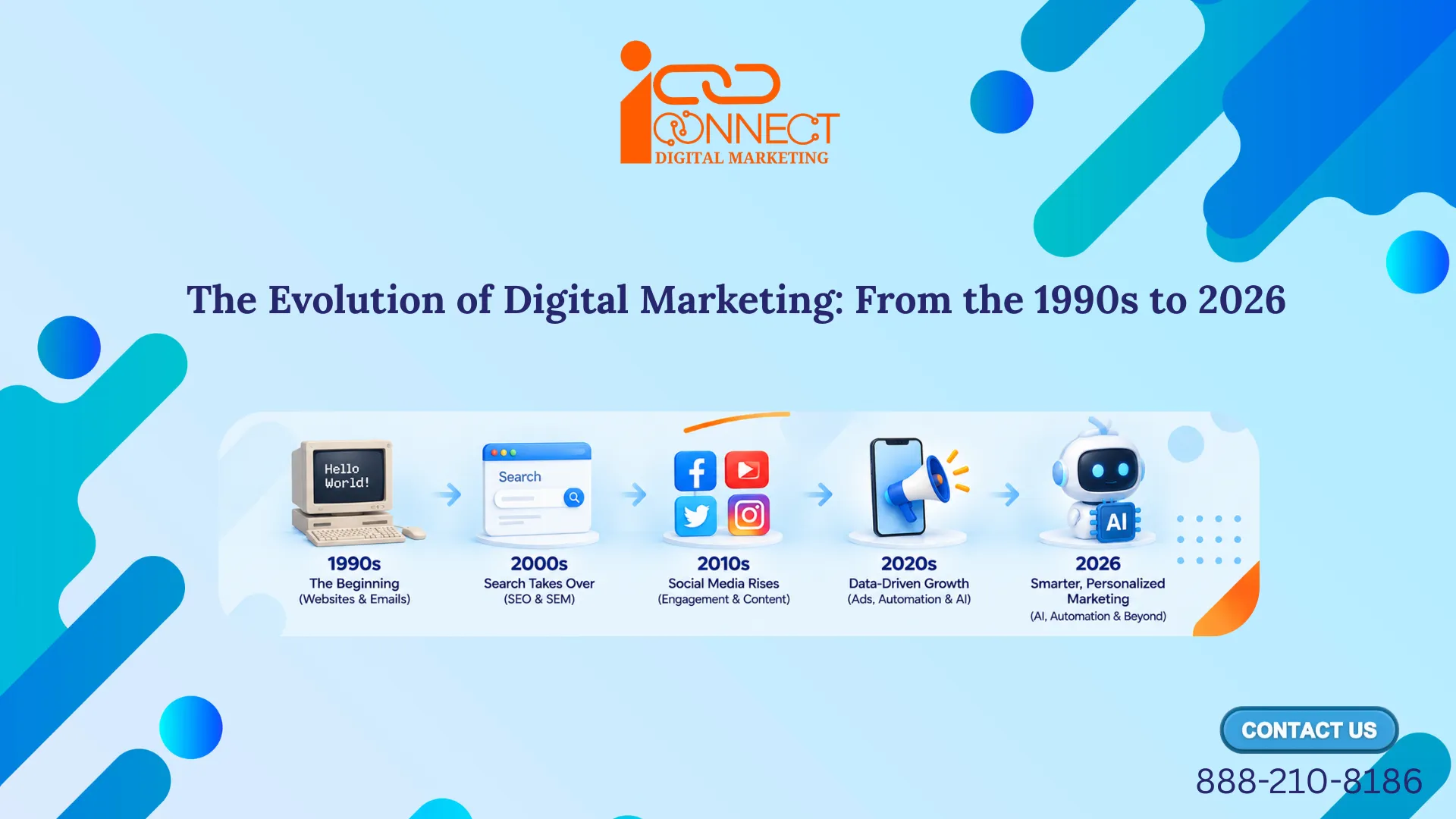
Digital marketing did not emerge overnight in a single year. In actuality, the evolution of Digital Marketing developed gradually from database marketing in the 1980s. Businesses began moving customer information from bulky paper files to computers back then. Instead of delivering the same message to the entire audience, this straightforward modification allowed businesses to speak to particular customer groups.
Around that time, email also came into the scene. Long before the internet even existed. So, we should not think of the 1990s as the time when a brand-new thing was invented from scratch. In a real sense, the 90s was just the decade when the internet arrived and altered the face of traditional marketing completely. As a result, a question began to arise in the minds of business owners, and they started asking themselves: “Should our business also have a website?”
You may also be interested in: 👉What is Digital Marketing and How Does It Work?
That question developed into far more complicated ones over the next 30 Years:
- How do search engines such as “Google” collect information about us?
- How can we take advantage of Social Media Networks to connect with and engage with customers more effectively?
- What should be utilized to analyze whether our ads are truly performing?
- How do we protect the security of customer data?
- How do we ensure that we remain visible and not lost as in increasing use of AI tools to locate and evaluate information?
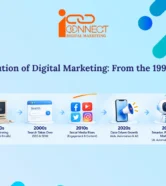
Let’s look at the evolution of digital marketing from the 1990s to 2026:
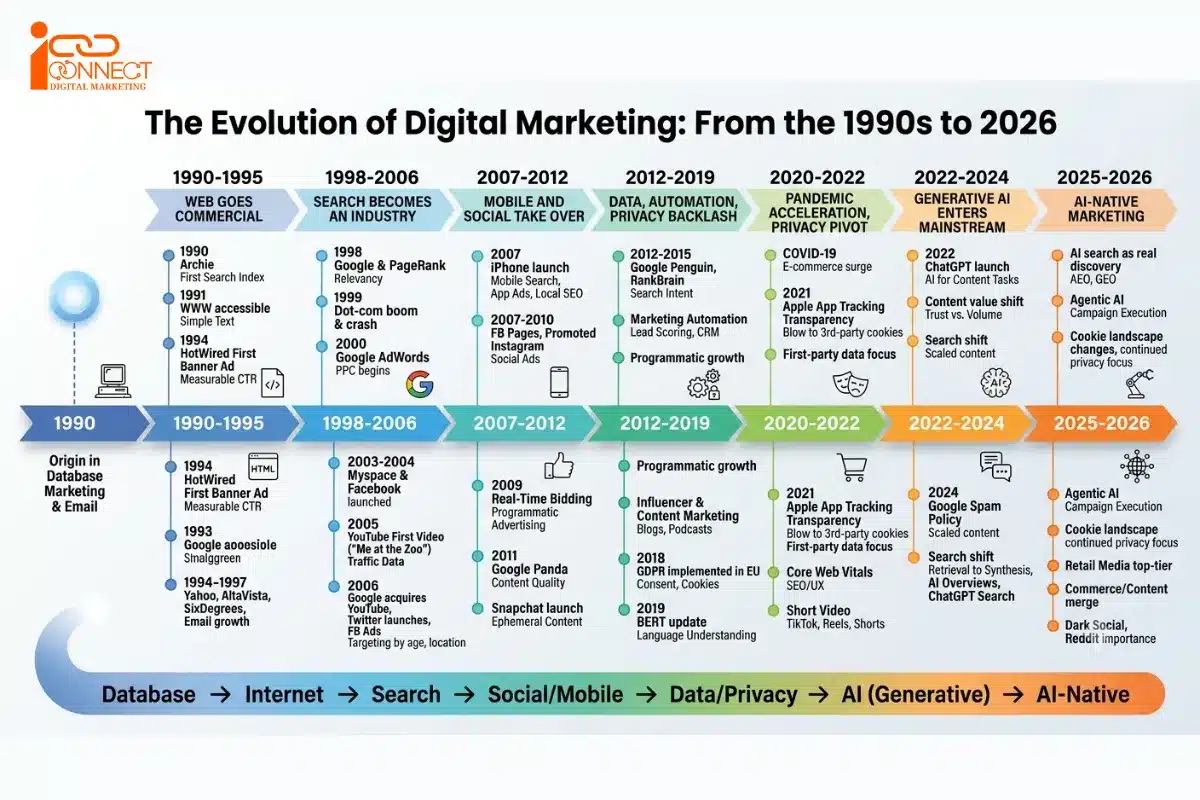
1990–1995: Web Goes Commercial
The early 1990s laid the foundation for the commercial Web and, consequently, for modern digital marketing.
- 1990: Alan Emtage at McGill University created Archie. A tool to index files on FTP servers. It’s often called the “first search engine”, but it’s more accurate to call it the first searchable index of internet content. It didn’t crawl or rank web pages the way modern search does. However, it defined the fundamentals of search marketing, which are: The user needs something → the system provides the required results to them.
- 1991: In 1991, Tim Berners-Lee made the World Wide Web publicly available beyond CERN, marking an important step toward the web becoming a broader information platform. In fact, web pages during that period contained only simple text, basic HTML, and hyperlinks. The business question was “should we have a website?” not “how do we rank #1?”
- October 27, 1994: Hot Wired (web version of Wired magazine) launched AT&T’s “You Will” campaign, which is considered the first clickable banner advertisement, with a reported 44% click-through rate (vs. today’s sub-1% average). This mattered less for the ad itself and more because it introduced the click as a measurable unit, considered the ancestor of CTR, CPC, and conversion tracking.
- 1994–1997: Yahoo launched; smaller search engines (AltaVista, Lycos, Excite, HotBot) emerged; SixDegrees.com became an early social network; email marketing grew as a direct, permission-based channel.
- 1998: Google was born. The true innovation was not Google as “just another search engine”. It was PageRank, which used the links between web pages to measure relevancy, thus creating the ideas of backlinks and domain authority.
- 1999–2000: The dot-com boom, followed by the 2000–2001 crash. Many businesses disappeared, but consumer internet adoption itself kept growing.
2000–2006: Search Becomes an Industry
- October 23, 2000:Google AdWords launched in 2000 with 350 advertisers, but the original system was not simply as today’s modern PPC auction model where people associate with AdWords today. The initial AdWords product used advertisers paying for impressions, while Google later introduced the self-service CPC auction model.
This shifted advertising from “pay to be seen” to “pay when a specific interest signal (a click) occurs”.
- SEO and PPC became distinct professional disciplines rather than IT side tasks.
- 2003–2004: Myspace and Facebook were launched. Myspace reached 25 million users in 2005. It was briefly the most-visited website in the US (2008) before Facebook surpassed it.
- 2005: YouTube uploaded the first video on the platform on April 23, 2005. It was titled “Me at the Zoo”. Meanwhile, Google Analytics was introduced. It provided access to behavioral data, like traffic sources, bounce rates and conversion pathways, for the first time to the common marketers.
- 2006: Google acquired YouTube for $1.65B; Twitter launched; Facebook opened its ad platform. Facebook increasingly turned social-network data into an advertising advantage. Allowing advertisers to target audiences using demographic and interest-related signals. This enabled targeting by age, location, and interest for the first time.
2007–2012: Mobile and Social Take Over
- January 2007: The iPhone came out. People, suddenly, did not need a desktop to use the internet. Apple’s iPhone helped accelerate the transition toward a mobile-first internet experience. This started mobile search, SMS marketing, and app ads. Soon, local SEO became a huge deal. Searches like “coffee shop near me” became very important for local businesses.
- 2007–2010: Facebook Business Pages, Twitter Promoted Tweets, and Instagram (2010) all launched — social platforms went from personal networking tools to formal ad channels.
- 2009: Real-Time Bidding (RTB) emerged — the technical foundation of programmatic advertising, where an ad auction, bid, and creative serve happen in about one-tenth of a second.
- 2011: Google’s Panda update cracked down on low-quality content. Snapchat launched, pioneering ephemeral/”Stories” content later copied by every major platform.
2012–2019: Data, Automation, and the Privacy Backlash
- 2012-2015: With Google’s release of Penguin, Hummingbird, and RankBrain (2015), SEO was forced out of simple keyword stuffing and linking. The search engines began emphasizing search intent, relevance and quality content.
- Marketing automation was made more intelligent through the use of behavior-based emails, lead scoring and campaigns connected to the CRM system.
- Programmatic advertising gained momentum for display, video and native ads, allowing advertisers to automate their purchase of ad space rather than negotiate placements manually.
- Influencer marketing and content marketing trends emerged from experimentation to being planned for regularly through blogs, YouTube, podcasts and guides – which have become some of the most effective ways to connect with the audience.
- May 25, 2018: Implementation of the General Data Protection Regulation in the European Union led to changes worldwide in consent, data gathering, and cookies.
- 2019: BERT, an update by Google, enhanced language understanding in more than 70 languages.
- January 1, 2020: California’s CCPA took effect, mirroring GDPR’s approach in the US.
2020–2022: Pandemic Acceleration and the Privacy Pivot
- COVID-19 didn’t invent digital transformation. What it did was it compressed years of adoption (e-commerce, social commerce, video conferencing, digital payments) into months.
- 2021: Apple introduced its App Tracking Transparency feature. With this, apps were required to seek consent from users before being able to track them. This was a major blow to the traditional third-party cookie advertising. As a result, companies started collecting their own consumer data.
- Around this time, Google introduced Core Web Vitals as a way of measuring key aspects of page experience, including loading performance, responsiveness and visual stability. It acts as ranking factors for SEO/UX through Core Web Vitals.
- Short clips on — TikTok, Instagram Reels, and YouTube Shorts. These emerged as the dominant way people discovered new things. It revolutionized the creator economy as a whole. Brands no longer depended solely on famous people but started collaborating with micro- and nano-influencers to a great extent.
2022–2024: Generative AI Enters the Mainstream
- November 30, 2022: ChatGPT launched, putting generative AI directly into marketers’ hands for drafting, ideation, summarization, and campaign variation — collapsing production costs for a huge range of content tasks.
- This created what’s arguably the defining tension of this era: when content becomes cheap to produce, trust and originality become the scarce, valuable resource.
- March 2024: Google explicitly added a “scaled content abuse” spam policy — clarifying that the issue was never “was AI used” but “is this content genuinely useful or just built to manipulate rankings.”
- Search began shifting from retrieval (a list of links) toward synthesis (a generated answer with citations) — Google’s AI Overviews and, in October 2024, OpenAI’s ChatGPT Search both launched.
2025–2026: AI-Native Marketing
This is where current search and industry demand is concentrated, so it’s worth going deeper:
- AI search is now a real discovery layer, not a novelty. AI search referrals reportedly jumped over 500% in 2025 and roughly 65% of Google searches now end without a click. Meaning visibility inside an AI-generated answer matters as much as, or more than, traditional ranking.
- GEO and AEO have emerged as industry practices: Generative Engine Optimization and Answer Engine Optimization focus on structured data, original information, and authoritative signals that help AI models decide what to cite. Important caveat: Google states there is no special schema or technical requirement to appear in AI Overviews or AI Mode. Existing SEO fundamentals (E-E-A-T, quality content, technical health) still apply. Treat “GEO” as an emphasis shift within SEO, not a replacement discipline with its own secret rules.
- Agentic AI is moving from content generation into campaign execution: Automated bid management, creative generation, and audience targeting increasingly run with AI supervision rather than manual control, shifting the human marketer’s role toward strategy, judgment, and brand decisions rather than tool operation.
- The cookie story didn’t end the way anyone predicted. Google actually reversed its plan for full third-party cookie deprecation, but the underlying privacy direction (less unrestricted cross-site tracking, more consented first-party/zero-party data) hasn’t reversed — only the deadline changed. New rules like California’s CPPA (effective Jan 1, 2026) reinforce the same direction.
- Retail media has become a top-tier channel (~$62B in US spend), commerce and content are merging (shoppable short-form video, AI-assisted shopping research tools), and authenticity is outperforming polish. Employee-generated content and real customer testimony are increasingly trusted over produced influencer content, and a large share of creator ad spend now goes to micro/nano-influencers rather than celebrities.
- Attention is fragmenting into “dark social” — A large majority of content sharing now happens in untrackable private channels (DMs, group chats), which is part of why community platforms like Reddit have become disproportionately important as trust signals AI models draw on when generating answers.
You may also be interested in: 👉What Is Answer Engine Optimization (AEO)
The Pattern Behind All of It: Evolution of Digital Marketing
If you remove the tools and platforms, the actual arc of change across 36 years looks like this:
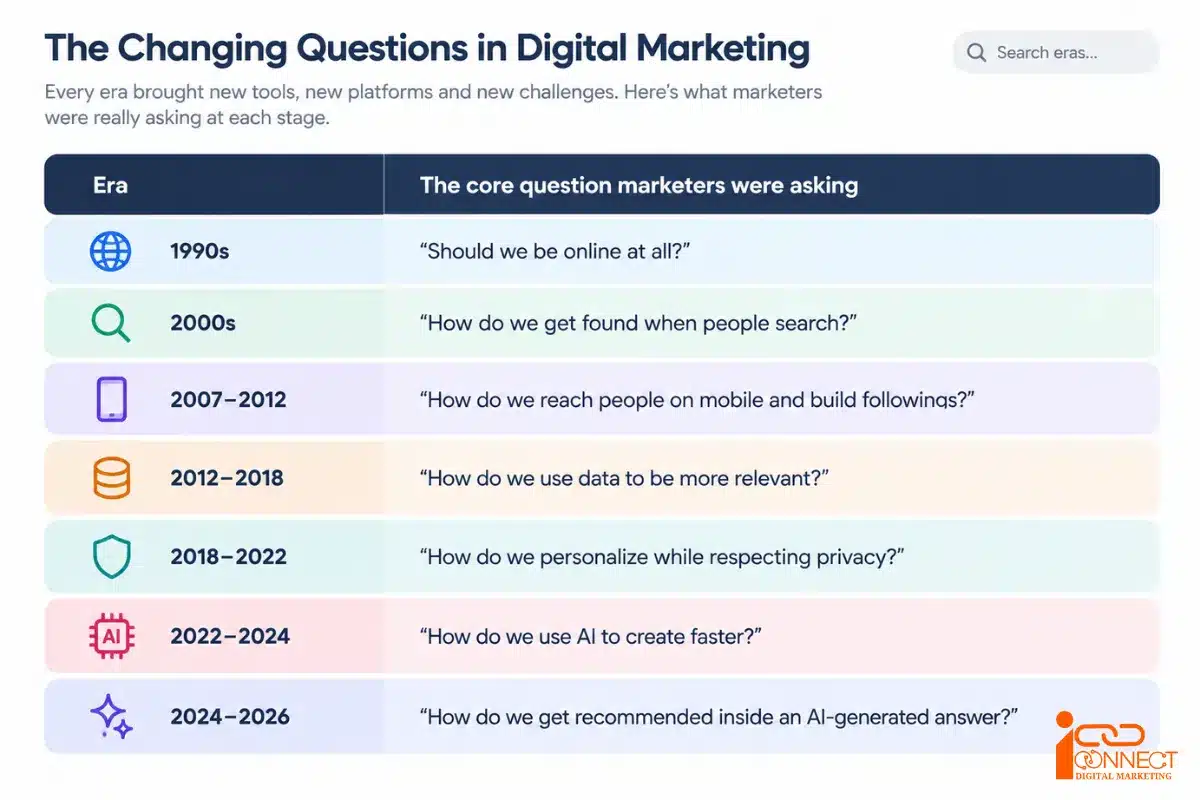
How digital marketing priorities evolved from getting online and search visibility to mobile, personalization, privacy, AI content and visibility in AI-generated answers.
The technology keeps changing, but the basic questions people ask before buying something have not changed much: Does this solve my problem? Can I trust it? The tools have evolved from websites and search engines to social media and AI, but the human need for useful information and trust remains the same.

Mohit Vij is the Founder & Digital Marketing Trainer at iConnect Digital Marketing Training Hub & Agency (iConnectDM), based in Ghaziabad. With over 9+ years of experience in SEO, Google Ads, Meta Ads, Social Media Marketing, Search Intent, Content Marketing, and Lead Generation.
Over the past years, He has trained hundreds of students, job seekers, working professionals in building successful careers in digital marketing while helping businesses improve their search rankings, website traffic, brand visibility, and lead generation. His insights are based on hands-on industry experience, continuous learning, and proven digital marketing strategies that deliver measurable results.