

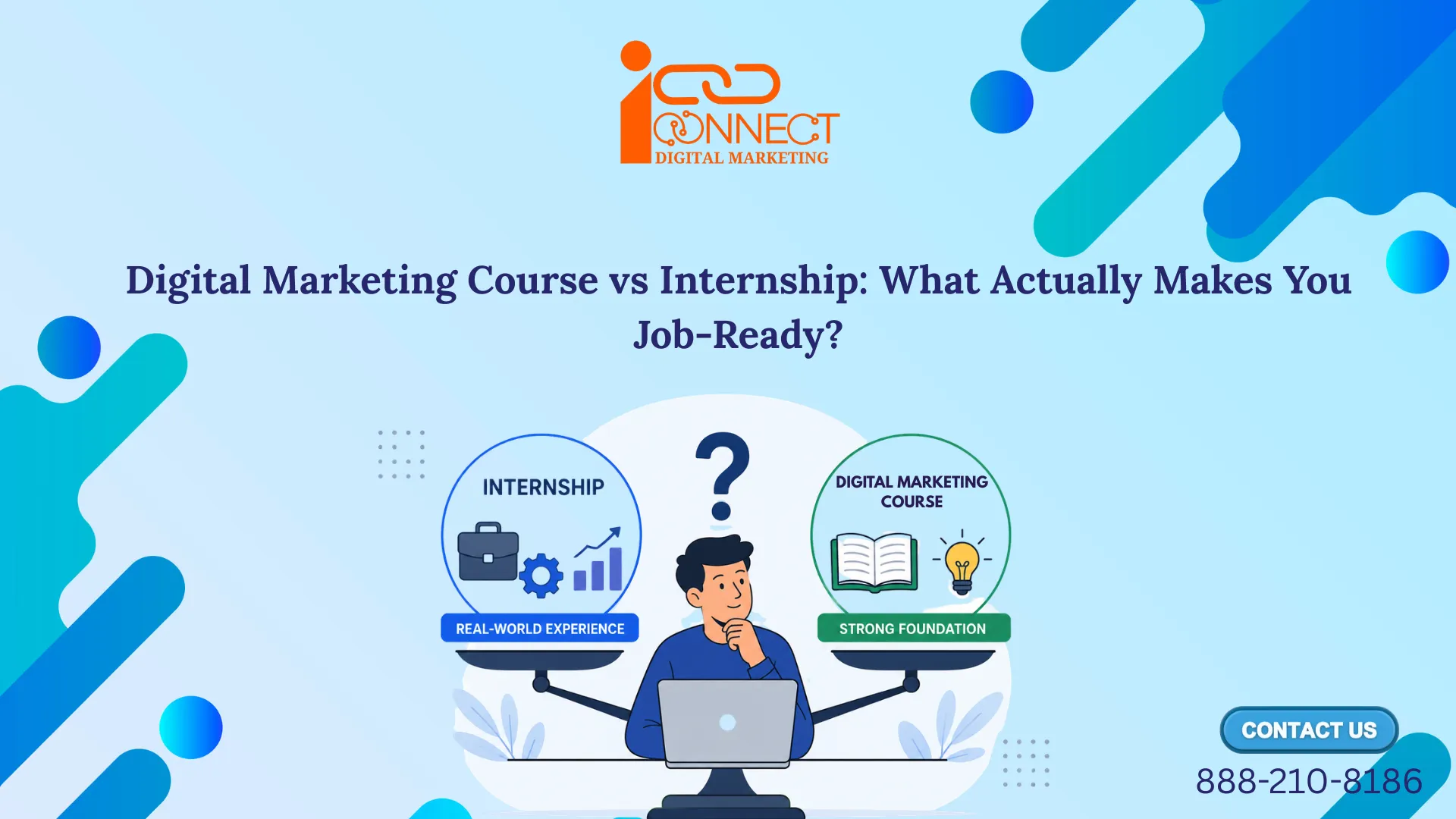
Having trained more than a hundred digital marketing students, I realize that there is one question that keeps coming up among them: Should you take up digital marketing course classes, or should you opt for an internship first?
Honestly, the truth is that it’s not that easy to choose one option over the other. Instead, what really makes the difference between success and failure is understanding the problem that each of them solves. That understanding often determines whether a student becomes job-ready or struggles to bridge the gap between learning and employment.
The India Graduate Skills Index 2025 by Mercer-Mettl discovered that employability rates for students of digital marketing had declined to a mere 41%, one of the largest declines of any category that they researched. In February 2026, the Manpower Group conducted a Talent Shortage Survey in India of over 3,000 companies, which revealed that 82% of them faced a shortage of manpower, with skills related to AI, and not marketing per se, being the most difficult to find. When all these three facts are put together, the conclusion becomes obvious: classroom training provides the base, but employers look for practical abilities, often including AI.
Taken together, these findings highlight an important reality: classroom learning provides the foundation, but employers increasingly look for practical, applied skills that can be demonstrated in real-world situations.
You May Also be Interested in |👉 Digital Marketing Jobs and Career Scope in India and Global Markets
Quick Answer: Should Students Choose Classroom or Online Digital Marketing Course with Internship?
The best approach is not choosing one over the other. Classroom education helps you grasp the terms, techniques, and tools of the digital marketing world. Internships help you gain hands-on experience using these principles in actual campaigns. Ultimately, students who build their knowledge in the classroom and then move into internship experiences often become job-ready sooner than students who go with just one or the other.
With that context in mind, here are the seven lessons that stood out most.
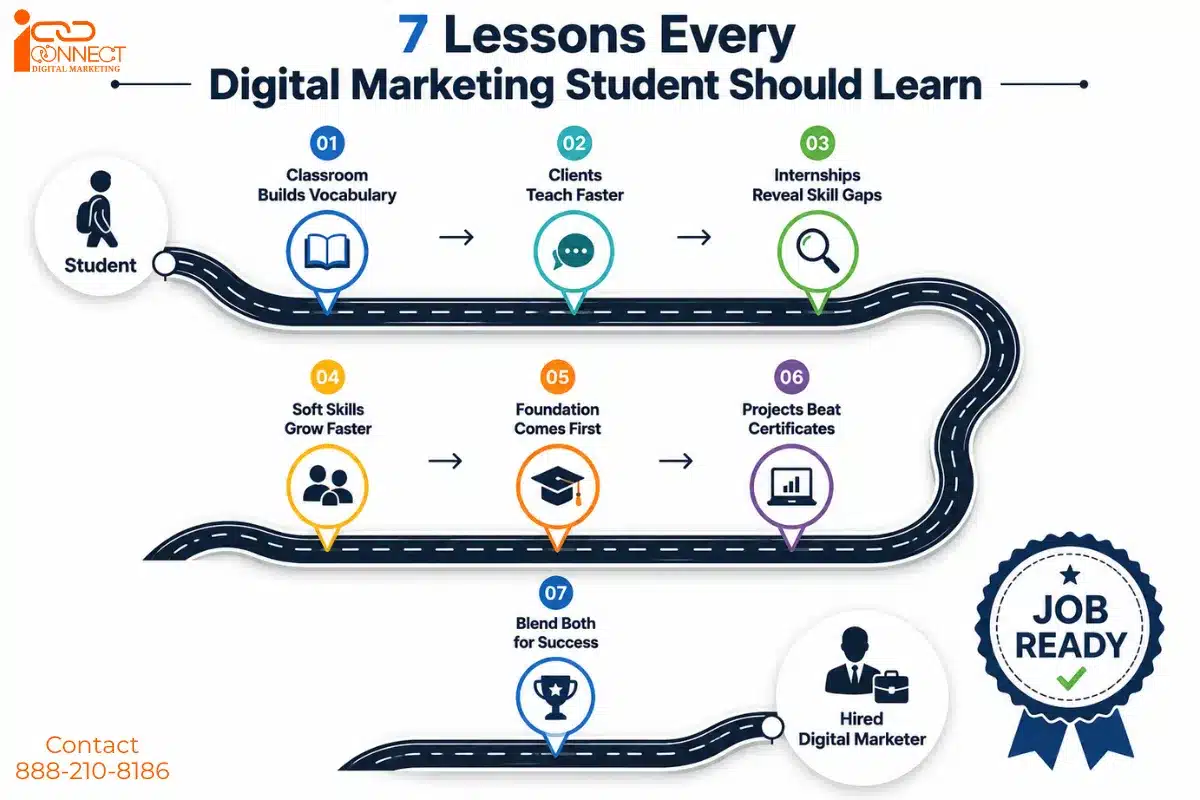
1. Classroom Learning Builds Vocabulary, Internships Build Judgment
In the classroom, students get to know what exactly terms like SEO, CTR or CAC actually mean. This is very important, and overlooking it would cause some gaps later. But just having knowledge about the definitions is completely different from making decisions in real time about whether a decrease in CTR means that it is due to a poor creative of the advertisement or wrong targeting. This kind of judgment only comes with experience — and that experience is what an internship provides, not classroom learning alone.
For example, one student we worked with could accurately define CTR and CPC during classroom discussions. However, when reviewing a live campaign during an internship, they struggled to determine whether a performance drop was caused by audience targeting, creative fatigue, or landing page issues. Within a few weeks of working on real campaigns, that same student became far more comfortable diagnosing problems because they were seeing actual data instead of textbook examples.
What classroom learning typically builds:
- Core definitions and frameworks (SEO, SEM, CTR, CAC, funnels)
- Familiarity with tools in a low-pressure setting
- A shared vocabulary to understand instructions and reports
What internships add on top:
- Real-time decision-making under actual budget constraints
- The ability to diagnose why a metric moved, not just define the metric
- Comfort with ambiguity, since real campaigns rarely behave like textbook examples
- Hands-on use of AI tools already built into everyday platforms — Google Ads’ automated bidding, GA4’s AI-generated insights, ChatGPT for content or images.
2. Students Take Feedback More Seriously When a Client Is Watching
We observed something time and again: The same piece of feedback given in the same manner can have completely different effects based on where it was given. A student often nods and gets back to their work after being corrected by the trainer. However, when the exact same feedback comes from the customer and they tell you that the update on social media doesn’t fit the voice of the brand, the lesson will stick around. The reason for this is simple; when you have a stakeholder in the picture, everything seems to matter more.
Why classroom feedback tends to fade:
- No real consequence attached to the mistake
- Feedback often feels generic or hypothetical
- Students can retake or revise without any real cost
Why client feedback sticks faster:
- A real brand reputation is on the line
- Correction comes with a visible, immediate reason
- Students associate the lesson with an actual outcome, not just a grade
This exposure helps students develop professional accountability much faster than classroom exercises alone.
3. Internships Expose the Gaps That Coursework Hides
Even though a student may score well in every assignment and exam, they still struggle when a client asks, “Why did our website traffic drop this week?”
This is where many beginners realize the difference between classroom learning and real work. Assignments follow a fixed structure, but client questions are often unexpected, unplanned, and require practical problem-solving. Hence, internships bring out weaknesses that could be hidden within a well-designed course due to its very nature as it is too controlled.
A common pattern we see is that students perform well when solving structured assignment questions but hesitate when asked open-ended business questions. A client rarely asks, “What is SEO?” Instead, they ask, “Why are our leads down this month?” Learning to investigate those questions is often where professional growth accelerates.
You May Also be Interested in |👉 What is Search Engine Optimization and How It Works?
Common gaps that only surface during internships:
- Difficulty explaining “why” behind a result, not just “what” happened
- Trouble prioritizing when multiple tasks compete for attention
- Underdeveloped instincts for spotting a problem before it escalates
Why coursework can accidentally hide these gaps:
- Assignments usually have one clear, expected answer
- Deadlines are fixed and predictable, unlike real client timelines
- There’s rarely a “surprise” element that tests genuine adaptability
4. Soft Skills Grow Faster Outside the Classroom
Communication, patience, and handling pushback are difficult to teach through lectures alone. Nevertheless, once a student has to explain a campaign delay to an annoyed client, or push back diplomatically on an unrealistic deadline, these skills develop fast. The data backs this up: the NSLS State of Higher Ed report found that 68.4% of students who completed an internship said it prepared them to work as part of a team — and employers consistently rank collaboration and communication as highly as technical skill.
Soft skills that develop mainly through real exposure:
- Explaining setbacks calmly and clearly to a stakeholder
- Negotiating realistic timelines without damaging the relationship
- Reading tone and adjusting communication style per client
Why lectures alone fall short here:
- Soft skills need a real emotional stake to actually form
- Role-play exercises rarely replicate genuine pressure
- Feedback loops are slower and less personal in a classroom setting
These abilities often become deciding factors during interviews and early-career growth.
You May Also be Interested in |👉 Digital Marketing As A Career: Why People Are Choosing It
5. Classroom Training Still Matters Most in the First Few Weeks
It would be inaccurate to assume that internships are “better.” Actually, it is the students who have decided to get an internship experience before getting some basic knowledge in class that face the most difficulties because they lack vocabulary or basic frameworks in order to understand what is going on around them. Thus, the students who progressed fastest were consistently the ones who had a short but solid classroom foundation first, followed by real internship exposure soon after — not the other way around, and not one without the other.
Risks of skipping classroom groundwork:
- Confusion over basic terminology during real client meetings
- Slower ramp-up time, since everything has to be explained on the job
- Higher chances of costly beginner mistakes with real budgets
What a short, solid foundation should include before an internship:
- Core platform basics like — Google Ads, Meta Ads Manager, GA4
- Fundamental SEO and content principles
- Basic reporting and analytics literacy
A short but structured learning phase often accelerates the value students gain from internships.
6. Portfolio Quality, Not Course Completion, Predicts Job Offers
One of the most consistent hiring patterns we observed involved portfolios. Oftentimes, we would discover that the students who were recruited the fastest were not always those who did well on the quizzes. What really made the difference was the ability of the candidate to present something concrete to the recruiter, whether a whole campaign or a landing page or even just before and after results. This lines up with broader hiring data too — LinkedIn’s India hiring reports show recruiters increasingly weighing demonstrated, hands-on digital skills over certificates alone when shortlisting candidates. Thus, portfolio development has become an integral part of the training process.
What a strong digital marketing portfolio should show:
- A real or simulated campaign with visible before-and-after metrics
- The specific tools used, named clearly (and not just mentioned as “SEO tools”)
- A short explanation of — the problem, the approach, and the result
Why this matters more than certificates alone:
- Interviewers can ask follow-up questions a certificate can’t answer
- It proves applied thinking, not just course completion
- It differentiates candidates in a crowded, certificate-heavy applicant pool
7. The Best Outcomes Come From Both, Not Choosing One
Finally, the clearest lesson of all: this was never really a competition between Digital Marketing Course vs Internship. Classroom sessions build the foundation — the vocabulary and frameworks a student needs to make sense of real work. Internships then introduce friction — real clients, real deadlines, and real consequences — and it’s this friction that actually converts foundation into usable skill. Skip the foundation, and friction just causes panic. Skip the friction, and the foundation never leaves the notebook. Foundation first, friction next — that’s the sequence worth remembering.
The Foundation-Then-Friction model, in short: Digital Marketing Course vs Internship
Stage 1: Foundation
Learn the fundamentals of digital marketing, including SEO, paid advertising, analytics, content marketing, and reporting. The goal is understanding concepts and becoming familiar with industry tools.
Stage 2: Guided Practice
Apply concepts through assignments, exercises, simulations, or personal projects. This helps build confidence before working on real campaigns.
Stage 3: Friction
Begin working with real clients, real budgets, real deadlines, and real performance expectations. This is where theoretical knowledge begins turning into practical skill.
Stage 4: Portfolio Development
Document campaigns, analyses, projects, and outcomes. Employers often evaluate demonstrated work more heavily than certificates.
Stage 5: Job Readiness
Students combine technical knowledge, practical experience, communication skills, and portfolio evidence into a professional profile that employers can evaluate confidently.
The sequence matters: Foundation without friction remains theoretical. Friction without foundation often creates confusion. The strongest outcomes typically come from combining both in the right order.
How AI Is Changing This Debate in 2026
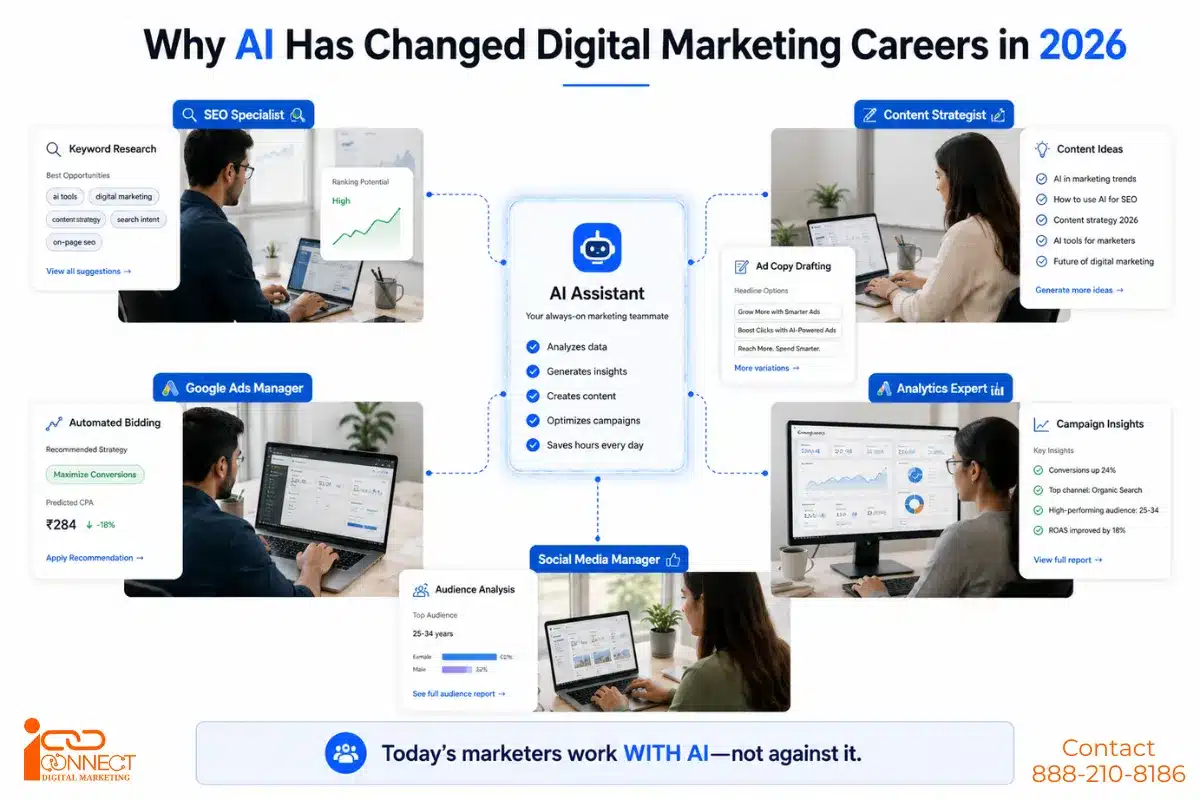
There’s one more layer to this in 2026: AI has changed what “job-ready” even means. The same ManpowerGroup survey cited earlier found that AI literacy and AI model development are now the hardest skills for Indian employers to find — ahead of traditional marketing and IT skills. A classroom course that hasn’t updated its syllabus to cover how AI tools are actually used in campaigns (auto-generated ad copy, AI-assisted keyword research, automated bid strategies) leaves students behind before they even start. This is one more reason internships matter more than ever — clients use whatever tools are current, whether or not the classroom has caught up.
Which makes it another good point for internships. Course work will take a while to get new tools into the curriculum. While in real client projects it is quick to see companies already jump into new tools. The students would know the technology that employers will require from internship candidates to know.
So, Which Digital Marketing Course Should You Choose?
If you’re a student struggling to make your choice, here is what you need to take into account:
A simple sequence to follow:
- Start with focused classroom learning to build your foundation
- Move into internship work as early as possible, while the learning is still fresh
- Apply what you’re learning immediately to real campaigns, real clients, and real feedback
- Build your portfolio continuously through this process, rather than after it
This isn’t just my opinion — it matches independent research too. Cornell University’s review of experiential learning revealed that the hands-on, reflective practice method enhances retention and readiness for employment much better than conventional learning in the classroom because it is through application of knowledge that it becomes an acquired skill rather than just a memorized fact.
Frequently Asked Questions: Digital Marketing Course vs Internship
Yes, it is perfectly possible to have a successful digital marketing career without an internship. Having said that, practical experience counts more than classroom teaching, so make sure you gain a lot of that! Employers would prefer a candidate that has worked on projects (through freelancing, creating personal sites, doing freelance work for small businesses, volunteer work or running actual marketing campaigns).
A 3-4 months long digital marketing internship is sufficient to obtain a decent amount of practical experience as long as it involves actual projects. The ideal digital marketing internship is 3 to 6 months so you get a good amount of exposure into planning, campaigning, analytics and reporting. Real practical skill building starts here – with hands-on Google Analytics data, running paid advertising campaigns, and implementing end-to-end digital marketing campaigns.
A valuable digital marketing internship should provide hands-on experience on SEO/SEM, Social Media Management, content creation, campaign creation, Google business profile, Google Analytics, Google Search Console, Local SEO and data analytics with real campaigns rather than observational tasks alone. By the end of the digital marketing internship students should have practical work samples and measurable achievements they can confidently present in their portfolio.
When it comes to digital marketing careers, a portfolio carries more weight than certificates. You might earn a certificate after taking an online course on Google Analytics, but the true testament of your abilities would be having a portfolio demonstrating you know how to work on the real projects and drive successful campaigns. The reality is that most employers want to see evidence that you can execute digital marketing campaigns, not just that you’ve attended training on them. So, even though certifications can enhance your portfolio and attest to your know-how, in and of themselves, they’re less meaningful for landing a role in digital marketing.
You can launch a digital marketing career without an internship, but doing so will allow you to gain the experience that you will learn in the classroom. An internship enables you to gain experience in practicing marketing, using digital tools, taking part in actual digital marketing campaigns, and observing the process. If you are unable to find an internship, you will be able to gain relevant experience through freelancing, taking on personal projects, volunteering, or working in a related field and taking on relevant responsibilities that can serve as an internship alternative. In most cases, employers are interested in what you know and what you can do to show them what you are good at.
The Bigger Picture
Ultimately, the entire discussion on digital marketing course classroom learning vs. internships is irrelevant. Employers are less bothered about whether the individual has undergone classroom learning or done internships. They’re asking whether that candidate can walk in and actually do the work. Since the data shows 82 percent of Indian employers are already struggling to find people who can prove their skills, the students who combine structured learning with real, hands-on exposure will always have the advantage.
After working with well over 100 students, that’s the lesson that stands above all the rest: it was never Digital Marketing Course versus internship. It was always classroom, then internship, done in the right order — foundation first, friction next. They learned the fundamentals, applied them quickly, built portfolios, accepted feedback, and gained experience while their knowledge was still fresh.
That is why the most effective path is rarely classroom learning alone or internship experience alone. It is a combination of both — foundation first, friction next, and continuous learning throughout the process.

Mohit Vij is the Founder & Digital Marketing Trainer at iConnect Digital Marketing Training Hub & Agency (iConnectDM), based in Ghaziabad. With over 9+ years of experience in SEO, Google Ads, Meta Ads, Social Media Marketing, Search Intent, Content Marketing, and Lead Generation.
Over the past years, He has trained hundreds of students, job seekers, working professionals in building successful careers in digital marketing while helping businesses improve their search rankings, website traffic, brand visibility, and lead generation. His insights are based on hands-on industry experience, continuous learning, and proven digital marketing strategies that deliver measurable results.