

For an MBA student, an SEO project shouldn’t be about “ranking #1 for a generic term.” When we talk about SEO project ideas for MBA students, well, in a corporate or startup environment, SEO is a capital allocation decision. It is an exercise in resource management, risk mitigation, and long-term asset building.
Most MBA SEO projects fail for one reason: they focus on activity instead of business outcomes. A student publishes a few blog posts, tracks keyword rankings for a month, adds screenshots from SEO tools, and calls it a “digital marketing project” instead of building a topical authority. That may work academically, but it rarely demonstrates strategic thinking, operational understanding, or commercial awareness.
A strong MBA SEO project should answer questions like:
- Can organic search reduce paid acquisition costs?
- Which content assets create long-term revenue value?
- Where is the company losing market share to competitors?
- What operational risks are hurting search visibility?
- Which SEO investments produce measurable business impact?
This guide focuses on SEO projects from a business and strategic perspective rather than a purely tactical one. The goal is not to “rank #1 quickly.” The goal is to build a project framework that reflects how modern businesses actually evaluate organic growth.
Students looking for practical SEO implementation experience can also study how real businesses structure organic growth systems through hands-on digital marketing training programs.
Website: https://www.iconnectdm.com/
What Makes a Strong MBA SEO Project?
A good MBA SEO project solves a measurable business problem using search data, technical analysis, user intent research, and ROI modeling.
The best projects usually include:
- A clear business objective
- Measurable KPIs
- Implementation feasibility
- Competitive analysis
- Financial reasoning
- Operational constraints
- Long-term scalability
A weak project focuses only on:
- Keyword rankings
- Traffic growth without conversion quality
- Generic blogging
- Vanity metrics
- Theoretical recommendations without execution planning
The difference matters during interviews, consulting presentations, and real business discussions.
The Strategic Lens: How to Select an SEO Project Before Starting
Before picking a topic, you must apply a professional evaluation matrix. A project that lacks data accessibility or business alignment will result in a “vanity report” that holds no weight in a job interview or a boardroom.
MBA SEO Project Evaluation Matrix
Start by looking at how much effort the work needs. A different thing to check is whether deadlines are realistic. See if the team has the right skills, this matters more than most think. Another angle: will the outcome actually help the goal?
1. Business Alignment: Could this tackle an actual company problem, maybe steep customer expenses, poor search rankings, or holes in income?
2. Data Accessibility: Got the right data close at hand, Google Search Console, GA4, CRM, what competitors are doing? If numbers feel shaky, trust in the findings slips fast.
3. Technical Feasibility: Will the suggested updates work once put into practice? Trying things out brings clearer results compared to just talking about ideas.
4. Measurement Clarity: Start by determining if the SEO changes are distinguishable from the holiday trend or ad campaigns. Without measurement clarity, it is difficult to have faith in the data. Most decisions then rest on guesses rather than evidence sitting solid behind them.
High-Impact SEO Project Frameworks
1. The Revenue-First Competitor Gap & Opportunity Mapping
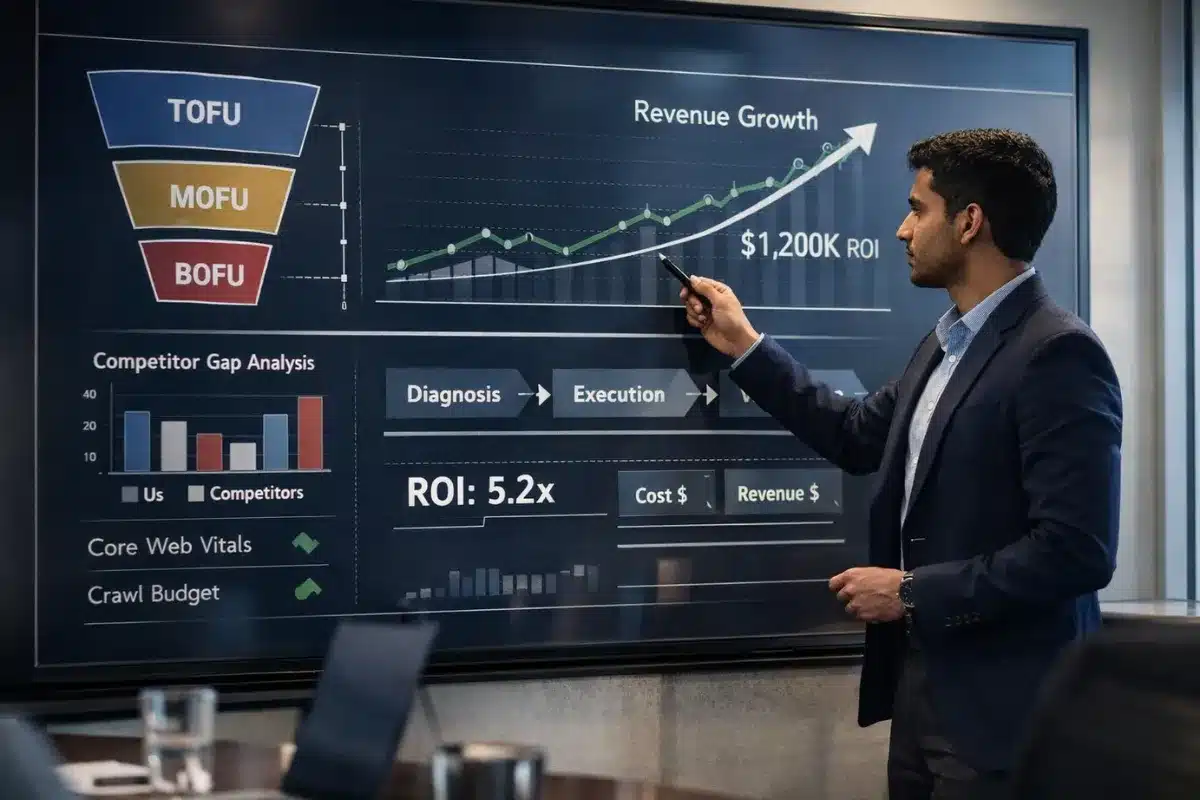
Students usually look at the competitors they rank for. A strategic approach also considers the value of the competitors they rank for and the cost of losing those positions.
- Strategic Objective: You have to find high-intent keyword gaps where competitors are winning the market share race and determine the “Cost of Inaction.”
- Implementation:
- Conduct a competitive overlap analysis with help of Ahrefs or SEMrush. Then, group the gaps based on the funnel stages.
- Now, categorize gaps by funnel stage (TOFU/MOFU/BOFU).
- The MBA Edge: Assign a “Proxy Revenue Value” to the gap. If the average CPC for a keyword is $10 and the competitor gets 1,000 clicks/month, that organic position is worth $10,000 in monthly media spend.
- Risk & Failure Patterns: The “Volume Trap.” Selecting high-volume keywords that have zero conversion intent.
- Expected Outcome: A prioritized roadmap of content or features backed by potential ROI projections.
2. Content Cluster Architecture & Topical Authority Buildout
Modern SEO has moved from individual keywords to “Topical Authority.” This project is about dominating a specific niche through semantic depth.
- Strategic Objective: The goal here is to move a domain from “scattered rankings” to a “niche leader” by building a hub-and-spoke content model.
- Implementation:
- Select a core “Pillar” page (e.g., “The Ultimate Guide to Supply Chain SaaS”).
- Develop 10–15 “Spoke” articles answering specific long-tail queries.
- Implement a rigorous internal linking schema that funnels “link equity” back to the pillar.
- KPIs: Internal link click-through rates, “Average Keywords per Page,” and Topical Relevance scores.
- The Strategic Paradox: There might be a short-term drop in overall site engagement due to the very targeted nature of the traffic, which is niche-specific rather than broad.
- Expected Outcome: Improved ranking for “hard” head terms due to the demonstrated depth of the surrounding content.
3. The Programmatic SEO (pSEO) Scalability Study
In the case of businesses with large data sets like real estate, e-commerce, job sites, etc., creating content manually is inefficient.
- Strategic Objective: This project involves evaluating the viability of creating thousands of good-quality landing pages based on structured data.
- Implementation:
- Find a “Head Term + Modifier” pattern — e.g., “Best Coworking Space in [City Name]”).
- Design a database schema to populate these pages dynamically.
- Governance Layer: Create a “Quality Thresholds” concept to avoid Google’s “Helpful Content” algorithm penalties. How will you ensure that these 500 pages are not considered “thin content”?
- Tools: Airtable, Webflow/WordPress CMS collections, and Low-code automation tools.
- Risk: Indexation bloat. Google might not index thousands of new pages if the Domain Authority is too low.
4. Technical SEO & Core Web Vitals (CWV) Financial Impact
This is a project for those interested in the intersection of Product Management and Marketing.
- Strategic Objective: The goal is to determine the correlation between Site Speed and User Experience metrics and Conversion Rate (CVR) and Organic Visibility.
- Implementation:
- Carry audit of the site’s LCP (Largest Contentful Paint) and CLS (Cumulative Layout Shift).
- Perform “A/B Tests” or “Before/After Snapshots” to determine the impact of changes on Conversion Rates for technical changes (image optimization, script minification, etc.).
- Measurement: Utilize the “SEO to Revenue” bridge. “If a 1-second improvement in site speed can increase CVR by 0.2%, what is the potential increase in Revenue?”
- Expected Outcome: A business case to secure engineering resources, proving that “Technical Debt” is, in fact, “Revenue Debt.”
5. Local SEO Domination & “Near Me” Attribution
Perfect for MBAs who are working with SMEs or franchises.
- Strategic Objective: Develop a strategy to capture hyper-local intent and measure offline impact.
- Implementation:
- You have to optimize Google Business Profiles (GBP).
- Niche citation building and “Local Information Gain” (adding unique local photos/reviews).
- Attribution Model: Use UTM tracking on GBP buttons and “Click-to-Call” metrics to bridge the gap between search and physical foot traffic.
- Risk: Over-reliance on a third-party platform (Google) which can change the “Local Pack” layout at any time.
For students learning SEO through local business case studies in service-based businesses or regional Digital Marketing institutes in Ghaziabad and Delhi NCR often provide more practical implementation exposure than purely theoretical projects.
6. The SEO Due Diligence Framework for M&A
In the world of Mergers and Acquisitions, digital assets are often undervalued or carry hidden liabilities (e.g., toxic backlink profiles or manual penalties).
- Strategic Objective: Evaluate the “Search Equity” of a target acquisition to inform valuation and post-merger integration (PMI) risks.
- Implementation:
- Liability Audit: Use tools to check for historical Google penalties or “black-hat” link patterns that could trigger a future collapse.
- Equity Mapping: Identify which specific URLs drive 80% of the revenue.
- The MBA Edge: Calculate the “Replacement Cost.” If the target company’s organic traffic were to cease to exist overnight, how much would the acquiring company need to spend on Google Ads (PPC) to maintain the same volume of leads?
- Risk: Overestimation of synergies. Merging two domains (e.g., company-a.com into brand-b.com) often results in a temporary 20–30% traffic loss.
- Expected Outcome: A “Digital Health Report” that can literally change the deal price during negotiations.
7. International Market Entry: The “Search-First” GTM Strategy
Prior to investing millions in physical infrastructure, SEO can be used as a cost-effective mechanism for validating the market.
- Strategic Objective: Develop a localized SEO strategy that can be used for market validation in a new geography. For example: a SaaS business from the US looking to enter India.
- Implementation:
- Linguistic Gap Analysis: In this, you need to find out how local search intent differs. (e.g., “Flat for rent” in the UK vs. “Apartment for rent” in the US).
- Technical Infrastructure: You need to assess the advantages/disadvantages of ccTLDs (.in), Subdirectories (/in/), or Subdomains (in.site.com) based on budget and technical resources.
- Hreflang Governance: Create a mapping document to make sure the correct version of the website is served to the right audience by Google.
- KPIs: “Market Share of Voice” in the new region and “Localized Conversion Rate.”
- Business Outcome: A validated “Go-to-Market” (GTM) plan that reduces the risk of expensive international failures.
8. SEO Attribution Modeling & The “Halo Effect” Study
SEO is rarely the “last click” before a sale. This project tackles the common management complaint: “How do we know SEO is actually driving sales?”
- Strategic Objective: Quantify the impact of organic search on other channels (PPC, Direct, and Email).
- Implementation:
- Multi-Touch Analysis: Use GA4’s Model Comparison tool to compare “Last Click” vs. “Data-Driven” attribution.
- The Halo Effect: Measure if an increase in organic rankings for “Top of Funnel” terms leads to a decrease in “Cost Per Lead” for branded PPC campaigns.
- Assisted Conversion Reporting: Create a dashboard showing how many sales started with an organic search but finished via a different channel.
- Information Gain: Prove that cutting SEO spend often leads to an immediate increase in PPC costs, as the “brand discovery” engine stalls.
9. Content Portfolio Management: The “Depreciation & Refresh” Model
Just like physical machinery, digital content depreciates. “Content Decay” occurs when old articles lose relevance and rankings.
- Strategic Objective: Build a “Content Maintenance” framework to protect existing traffic assets and maximize ROI on historical spend.
- Implementation:
- Decay Identification: Use Search Console to find pages that have lost >20% of their traffic in the last 6 months.
- The “Keep, Kill, or Refresh” Matrix:
- Keep: High performing, leave alone.
- Kill: Low traffic, low intent; 410 or redirect to consolidate juice.
- Refresh: High potential but falling; update data, add “Information Gain” (new stats/expert quotes).
- Measurement: “Traffic Recovery Rate” and “Delta in Organic Revenue” post-refresh.
- Business Outcome: Stabilizing the “floor” of organic revenue, ensuring the marketing team isn’t just “running to stand still.”
10. SEO Governance & Risk Management for Large Enterprises
In large organizations, “SEO accidents” (like a developer accidentally “no-indexing” the site) can cost millions in hours.
- Strategic Objective: The aim here is to develop a “Digital Governance” model for preventing SEO regressions during product updates or site migrations.
- Implementation:
- SOP Development: Start by building an “SEO Checklist for Developers” and make it part of the Jira or Agile workflow.
- Automated Monitoring: Establish simple guidelines to assist other non-SEO teams (e.g., content writers, user experience designers) in understanding how their activities affect search engine visibility.
- Stakeholder Training: Keep processes simple and not overly complicated. Too many rules can slow down development and execution.
- Risk: Watch out for “bureaucracy bloat.” If the rules get too heavy, engineering slows down.
- Expected Outcome: Fewer unforced SEO mistakes and a digital presence that’s a lot more solid.
Implementation Roadmap: The 3-Phase SEO Project Execution Model
If you want that your project is managed professionally, then follow this timeline:
| Phase | Focus | Deliverable |
| Phase 1: Diagnosis | Audit, Competitive Benchmarking, Hypothesis Setting | Strategic Brief & Baseline Report |
| Phase 2: Execution | Technical Fixes, Content Deployment, Backlink Outreach | Implementation Log & Mid-point Data |
| Phase 3: Validation | Trend Analysis, ROI Modeling, Post-Mortem | Final Executive Summary & Future Roadmap |
Why Most SEO project ideas for MBA students fail?
Most MBA students assume that SEO is a linear “Input = Output” game. It isn’t. The “Strategic Paradox” of SEO is that Traffic growth alone does not guarantee business growth. An SEO project that doubles traffic but halves the lead quality is a failure. In your project, you must address Traffic Quality. Use a “Lead Scoring” or “Search Intent Mapping” framework to prove that the traffic you are generating is aligned with the company’s Target Addressable Market (TAM).
Hidden Risk Factor: Many students overlook the “Crawl Budget.” On large sites, Google might not even see your hard work if the site architecture is a mess. Always include a “Crawlability” check in your technical phase.
Common Failure Reasons of SEO project ideas for MBA students:
- Focusing only on rankings
- Ignoring conversion quality
- Weak attribution modeling
- Unrealistic execution assumptions
- Poor crawlability
- Publishing thin content at scale
- Overestimating traffic intent
- Failing to measure business outcomes
SEO Project Governance & Reporting Model
When presenting to stakeholders (or professors), use this reporting hierarchy:
- Executive Level: Organic Revenue, Market Share (SoV), ROI.
- Managerial Level: CVR, Cost Per Lead (CPL) compared to PPC, Goal Completions.
- Operational Level: Keyword Rankings, Backlink Count, Site Speed Score.
What Tools are commonly used in SEO projects?
Some common tools include:
- Google Search Console
- GA4
- Ahrefs
- SEMrush
- Screaming Frog
- PageSpeed Insights
- Looker Studio
Conclusion: Turning Academic Insights into Business Assets
An SEO project for an MBA should not be a “simple paper.” It should behave more like a business pilot program. By focusing on competitive gaps, scalable structures, and rigorous financial attribution, you demonstrate that you aren’t just a “marketer”—you are a business leader who understands how to build a sustainable, organic growth engine.
The strongest projects combine:
- Strategic thinking
- Operational realism
- Financial reasoning
- Technical understanding
- Measurable business impact
However, companies do not invest in SEO because rankings look impressive in dashboards. They invest because sustainable organic visibility can reduce acquisition costs, strengthen market positioning, and create long-term growth assets. That is the perspective your project should demonstrate.
This article was written for MBA students, marketing learners, and business owners who want to understand SEO from a practical business and implementation perspective rather than only theoretical ranking concepts.
The frameworks discussed here are based on modern SEO practices involving content strategy, technical SEO, local SEO, analytics, organic growth planning, and search visibility management used across real business environments.
Students and professionals interested in gaining hands-on SEO and digital marketing implementation experience can also explore the practical training programs available at iConnectDM.
👉 Learn more about our Digital Marketing Training Program
👉 View our training center and student reviews on Google

Mohit Vij is the Founder & Digital Marketing Trainer at iConnect Digital Marketing Training Hub & Agency (iConnectDM), based in Ghaziabad. With over 9+ years of experience in SEO, Google Ads, Meta Ads, Social Media Marketing, Search Intent, Content Marketing, and Lead Generation.
Over the past years, He has trained hundreds of students, job seekers, working professionals in building successful careers in digital marketing while helping businesses improve their search rankings, website traffic, brand visibility, and lead generation. His insights are based on hands-on industry experience, continuous learning, and proven digital marketing strategies that deliver measurable results.