
 AI in Digital Marketing
Yes, content generated with the help of AI can be helpful to your SEO, but this is only the case when you make real edits to it, genuinely add value, and ensure that it is of use to people. Directly outputting AI content, which is not checked by a human, can negatively affect SEO.
Many businesses today use AI to write content. They hope this will boost their SEO (search engine optimisation). However, is AI-generated content effective in enhancing a business’s SEO? We will go through these questions in this article.
First, we’ll clarify what AI content is. Then we’ll explain how it can be beneficial to your SEO. What issues you need to be aware of. Finally, how you can be well advised in its utilization.
Also Read: What’s New in SEO for 2025: Big Updates You Must Know
What is AI Content? (Simple Definition)
AI content refers to the written material that is generated or facilitated by AI-Powered Tools. Such technology is a software program that is capable of creating or likewise generating content like an article, a product description, or a social media post. As an illustration, a user can let an AI Program write a complete article and then intervene to make the final version.
Since the tool does much of the initial work, by which you save time. However, the content must still meet your business’s purpose and your written content must speak to real people, not just only search engines.
How AI Content Can Help Improve Your SEO
There are several good ways in which AI content can support your business’s SEO.
1. It Helps You Produce Content Faster
Within a few minutes, AI is capable of producing several different versions of a blog or a product description. As a result, it keeps your website site not only fresh but also active and updated, as those both are very dear to the search engines.
2. It Helps with More Effective Utilization of Keywords
Artificial intelligence facilitates the process of pinpointing the keywords and their optimal positions, thus leading to a better rank without the need to stuff the content with keywords unnaturally.
Say; if you have a business that provides “The Best Digital Marketing Course in Ghaziabad”, an AI-tool can integrate that term into the different statements such as: “Our Digital Marketing Course in Ghaziabad” is perfectly designed to provide 100% Practical Skills to the beginners.”
It is these keywords that help the search engines to figure out the topic of your page. This improves the relevance of your content without Keyword Stuffing.
Website: https://www.iconnectdm.com/digital-marketing-course-in-ghaziabad/
3. Generating Unlimited Content Ideas
AI Tools can also suggest unlimited content topics. They analyse trends or what people search for and help you pick a relevant topic.
For instance, if many people search “How to do SEO without coding in 2025”, then you can write blog posts content aligned with that. As a result, this helps attract traffic.
4. Consistency of Style & Tone
If you want your website to speak in a consistent tone, AI can help. It can follow the same style instructions across many pages. Consistency helps in building trust with your readers that gives good experience.
What Google Says About AI Content (Important)
When you use AI content, you must keep in mind what Google LLC expects. According to Google:
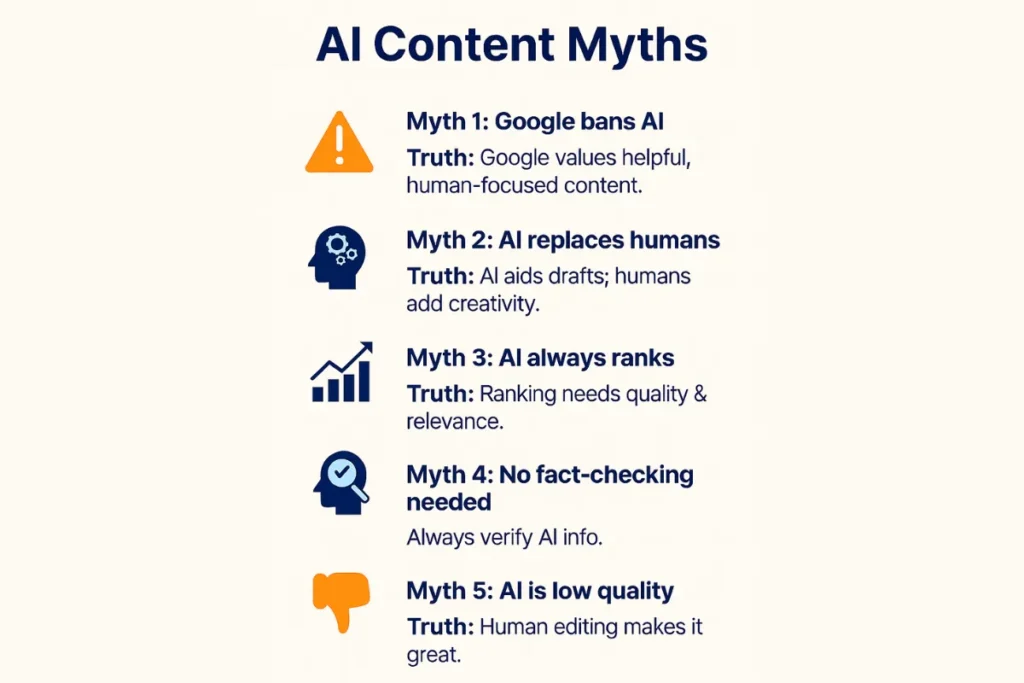
- “Automation—including AI—to generate content with the primary purpose of manipulating ranking in search results is a violation of our spam policies.” (Google for Developers)
- In other words: Using AI content is not banned per se, but using it just to trick search engines is risky.
- Also: Google rates your content on Helpfulness, Originality, Accuracy, People First Content and E-E-A-T ((Experience, Expertise, Authoritativeness, Trust) and whether it is made for people rather than only for search engines. (Search Engine Land)
Thus, if you use AI content, you must use it in a way that adds value for readers and not just for search engines.
Problems & Risks With AI Content That Can Hurt Your SEO
Despite the benefits, there are real risks. You should know about them and plan accordingly.
1. Accuracy and Originality Issues
AI tools often draw on large data sets and might produce incorrect facts or outdated numbers. If you publish those errors, you risk losing reader trust. For example: publishing “India’s population is 800 million” when it is much higher. Google’s guidelines warn that low‑value, shallow, or unoriginal content can cause ranking penalties.
2. Lack of Human Feel or When the Writing Feels Robotic
AI content may feel generic or robotic. It may lack real insights, stories, or emotions that humans connect to. When your reader feels “this is just words”, they may leave quickly. That increases bounce rate, which can hurt SEO.
3. Risk of Spam or Abuse – When You Publish Too Much Low-Value AI Content
If a business uses mass AI‑generated posts with little editing or adds content only for keywords, that is seen as spam. Google’s quality raters may rate such content as “Lowest” quality. In short: using AI content doesn’t guarantee success; misuse can cause harm.
When AI Content Makes The Most Sense
AI content is most useful in certain situations:
- When you have to create many similar pages (like product descriptions) and you need time‑saving.
- When you need topic ideas or brainstorming.
- When you want to update old content fast (e.g., refresh a blog from 2022 to 2025).
On the other hand, you should not rely only on AI for content where trust, human story, expert opinion matter — like “How I Balanced College and Digital Marketing Internship” or “Case study: our top student’s journey”. For such pages, a human writer works best.
Does AI Content Hurt Your SEO?
Let’s answer a fundamental question. Is AI content bad for SEO? Not necessarily. But it can hurt if misused.
According to Google and independent research:
“It does not really matter for SEO whether that content is human‑ or machine‑generated.” (techtarget.com)
“Using generative AI tools or other similar tools to generate many pages without adding value for users may violate Google’s spam policy on scaled content abuse.” (Google for Developers)
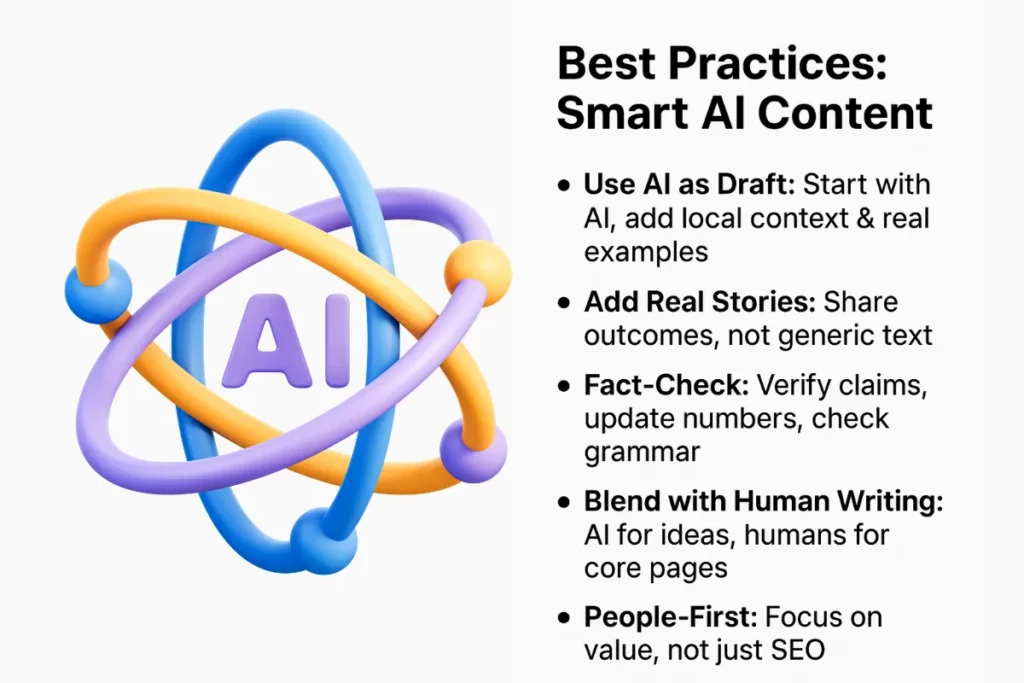
So, you can still use AI content. But you must ensure it is high quality, original, helpful, and edited. If you only publish raw AI output with little human value, you risk negative SEO impact.
Key Takeaways
- AI content can save time and help with keywords, ideas and scale.
- But it is not a magic bullet. The content must be edited, given human touch, and fact‑checked.
- For best results, use AI with humans, not instead of humans.
- Follow Google’s “people‑first” and E‑E‑A‑T (Experience, Expertise, Authoritativeness, Trustworthiness) principles for content.
- If you have a blog or business site, use AI content for supporting pages and human‑rich content for key pages.
When you use AI content in the correct manner, it can help your SEO and help your business too. But when used wrongly, AI can also hurt your rankings and credibility.
A. It might, but only if the AI content is edited well, adds real value, and is made for people, not just for search engines. Raw AI alone won’t guarantee high ranking.
A. Technically yes, but it is not recommended for important pages. Google’s guidelines state that the content must be helpful and of high quality. If it lacks human editing or unique value, it risks being rated lowest.
A. Simply give clear and direct answers of one or two sentences each, using simple and understandable language, arrange the content by using titles or subtitles of the text, make use of transition words, a conversational style and local context, if there is any.
A. The best solution is a hybrid model: employ AI for generating drafts and ideas, after that, human writers can polish the content, verify the accuracy, and most importantly, add trustworthiness—for example, for main pages.
A. Quite often. Because AI output may get outdated or generic, you should update content regularly—check facts, add new data, adjust context (for example local changes in Delhi/NCR), and refresh keywords. Updating every 6‑12 months is a good rule.


