
 SEO (Search Engine Optimization)
In the Search Engine Optimisation, or SEO, we come across several terms again and again in a few weeks. Domain Authority (DA), Page Authority (PA), and Spam Score. These are very common terms that define the power and risk level of a website. None of these are actually used by Google as ranking factors, but these terms are largely used by SEO professionals as diagnostic benchmarks to compare websites, evaluate link quality, build their and avoid risks.
In this article, you will learn about what DA, PA, and Spam Score actually means and how they are calculated. You can also learn ways when they are useful, and when they are often misunderstood. Additionally, use of these in making a backlink strategy, which would help you in your Search Engine Optimisation.
Also Read | What is SEO and why is it important
1. What Is DA (Domain Authority) in SEO?
Definition and Core Meaning
Domain Authority (DA) refers to a metric or measure that is created by Moz (a popular SEO software company that provides tools for keyword research, link building, technical SEO Website audits, and track rankings. Moz provides the potential of a website, like how strong a website’s backlink profile is compared to other websites on search engine results page (SERP). It is basically scored on a scale ranging from 1 to 100. Higher scores indicate stronger link authority relative to competitors, but not guaranteed rankings.
DA considers many factors — especially backlinks and linking domains — but it is not the same as Google’s ranking algorithm.
Data Insight:
“The DA score uses advanced machine learning and link data to approximate the authority level of a domain.”
What does DA Actually Measure?
DA does not measure content quality, UX, or relevance directly. It mainly evaluates link‑based signals such as number of unique websites or referring domains linking to your website, quality and authority of those websites and the overall trust and spam signals in the link profile.
DA is best used for Domain Authority comparison, not as an absolute success metric.
In real SEO audits, DA helps answer one practical question: How strong is this website link profile compared to others ranking for the same query?
Understanding of DA’s Logarithmic Scale
DA scores work on logarithmic scales. It is easy to go from 20-30. But, for example, it is hard to go from 70-80. It is also quite simple for a website with a lower score to get better positions with the help of strong backlinks. But very high DA sites (80+) require many authoritative links and a strong backlink profile. (Immwit)
In SEO terms, What is DA and PA in digital marketing helps you understand how a site compares with competitors. A higher DA usually means a stronger website and better potential rankings.
2. What Is PA (Page Authority) in SEO?
Definition and Core Meaning
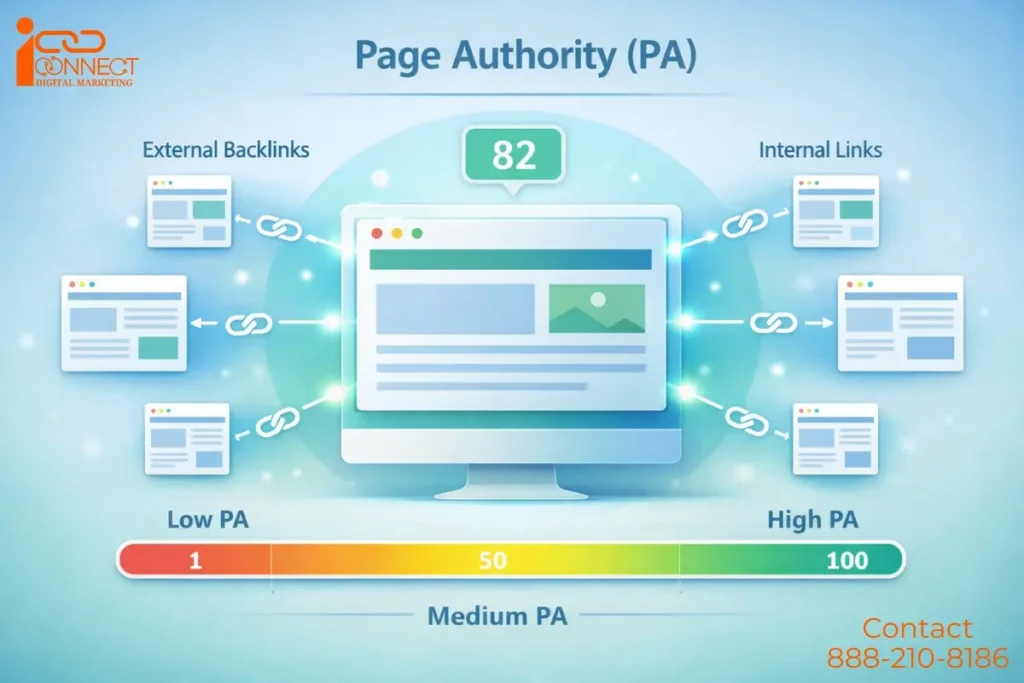
Page Authority (PA) is also a Moz metric that measures the backlink strength of a single page, not the whole domain. Like DA, it is scored from 1 to 100 on a logarithmic scale.
PA tells you how well a specific page might perform in search results — for example, a blog post, landing page, or product page.
Why PA Matters
PA is vital for activities such as:
• Choosing pages for backlink building
• Content performance analysis
• Guest post strategy
For example, a website might have a relatively low DA, but a few pages with high PA — usually because those pages earned strong backlinks.
3. What Is Spam Score in SEO?
Definition and How It Is Used
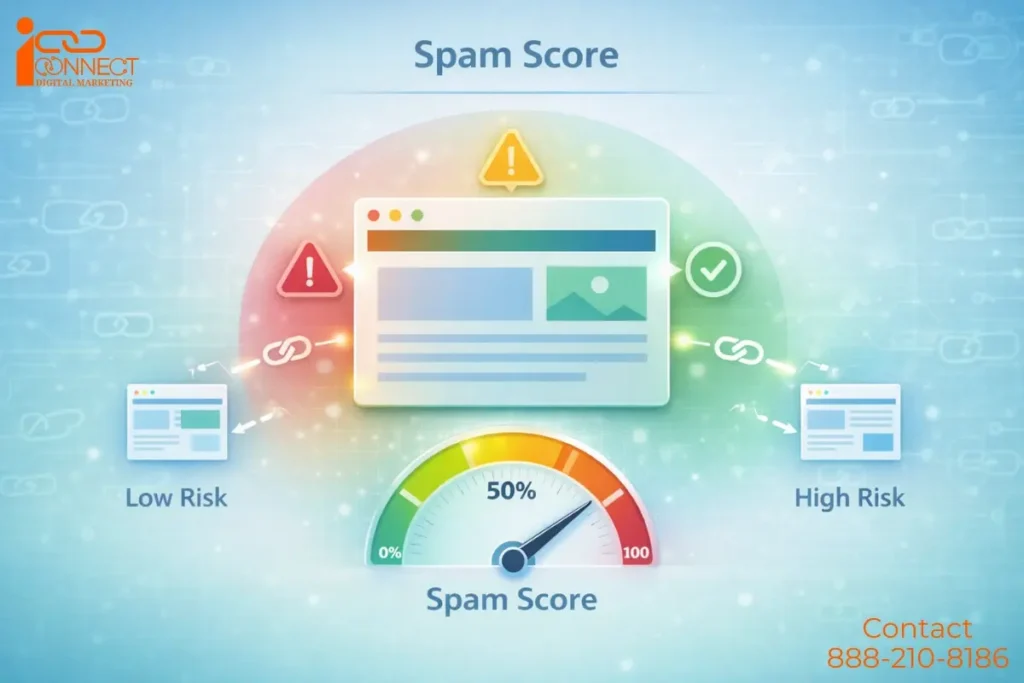
Spam Score is a risk metric that estimates the risk level of a domain by comparing it to websites that have been previously penalised or banned. It is expressed as a percentage, not a quality score.
Spam Score should not be interpreted as how spammy a site is. Instead, it shows how many typical spam signals a site shares with penalised or untrustworthy websites.
How Does Spam Score Work?
Moz’s model looks at 27 common features among penalised sites and assigns a Spam Score percentage.
Spam Score does not mean a site is penalized. It indicates risk, not guilt.
Spam Score interpretation
• 0–30% – Low risk
• 31–60% – Medium risk
• 61–100% – High risk and warrants deeper investigation.
In real audits, a rising Spam Score is often a signal to review backlinks, not panic.
How is Domain Authority (DA) Calculated?
DA is calculated with a combination of link-related metrics into a predicted score. Moz combines these signals into a comparative authority score, not a ranking promise. Let’s check below explanation for better understanding on how DA is actually calculated:
1. Linking Root Domains – Number of Websites Linking to You
- More unique websites linking to you = stronger DA.
- For Example: 50 links from 50 different websites are far better than 50 links from the same website.
2. Total Backlinks – All the Links Pointing to You
- Each and every back link counts.
- Quality backlinks matter more compared to low quality ones.
- It is more desirable to have a single link from a trusted website than to have multiple links from smaller, spamming or low quality websites.
3. Authority of Linking Pages
- DA considers how strong the pages linking to you are like from the trusted websites.
- Links from High-Authority pages increase your DA faster.
4. Spam Score and Trust Signals
- Moz checks for spammy links or risky patterns.
- Low spam score = safer and stronger website.
- High spam score = warning to review your links.
5. Domain Age and Link History
- Older websites with steady growth are stronger.
- A Website that builds links naturally over time gets higher DA than a new site with sudden links.
6. Logarithmic Scale
- DA is not linear.
- Increasing DA from 20 → 30 is quite simpler than from 70 → 80.
- The higher your score, the harder it is to grow your site.
7. Moz Algorithm Combines Everything
- Moz combines all factors using a formula to generate a predictive DA score.
- The score helps compare your website to competitors.
Example DA Calculation
| Factor | Example Value | Impact |
| Linking root domains | 120 | Strong |
| Total backlinks | 450 | Medium |
| Quality of linking pages | Mostly high | Strong |
| Spam Score | 5% | Low risk |
| Domain age | 5 years | Medium |
| Historical link profile | Steady growth | Medium |
Predicted DA: 48/100
Pro Tip: Use a DA PA and Spam Score Checker to see your score and know which areas need improvement.
5. What Is a “Good” DA, PA and Spam Score?
There is no universal “Good” Number, but based on industry standards here are some guidelines:
| Metric | Score / Range | What It Means | Notes / Example |
| Domain Authority (DA) | 0–20 | Needs work | Your website is new or has few quality backlinks |
| 21–40 | Growing / Average | Building backlinks, improving SEO | |
| 41–60 | Strong for most niches | Competitive sites in small to medium niches | |
| 61–80 | Very high authority | Well-established sites with many quality links | |
| 81–100 | Elite domains | Top industry leaders and brands | |
| Page Authority (PA) | 1–100 | Measures single page strength | Depends on backlinks and internal linking; same scoring as DA |
| Spam Score | 0–30% | Low risk | Safe website with few spam signals |
| 31–60% | Moderate risk | Needs link audit; some spam signals detected | |
| 61–100% | High risk | Likely penalized or unsafe; requires investigation |
A DA of 35 can outperform a DA of 70 when content relevance, intent match, and internal linking are better.
6. Do Search Engines Like Google Use DA, PA or Spam Score?
No. These metrics are not used by Google or other search engines to rank their websites. They are third-party services that assist an SEO specialist in recognizing patterns related to link profiles and site structure.
Google has its own set of parameters to rank web pages, in which it includes—relevance, quality of content, backlinks, quality of backlinks, user experience, and speed of pages. DA, PA, and Spam Score are not directly used in Google rankings, but these parameters are linked to quality SEO in many situations.
7. How to Check DA, PA and Spam Score (Tools + Tips)
There are many tools you can use to check these metrics, but some commonly used tools include:
• Moz Link Explorer – official source for DA, PA, and Spam Score
• DA PA and Spam Score Checker – free tools online
• Bulk DA PA Checker – for multiple URLs at once
These checkers allow you to see metrics quickly. Make sure you use trusted tools rather than random sites, as reliable data helps with better decisions. Reliable analysis comes from combining these metrics with content quality, relevance, and user experience — all of which are covered in our SEO fundamentals learning resources.
8. Practical Uses of DA, PA and Spam Score in SEO
A. Backlink Strategy
Before building backlinks, one should check the DA (Domain Authority) value, PA (Page Authority) value, and Spam Score of targeted sites. Websites having a high DA and a low Spam Score provide link juice and quality value through backlinks.
B. Competitor Analysis
Compare your site’s authority with competitors using DA/PA data. This helps you understand where you stand in your niche.
C. Planning of Internal linking in SEO
The high PA pages in your website should also be further optimised and linked internally so as to enhance SEO.
9. Common Misconceptions and Truths of DA PA and Spam Score in SEO
| Myth / Misconception | Truth / Fact |
| DA and PA cause Google to rank your site | Google does not use DA or PA in its ranking algorithm. They are third-party metrics to help evaluate website strength. |
| High Spam Score automatically causes penalties | A high Spam Score does not directly trigger penalties, but it indicates a risk that should be reviewed. |
| DA and PA are fixed and cannot be improved | DA and PA can improve by building high-quality backlinks, internal linking, and reducing spammy links over time. |
| Spam Score shows how spammy your content is | Spam Score only estimates risk based on link patterns, not the content itself. High spam signals in links increase risk. |
| Only high DA websites matter for SEO | Even if the DA is low, the page can rank highly if the content is good, the keywords are relevant, and there are internal or external links. DA is just one signal among many. |
One can explore this learning path in our digital marketing and SEO training program, where such metrics are explained using real websites and practical examples.
FAQ’s: About DA, PA, Spam Score
Domain Authority (DA) plays an important role in SEO as it helps in checking how likely a website is to rank in search engine result pages (SERPs). A higher DA usually means the website has strong backlinks, unique content and good overall SEO health, which can make it easier to rank for competitive keywords.
A good or a safe spam score is low, ideally below 10%. A low spam score means your website looks trustworthy and follows SEO best practices, reducing the risk of search engine penalties. The ideal scoring requirement states that scores should remain below 5% to achieve ideal results. The score range above 50% will show a high chance of receiving penalties that include deindexing. Backlink monitoring needs to happen on a regular basis because it plays an essential role in maintaining website backlink score.
DA (Domain Authority) measures how well the strength is of the entire domain. PA (Page Authority) predicts how well a specific page may rank according to the page strength and Spam Score shows likelihood that a website could be seen as spammy by search engines.
The best tools to analyze Domain Authority (DA), Page Authority (PA), and Spam Score tools include Moz, Ahrefs, SEMrush, and Ubersuggest. These tools provide insights into website authority, backlinks, and potential SEO issues. Moz is the industry standard because it provides exact Spam Score measurements. The tool SEMrush delivers complete backlink assessment capabilities while Ahrefs receives recognition for its ability to evaluate link quality and domain authority.
Yes. The process of improving Domain Authority (DA) and decreasing spam score results in better organic traffic results, but indirectly. A website with higher Domain Authority status has stronger backlinks that create trust with search engines, which makes the site more trustworthy. The website benefits from improved site quality signals through the use of a lower spam score which protects against algorithmic penalties. The actions that enhance Domain Authority (DA) through acquiring valuable links, removing harmful backlinks and enhancing content will improve rankings, increase visibility and drive more organic traffic to your site over time.
In Conclusion,
DA, PA, and Spam Score are powerful metrics when used correctly. They are not magic numbers, nor ranking factors, but they give clear direction in SEO planning. With practical use and careful interpretation of DA PA and Spam Score in SEO, they help you build a stronger SEO strategy in 2026 and beyond.


Comments are closed