

 Digital Marketing Course
It is really exciting to start a career in digital marketing. The inconvenience, however, is that there are so many online courses available that it is very difficult to figure out which one suits you the most. So, picking the right course when you are at the very beginning of your journey is basically your most important choice. The right course will lead to your success, while the wrong one can only make a mess of your time and money.
Quick Answer:
The Best Digital Marketing Course for beginners should cover SEO, Performance Marketing, Social Media Marketing (SMM), Google My Business (GMB), Online Reputation Management (ORM), All Marketing Fundamentals, and most importantly, Content Marketing. It must include hands-on projects, real tool training, portfolio support, and updated content aligned with current industry trends.
You may also be interested in: 👉 Can I Do a Digital Marketing Course After 12th?
This guide will assist you in examining the most essential things when selecting a course. We will use simple language and concentrate on what is of the greatest importance to a beginner.
1. Check the Teacher and Course Credibility
The very first step is to check out the instructors and the creators of the course. The rules of digital marketing keep on changing quite fast, So it is better to learn from people who are still actively working in the field.
Verify the instructor’s background. Are they active in the industry? Do they have real experience with known brands? Learning from someone who does the work is better than someone who only explains theory.
Website: iConnect Digital Marketing Agency & Training Hub
Moreover, have a look at the platform. Classes by well-known sources such as Google, HubSpot, Meta, or reputed universities are generally more dependable and get updated regularly.
A Tip for You: Avoid courses that promise you can get rich quickly.
2. Look Deeply at the Course Content
After checking the course credibility, the next thing is to see what you will actually learn. As a beginner, you need a course that gives a strong base. It should clearly teach the main pillars of digital marketing.
| Pillar | What You Need to Learn | Why It Matters |
| SEO – Search Engine Optimization | Learn to make your website rank higher on – Google without spending money. | This brings free, valuable visitors to your site. |
| PPC – Pay-Per-Click | Run paid ads on – Google & social media. | This brings fast, targeted traffic to sell products. |
| SMM – Social Media Marketing | Learn to use platforms – Instagram, Facebook, and LinkedIn – to build a brand. | You can use it to get in touch with consumers personally and to establish their loyalty. |
| Email Marketing | How to write emails that people open and read. | This is one of the cheapest ways to keep customers. |
| Content Marketing | How to plan and create useful blogs, videos, and guides. | Helps you in building trust with your audience over time. |
Additionally, look for keywords like “hands-on projects” or “real-world case studies.” It is not enough to just watch videos. Instead, you need to practice. A good course will have quizzes and projects where you try out your new skills.
You may also be interested in: 👉 Top Questions Students Ask Before Joining a Digital Marketing Course?
3. Check Course Format and Time
If someone is just starting out and also has a job, the way of learning is equally important to the content of the learning.
- Which one is better – self-paced or live: With self-paced courses you are free to study at any time of the day and thus it is very flexible, but one needs to have a strong willpower. In live classes, which are at set times and with a teacher, it is easier to ask questions, but the flexibility is limited.
- Total time: A good beginner course usually takes 40–100 hours. Courses claiming complete mastery in just a few hours are often too short to be useful.
4. Look at the Cost and Value
Price is important, but less expensive is not always better. You should focus on value – the things you get for the money you spend.
- Free Courses: Many great resources like Google’s courses are free. These are excellent for getting a certificate and basic knowledge. However, they often lack personal feedback or in-depth tools training.
- Paid Courses (₹8,000 – ₹40,000): These normally are comprehensive and include all the major aspects. In most cases, they provide you with a link to a private group (for example, a Facebook group) where you can ask questions. Generally, these courses are more structured.
- Very Expensive Courses (₹80,000+): These might be bootcamps or university programs. For a beginner, you usually do not need to spend this much money right away. Wait until you know you like the field.
Crucially, check if the price includes updates. Since the digital world changes quickly, you want a course that gives you new content as tools (like TikTok or Google Ads) change their rules.
5. Check for Practical Elements: Tools and Portfolio
Digital marketing is practical, so your course should help you build tool skills and a portfolio.
- Tool training:
You should learn to use real tools like Google Analytics, an email tool such as Mailchimp, and basic SEO tools like Google Keyword Planner. If a course only explains tools without hands-on use, that is a red flag. - Portfolio projects:
A portfolio proves your real skills, not just a certificate. So choose courses that make you plan a mock campaign, run a small ad, and write sample blog content. - Internship support:
A free or paid internship adds strong weight to your resume. Look for company tie-ups, resume and interview help, or a guaranteed internship. Even three months of internship gives real experience and a company name.
Moving on, courses that help you start a small real project, like a simple blog, are a big advantage. You have something real to show in interviews.
6. Read Reviews from Real Students
Before enrolling, check what real students say. Do not trust only website reviews. Search on LinkedIn to see where past students are working and read honest reviews on platforms like Trustpilot or G2. Repeated complaints about outdated content or slow replies are warning signs, while “hard but helpful” projects usually mean good learning.
Summary of Key Actions for Best Digital Marketing Course for Beginners
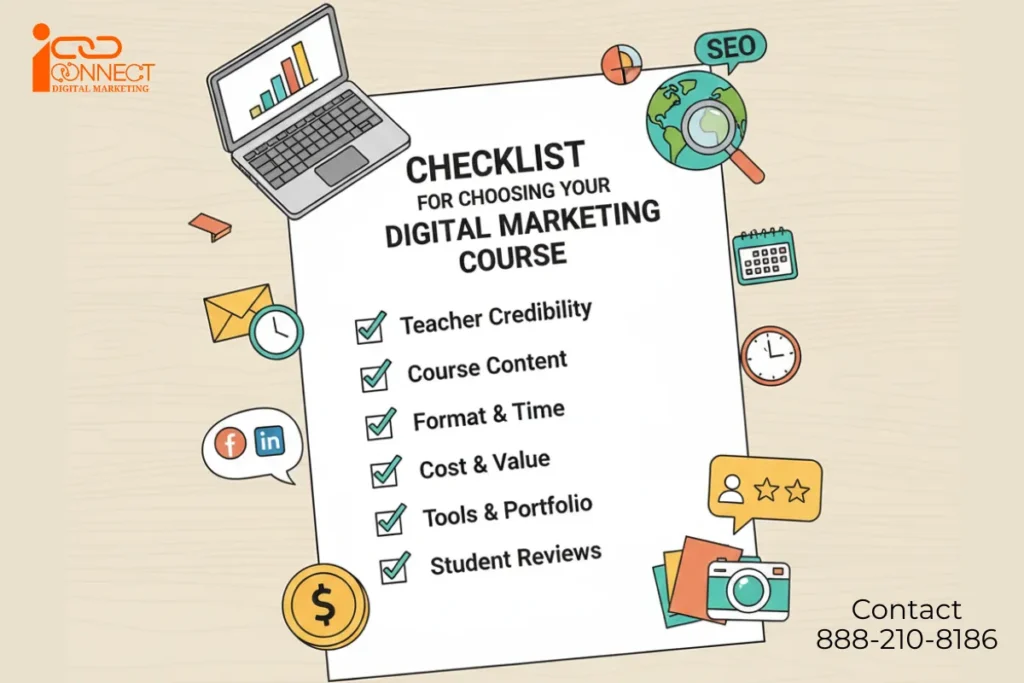
- Check the source, the content, and whether it covers SEO, PPC, Social Media, Email, and Content.
- Make sure the format fits your schedule and the price offers real skill and tool training.
- Finally, check proof—portfolio support and genuine student reviews.
In conclusion, choosing your first Digital Marketing Course is like choosing a coach. A good reputation, clear structure, and strong practical focus will give you the best start to your career.
FAQ’s: Best Digital Marketing Course for Beginners in 2026
A. It should teach main things like SEO, PPC ads, social media work, email marketing, and basic content writing.
A. Free courses can be very helpful to learn the basics and get certificates, but they normally do not offer the practice part and the personal feedback that are available in paid courses.
A. As it reflects actual work and hands-on skills. Employers are more interested in what you are able to do rather than just a certificate.
A. A good beginner course is generally around 40-100 hours. Very short courses are often insufficient.
A. Beginners should use real tools such as – Google Analytics, simple email tools like Mailchimp, and basic SEO tools such as Google Keyword Planner.


