

 AI in Digital Marketing
Creating blog posts that rank on Google Search is not just about the writing. When we talk about the best AI tools for SEO blog writing, It’s about understanding keywords, search intent, readability, structure, and user experience.
The truth is, for many students and new marketers, this feels complicated. That’s exactly where AI writing Tools make life easier. They help you write faster, learn SEO naturally, and improve your skills step by step. Moreover, the work becomes easier for us, allowing us to produce content that is readable, attractive, and properly formatted.
However, which AI tool produces the best SEO blogs? In this Guide, we will look at and learn about the 10 Best AI tools for SEO blog writing, along with practical examples and recommendations that can be of real assistance in your learning, writing and growth in Digital Marketing.
💡 If you’re completely new to online marketing, you can first read our beginner’s guide on what digital marketing is and how it works to understand the basics.
Why AI Tools Matter for SEO Writing

AI tools such as ChatGPT and Jasper are not only the means to hasten the writing process but also the ways to enhance the intellect.
They recommend the use of keywords, take care of the text to be more understandable, and can even estimate the success of the new content created.
For example:
“ChatGPT helped me write my first SEO blog about digital marketing internships. It not only gave me structure but also taught me how to optimize for keywords naturally.”
That’s what makes these tools valuable for students—they act like assistants that teach while helping.
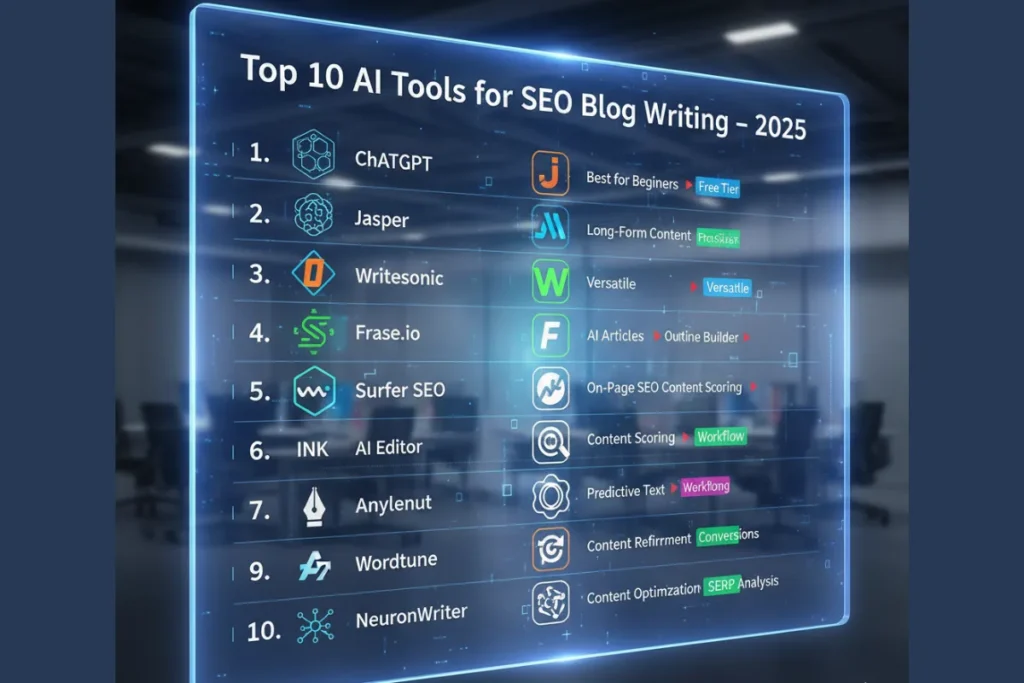
1. ChatGPT – The Most Flexible Writing Assistant
Best for: Students & Beginners
ChatGPT is often the first choice for SEO writing because it’s simple and fast.
You can use prompts like “Write a 1000-word SEO blog on local marketing with keywords integrated naturally” — and it will give a ready draft.
However, you still need to edit and verify facts manually. Pair it with tools like Google Keyword Planner or Ubersuggest for accuracy.
💡 Want to understand how SEO works from scratch?
Also Read: Real Examples of Students Using ChatGPT for SEO
2. Jasper AI – Great for Brand Voice and SEO Templates
Best for: Content Marketers
One of the main features of Jasper is its ability to control the tone and provide SEO-friendly templates. Without a doubt, Jasper is able to produce product descriptions, blog posts, and even lengthy-form content, all the while keeping the brand voice consistent.
It’s more advanced than ChatGPT but works best for those who already understand marketing structure.
3. Writesonic – SEO Blog Creator with Keyword Support
Best for: Freelancers
Writesonic has integrated SEO features that in turn help to improve by themselves titles, meta descriptions, and keywords. This is great for those who need to produce SEO-ready articles in no time and with little post-editing. The number of free tokens is limited, yet it is a strong first step towards experimenting with content ideas.
4. Frase.io – Perfect for SEO Research + Writing
Best for: SEO Learners
Frase.io doesn’t just write—it researches. It scans top-ranking pages for your topic and helps structure your post based on what’s performing.
For instance, if you’re writing “How to learn SEO faster”, it shows what headings and keywords top blogs use.
That’s how you learn real SEO while writing.
5. INK Editor – Improves Readability and Ranking Chances
Best for: Writers Optimizing Posts
INK gives real-time SEO and readability scores as you write.
If your content is too long or keyword-stuffed, it highlights and corrects it instantly.
For students practicing on Blogger or WordPress, it’s a great tool for polishing final drafts.
6. Surfer SEO (AI Mode) – For Deep Optimization
Best for: Agencies and Professionals
Surfer SEO now has an AI integration that writes and scores content simultaneously.
It’s highly technical—offering data about keyword density, content structure, and backlinks.
While expensive, it’s useful for those who want to go beyond basic optimization and learn how professionals rank content.
7. Anyword – Predicts How Your Blog Will Perform
Best for: Copywriters
Anyword uses AI to analyze the tone and predict how engaging your content will be before publishing.
It’s good for blogs, ad copy, and social posts.
Students can use it to test which versions of headlines or intros might attract more readers.
8. Wordtune – Simplifies Complex Sentences
Best for: Students Refining Their Writing
Sometimes AI writing sounds robotic or too formal.
Wordtune helps you rewrite such lines into more natural, human-like sentences.
It’s excellent for improving clarity and flow—perfect for learning how to write conversational SEO content.
9. NeuronWriter – For Competitor SEO Insights
Best for: Bloggers
NeuronWriter combines content creation with competitive research.
It shows how your competitors rank, which keywords they target, and what kind of structure works best.
You can use it to improve your blogs and understand real-world SEO strategy.
10. Scalenut – All-in-One SEO and AI Planner
Best for: Students & Startups
Scalenut merges AI writing with keyword clustering and topic planning.
It’s simple enough for beginners but powerful enough to handle entire campaigns.
Students who want to practice full blog workflows—research, write, and optimize—will find it very effective.
Table Summary: Top 10 AI Tools for SEO Blog Writing
| Tool | Key Strength | Ideal For | Free Plan |
| ChatGPT | Drafting + Keyword Ideas | Students | ✅ |
| Jasper | Tone & Brand Voice | Marketers | ❌ |
| Writesonic | SEO Blog Creator | Freelancers | ✅ |
| Frase.io | SERP Research + Writing | Learners | ✅ |
| INK Editor | SEO + Readability | Writers | ✅ |
| Surfer SEO | Technical Optimization | Agencies | ❌ |
| Anyword | Predicts Content Success | Copywriters | ✅ |
| NeuronWriter | Competitor SEO | Bloggers | ✅ |
| Wordtune | Text Refinement | Students | ✅ |
| Scalenut | AI + SEO Planner | Startups | ✅ |
How to Pick the Best AI Tool for You?
If you still don’t know how to start, you can also explore our Digital Marketing Course in Ghaziabad
for full guidance.
- Keep it simple at first: Make use of ChatGPT or Wordtune to get your writing skills up.
- Introduce SEO tools when you feel ready: Employ Ubersuggest, Frase, or Scalenut to be aware of your keywords.
- Don’t stop writing: The AI can come up with great ideas but only a human can make them sound authentic and relevant.
Remember:
“The best SEO writer is not the one who throws the most tools into the game, but the one who uses them wisely.”
FAQ’s: Best AI Tools to Write SEO Blog Posts
A. ChatGPT and Writesonic are easiest for starting out. Both help you understand structure, tone, and keyword usage without feeling overwhelming.
A. No. AI can assist but not replace human creativity, emotional understanding, and real-world examples that search engines value.
A. Frase.io, NeuronWriter, and Surfer SEO provide actual SERP and keyword data that connect writing with ranking performance.
A. No, you should always edit your AI content. Fact-check statistics, add examples, and keep the tone natural for your readers.
A. Create short blogs, test SEO scores, and keep improving with free plans. The goal isn’t just to rank—it’s to learn how ranking works.
In Conclusion,

As we have discussed about Best AI tools for SEO blog writing, AI tools are changing how blogs are written, optimized, and shared. For students, they are not shortcuts—they’re learning companions that make SEO writing easier to understand and faster to practice. Once you know how to balance AI help with your own creativity, you’ll not only write better blogs but also learn digital marketing in a smarter way.


